There’s a running joke in Formula 1 circles: the “potential race strategies” infographic from Pirelli on Sunday mornings often misses the mark on how the race actually plays out.
The Hungaroring was no different. Lando Norris found himself on an unexpected one-stop strategy after a less-than-ideal start, which surprisingly worked in his favor. He wasn’t alone – Helmut Marko, Red Bull’s driver advisor, suggested that Max Verstappen could have secured fifth or sixth place instead of ninth if he had opted for one stop rather than two.
On Saturday, Pirelli strongly suggested that a two-stop approach was superior, despite the possibility of overnight rain affecting the track’s new surface.
“Right now, a one-stop is roughly 10 seconds slower,” stated Pirelli motorsport manager Mario Isola on Saturday evening. “Based on the degradation levels we observed yesterday [Friday]. If conditions are cooler and you can manage the tire better, that 10-second gap might shrink. That’s why I still believe a two-stop is the better option.”
The conditions were indeed cooler. However, the race’s trajectory was shaped by the events of the opening lap, where Norris – starting third on the grid – moved to the inside heading into Turn 1, aiming to overtake his teammate, Oscar Piastri, who had qualified second behind Ferrari’s Charles Leclerc. The move didn’t pan out, and in the process, Norris lost positions to George Russell and then Fernando Alonso.
Norris quickly reclaimed fourth place from Alonso but struggled to escape Russell’s Mercedes’ ‘dirty air’. As Alonso dropped back, creating a bottleneck, the possibility of a one-stop race began to emerge.
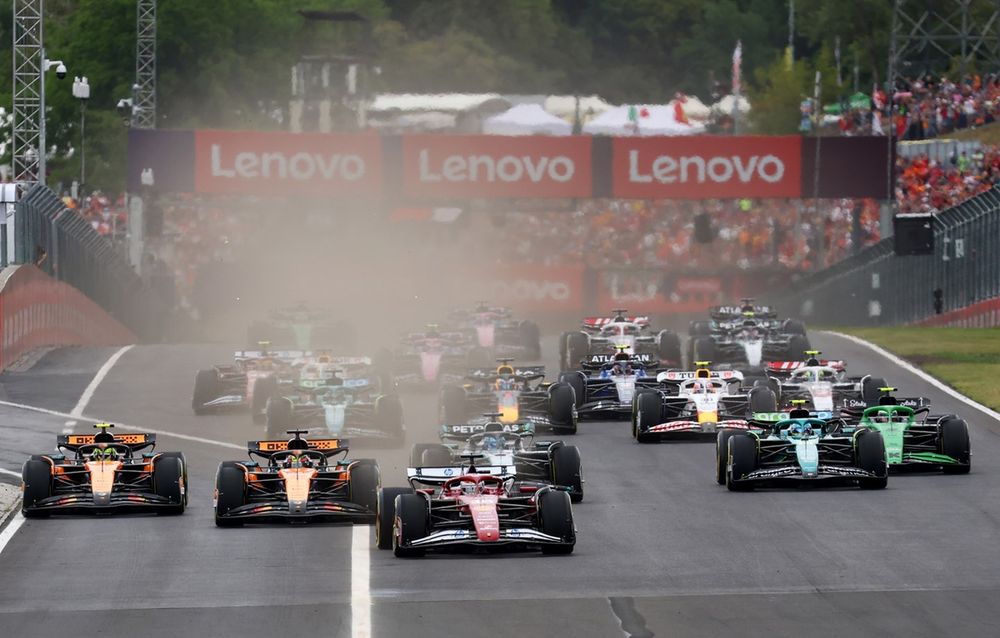
Charles Leclerc, Ferrari leads at the start
Photo by: Mark Thompson / Getty Images
Indeed, this quickly became Norris’s only viable route, while McLaren’s strategy for Piastri hinged on finding a way past Leclerc.
“Our primary strategy for today was a two-stop approach,” McLaren team principal Andrea Stella explained in his post-race briefing.
“We weren’t entirely convinced that a one-stop was feasible. So, with Oscar, we aimed for a solid, predictable two-stop strategy, hoping to overtake Leclerc during the first stop. Then, we planned to extend the second stint to gain a tire advantage, giving us those crucial tenths of a second to pass Leclerc. This tactic proved successful.”
However, the shift towards a one-stop strategy occurred between Piastri’s two pit stops. When he pitted for his initial set of hard-compound Pirellis at the conclusion of lap 18, it prompted Ferrari to respond. Leclerc emerged ahead, and both drivers rejoined the race behind Alonso, who had been increasing his pace three laps prior, capitalizing on the gap that McLaren and Ferrari thought they possessed.
Although Leclerc and Piastri both overtook Alonso in the early 20s, it became increasingly apparent that the Aston Martin driver intended to extend his first stint, which would create problems for Russell and Norris if they were to pit. Russell demonstrated this by needing four laps to pass the two-time F1 world champion.
At this juncture, opting for anything other than a one-stop was becoming unfavorable for Norris, and Piastri had already begun to suspect that his strategy might not be ideal. While he initially responded negatively to race engineer Tom Stallard’s inquiries about a one-stop, he started questioning whether it would be possible to remain out for the rest of the race.
The tone suggested that, in attempting to undercut Leclerc, he had inadvertently created an opportunity for Norris to overtake both of them. So, even as they closed in on Norris before his pit stop at the end of lap 31, the course was set.

Lando Norris, McLaren
Photo by: Mark Thompson / Getty Images
“When it comes to Lando and the one-stop strategy, when we extended, keeping Lando on track, we weren’t confident that a one-stop would still be a viable option,” Stella admitted.
“But, to Lando’s credit, he managed to string together some very impressive sectors and lap times on tires that had already seen considerable use. We gradually became convinced that a one-stop was becoming a real possibility as we progressed through the first stint.
“It wasn’t like we entered the race with a clear preference between a one- or two-stop, viewing them as equally good. We initially believed that a two-stop would be the most effective strategy today.”
Norris achieved numerous fastest laps during the initial phase on the hard tires. It was at this moment that the nature of the conversations between Stallard and Piastri changed: the Australian driver was presented with a choice between “undercutting Leclerc or creating a tire delta to Lando.”
McLaren then attempted a deceptive move, instructing Piastri to “box this lap” and positioning its mechanics on the pit apron on lap 39. Ferrari reacted by preemptively calling in Leclerc to block the undercut – but Piastri instead extended his stint for another six laps.
Norris gained an advantage when Russell pitted, clearing his path at the end of lap 42. By this point, he was 9.5s behind Piastri and inherited the lead when his teammate pitted. Crucially, Piastri had been losing significant ground while extending his stint – losing 2s to Norris on lap 44 alone.
Piastri then had to maximize his tire advantage to overtake Leclerc on the track.

Lando Norris, McLaren, Oscar Piastri, McLaren
Photo by: Guido De Bortoli
Unsurprisingly, given the race’s progression, Stella was questioned about whether the team had intentionally favored Norris over Piastri, which he firmly denied.
“We wanted to give Oscar sufficient tire advantage to overtake Leclerc, while also giving him a fair shot against Lando, as this would have meant being on an optimal two-stop strategy,” he stated.
“So, with Leclerc in mind, we aimed to stay close to an optimal two-stop strategy, as deviating too much would have been unfair to Oscar in his competition with Lando. We also consulted with Oscar about his preference, and he certainly expressed his desire to have a chance to win the race.
“We believed that with enough tire advantage over Leclerc, Oscar would have had a chance in the end.”