As we approach the final three race weekends under the existing regulations, Formula 1 teams are increasingly turning their attention to the 2026 season. The capabilities of all power units remain a significant unknown, and this uncertainty extends to the chassis design as well.
While the initial reaction from technical directors – mirroring the sentiment in 2022 – suggested the rules were quite limiting, Adrian Newey has indicated that a more thorough examination might reveal greater flexibility. This is reflected in some of the preliminary forecasts for the cars of the upcoming year. The figures provided by different teams exhibit variations in at least a couple of areas. Brembo has noted considerable differences in the anticipated dimensions of rear brake discs for the next season, and Pirelli has reported substantial discrepancies in the downforce levels predicted by teams.
What do these differences between teams really mean?
The tyre provider receives projections of downforce levels from all teams, forecasting the end of the subsequent season. This data serves as an indicator of the anticipated load on the new tyres, providing Pirelli with a benchmark for developing both the tyre structure and the rubber compounds.
“That is indeed our requirement. Each team is obligated to submit their expected load projections for the conclusion of the next season,” explains Mario Isola in an exclusive interview with Autosport.
What’s particularly noteworthy is the considerable variation in these initial forecasts for 2026. However, according to Isola, this doesn’t necessarily imply a widely dispersed competitive field. It primarily highlights the inherent difficulty in making precise predictions at such an early stage.
“I don’t believe that these simulations offer any real insight into the competitive hierarchy for the coming year. Frankly, the numbers are far from indicative of that. They’re simply simulations reflecting the teams’ expectations, not the actual performance we’ll witness on the track,” he states.

Mario Isola, Director of Pirelli F1, Max Verstappen, Red Bull Racing
Photo by: Sam Bloxham / LAT Images via Getty Images
Isola is keen to downplay some of the recent commentary surrounding these simulations. “I’ve already seen articles suggesting that ‘based on this data, we already know who will be the fastest’. The reality is quite different. Even with a higher load at the front or rear, that doesn’t guarantee superior speed. It’s also contingent on drag coefficients and a host of other variables, so these simulations aren’t definitive in establishing the competitive order.”
Isola has followed some of these narratives with amusement: “So, in essence, I could already predict the winner for next year! Unfortunately, it doesn’t work that way, or perhaps I should say, fortunately, it doesn’t!”
Can Pirelli rely on simulations when developing the 2026 compounds?
While this element of unpredictability may be appealing to fans, it introduces added complexity for Pirelli. Given the wide divergence in the teams’ initial simulations, the question arises: which figures should the Italian tyre supplier prioritize?
“In the initial stages of development, it wasn’t a major concern, as we focused on ensuring the tyre’s structural integrity based on the highest simulation figures,” Isola explains. “The real challenge arises during the compound definition process, as this also hinges on energy levels and load.”
When it comes to ensuring the tyre’s structural integrity, a ‘better safe than sorry’ approach is adopted. “While obtaining reliable simulations from the teams can be difficult, these figures are essential. We can’t afford to start with a tyre that’s adequate for the loads at the season’s outset but insufficient for the season’s end. In such a case, we’d have to significantly increase tyre pressure to support the construction. We’d rather design a tyre that aligns with the projected expectations for the end of the season.”
Pirelli anticipates greater convergence in the teams’ figures during the next round of simulations. “This has been the trend in the past, for instance, when we introduced the 18-inch tyre. By that point, we will have already homologated the tyres for 2026, but we can still use that information to refine our compound selection for each race.”
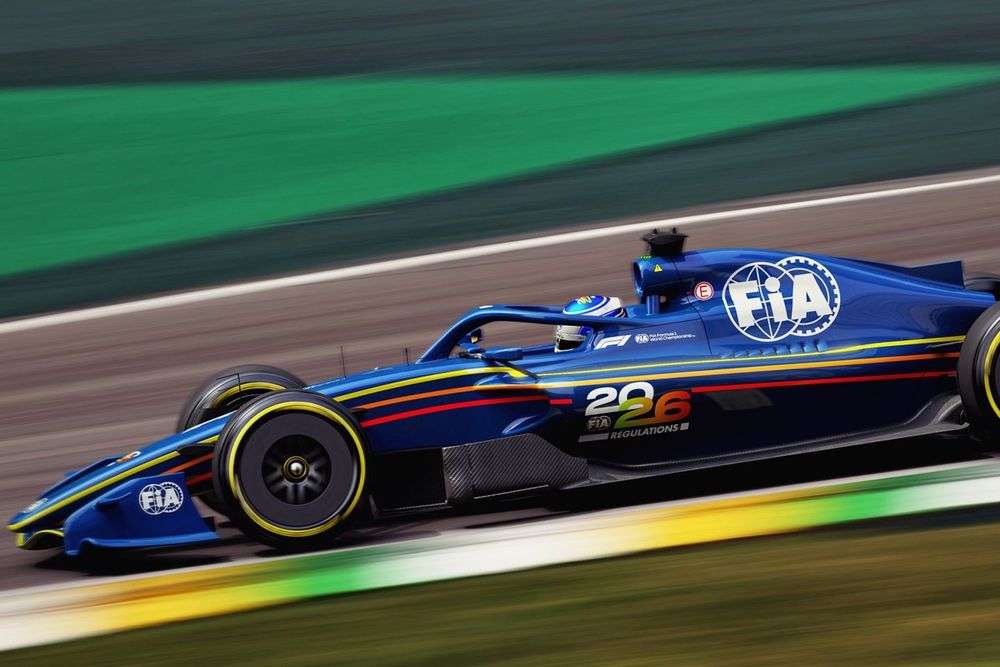
F1 concept
Photo by: FIA
For this reason, Pirelli intends to offer a broader range of compounds with the 2026 tyres, allowing for greater flexibility in tyre selection at each Grand Prix. “We commenced development using the C3 compound as our baseline, as it sits in the middle of the range. We started by designing a C3 with the same level of hardness as the current C3 and then progressed to the other compounds, aiming to widen the performance gaps between them.”
Pirelli hopes to cater to all potential scenarios with these larger performance increments. “If, for any reason, the cars aren’t as fast as projected at the start of the season, then the range of compounds might lean towards the harder side. However, in that case, we can still opt for softer compounds for specific races.”
We want to hear from you!
Let us know what you would like to see from us in the future.
Take our survey
– The Autosport.com Team