The principal of the McLaren Formula 1 team, Andrea Stella, suggests that Oscar Piastri’s improved performance in Qatar aligns with his theory about the Australian’s capabilities in high-grip conditions.
Piastri experienced challenges in matching the pace of his teammate, Lando Norris, on circuits with low grip, such as Austin and Mexico. Additionally, Norris outpaced him in Brazil and Las Vegas. However, the Australian showcased his top form this past weekend in Qatar, securing a clean sweep of sprint qualifying, the sprint race, and pole position for grand prix qualifying – his first since Zandvoort, which occurred at the conclusion of August.
While pole position for the grand prix might have been within reach for Norris, who believed he had additional tenths of a second to gain but made an error at the commencement of his final flying lap in Q3, there’s little debate that Piastri is performing exceptionally well once again. According to his team principal, it’s not a coincidence that the Australian’s resurgence coincides with the high-downforce Losail circuit – which is the opposite of Austin and Mexico regarding available surface grip.
“Even as we observed Oscar facing some difficulties, I consistently emphasised that there are technical elements related to how drivers utilise the available grip and the car’s potential,” Stella clarified.
“Here in Qatar, we’re back to a category of circuits known for their high grip levels. In this type of circuit, I believe Oscar naturally drives the car in his most effective manner, enabling him to maximise its potential.
“At circuits like Mexico and Austin, particularly in terms of braking and car rotation, sliding the rear axle becomes necessary. This approach is essentially a different technique for driving a Formula 1 car, one that Oscar is actively developing, but it is an area where Lando particularly shines.”
Stella doesn’t think that Piastri’s recent dip in performance had a mental aspect, especially as he surrendered control of the drivers’ championship to Norris.
“I don’t believe it is primarily related to mindset or mentality,” he stated. “Oscar has demonstrated consistent mental strength throughout. This is purely a technical issue. We are discussing professional sport at its highest level, and in this context, even a 1% deficit from a technical perspective can result in losing several positions due to the intense competition.”
If there’s a singular surprise that Doha has presented, it’s not the anticipated fact that McLaren possesses the fastest car, but instead the precise way in which it has created that edge over Red Bull and Mercedes.
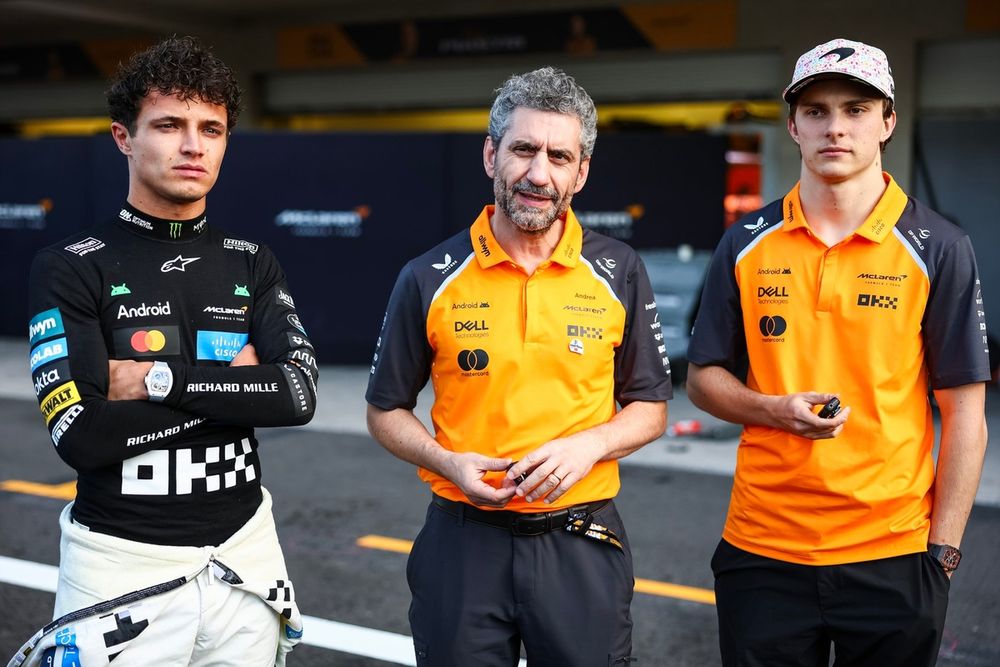
Lando Norris, McLaren, Oscar Piastri, McLaren, Andrea Stella, McLaren
Photo by: Andy Hone/ LAT Images via Getty Images
McLaren’s typically strong performance is expected on long, medium-speed corners, which tend to pose challenges for Red Bull. Max Verstappen’s RB21 generally performs better with rapid directional changes at high speeds.
However, that wasn’t the precise scenario in Qatar. McLaren showed notable speed in the extremely high-speed final sector, whereas Red Bull – and Mercedes in particular – appeared capable of competing closely with the MCL39 in the medium-speed second sector and the initial two corners.
“We anticipated that this track would align with our car’s strengths, but the manner in which we’re achieving speed isn’t precisely what we initially projected,” Stella noted. “We’re gaining significant lap time in corners 4 and 5, and especially in the last sector’s high-speed section, our performance stands out. In reality, though, I had expected us to be fast in medium-speed corners such as corner 1, the final corner, or the middle sector.
“I believe this also depends on how the car is set up and how it has been developed. We’ve undertaken certain efforts to enhance high-speed performance. Additionally, it’s possible that Red Bull has moved somewhat in the opposite direction, potentially compromising some high-speed strengths to improve low-speed potential.
“Currently, Mercedes demonstrates the most effective car performance in Qatar’s medium-speed corners. The truth is that everything is remarkably close. This situation accurately reflects the maturity of the regulations, leading to a convergence in performance among teams.”
We want to hear from you!
Let us know what you would like to see from us in the future.
Take our survey
– The Autosport.com Team