Sebastian Vettel has acknowledged that his performance levels were already in decline during his final couple of years competing for Ferrari in Formula 1.
Vettel joined the Italian team in Maranello in 2015, following a six-year period with Red Bull where he secured four world championships, and quickly established himself as the Scuderia’s primary driver.
Over four years, Vettel achieved 13 Grand Prix victories, significantly outperforming his teammate Kimi Raikkonen, who managed only one. The German racer was a contender for the championship title in both 2017 – when he held the lead from April through September – and 2018, though he ultimately lost out to Lewis Hamilton on both occasions.
However, once Charles Leclerc took Raikkonen’s place in 2019, the young Ferrari prodigy rapidly gained an advantage, immediately surpassing Vettel in points with 264 to 240 and securing two wins compared to Vettel’s one (Leclerc was denied a third win in Bahrain due to mechanical issues). Subsequently, during a challenging 2020 season for Ferrari, Leclerc substantially outperformed Vettel, scoring 98 points to Vettel’s 33, after the Scuderia had already announced the signing of Carlos Sainz for 2021 before the 2020 season commenced.
“I entered Formula 1 in 2006, ‘07, and by 2010 – when I obviously won the championship – I would say I was nearing my peak,” Vettel shared during an appearance on the Beyond the Grid podcast. “Yet in 2011, I felt considerably more prepared to clinch the championship than I had in 2010, for instance, followed by a number of consistently strong years during which I secured championships.”
“2015 was a very robust year, as were ’17 and ’18 – but then in ’19 and, to be fair, in ’20, I was already experiencing a downturn. I’m comfortable acknowledging that now because I genuinely lacked that final, decisive surge of effort.”

Sebastian Vettel, Ferrari SF1000, leads Charles Leclerc, Ferrari SF1000
Photo by: Andy Hone / Motorsport Images
The German driver articulated that a significant difference between himself and Leclerc, who is a decade his junior, was their level of motivation.
“Charles possessed immense drive,” he highlighted. “Frankly, I had been fortunate – having won four championships, numerous races, and achieved countless pole positions, among other things. My sole focus was on winning, and that defined me as an athlete: I desired to win, coveted the grandest trophy, sought that podium moment where I knew I had triumphed in the race, craved the Monday morning sensation of ‘I won the last race and feel so good,’ but that feeling is fleeting, compelling you to secure another victory.”
“And then Charles arrived, and upon finishing fifth and sixth, he was absolutely thrilled with those results, as it marked a different stage in his career and his first time in a competitive car. I believe that’s when I began to encounter some difficulties.”
“Then 2020 arrived, an exceptionally unusual year due to COVID, preventing us from racing, and I received this wonderful break that I had never experienced before, thoroughly enjoying it with my family.”
“Simultaneously, with my children growing, I became more cognizant of global issues and how they began to impact me, and I found myself reflecting on them. I would suggest that at that point, I was likely no longer at my peak.”
Nevertheless, Vettel embraced a fresh endeavour: the Aston Martin team, financed by Lawrence Stroll, which had evolved from the Force India/Racing Point team with substantially increased financial backing.
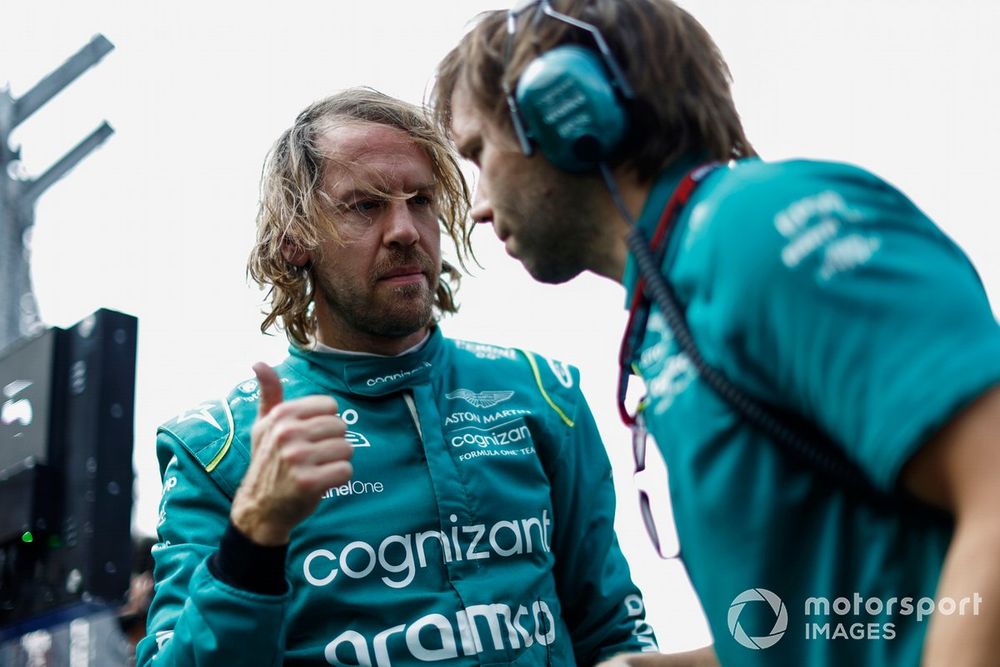
Sebastian Vettel, Aston Martin, on the grid
Photo by: Zak Mauger / Motorsport Images
“Ultimately, I believe I was seeking validation that… ‘Can I still perform at this level?’ Which might sound absurd because, of course, I am capable, having demonstrated it countless times, but that also intertwines with the uncertainty or self-doubt that affects all of us, every driver on the grid today,” Vettel explained.
“I had a conversation with Michael [Schumacher] about this many years ago, and even he experienced it. And for me, when I say ‘even he,’ it’s because he represents the pinnacle. You know, I grew up with his posters adorning my wall. He was the absolute best in every aspect of racing I could envision. And he was insecure. ‘What? You?’”
“Thus, we all share that sentiment, and I believe those years, from a performance perspective, while I certainly wished to witness the team advance more swiftly, were crucial for me because I began to feel genuinely comfortable with my driving once more, and I think I did deliver outstanding performances even at a later stage – but my overall peak, perhaps not anymore.”
Vettel served as Aston Martin’s primary driver for his two seasons with the team before his retirement and subsequent replacement by Fernando Alonso. The 2021 season saw him achieve his final F1 podium finish in Baku; another potential podium in Hungary was lost when he was disqualified from second place due to an insufficient fuel sample.