The initial viewing of a 2026 Formula 1 vehicle in operation has appeared across social media platforms, featuring clandestine recordings of Audi’s test run in Barcelona released on YouTube and through the official team channels.
Audi’s forthcoming car, designated as the R26, completed a limited number of circuits at the Circuit de Barcelona-Catalunya, making the new German entrant the inaugural team to privately test its fresh design before Barcelona’s confidential testing session scheduled for late January.
Both Nico Hulkenberg and Gabriel Bortoleto were slated to pilot the vehicle during a designated filming event, allowing Audi’s debut F1 power unit to undergo evaluation at Barcelona, as the former Sauber team begins to integrate its new brand image.
While grainy pictures circulated online, falsely claiming to depict the new vehicle, they were in fact merely AI-generated visuals obscured by a Gaussian blur filter.
Nevertheless, video material, first appearing on the YouTube channel F1 A TODO GAS, presents the fresh R26 operating. Although the recording doesn’t offer a very close view of the car, having been captured from an elevated position beyond Turn 13, several significant features are discernible.
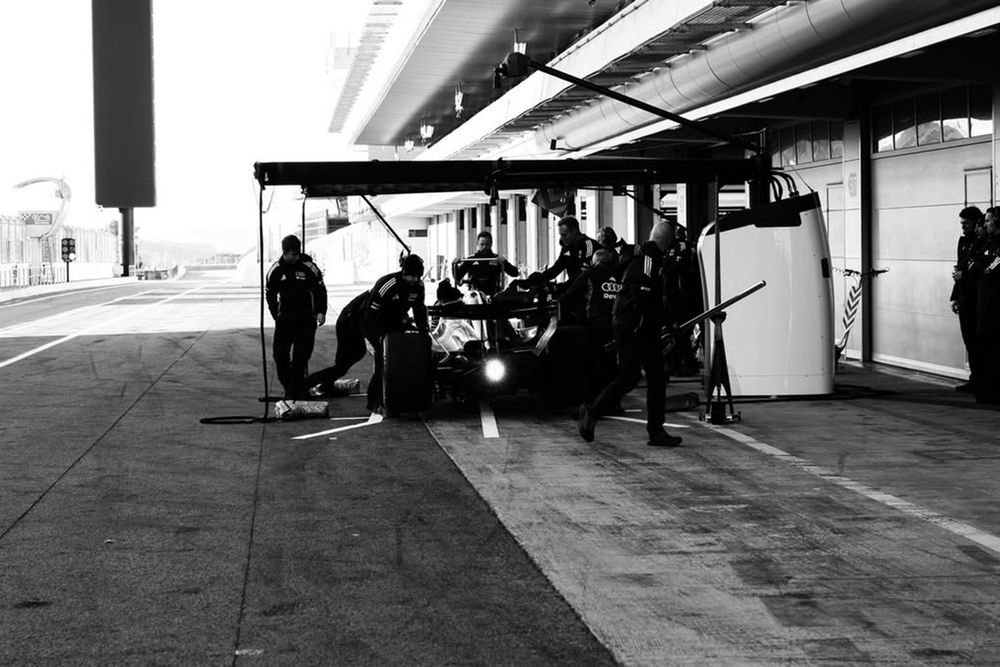
Audi F1 Team
Photo by: Audi
Subsequently, the team published preliminary images of the R26, deliberately blurring the vehicle to safeguard its initial design specifications.
Vehicles for the upcoming year will be 100mm slimmer, marking a significant aesthetic alteration. Within the footage, an elevated nose cone is detectable, alongside an inward-directing front wing, a design choice influenced by the FIA’s directives aimed at managing airflow disturbance around this component. The wing’s extremities now incorporate a base plate and an upward curve to govern the air movement around the forward wheels.
Beyond these features, a particularly striking element of Audi’s new vehicle is its front push-rod suspension system. Sauber had previously adopted a pull-rod front suspension configuration in 2024, mirroring the approaches pioneered by McLaren and Red Bull with the introduction of the preceding ground-effect rules. The track rod’s angle originates from the upper surface of the chassis’s main structural element, linking to the lower segment of the wheel’s vertical support.
Under the former regulatory framework, it was hypothesized that pull-rod suspension offered greater advantages for a vehicle’s kinematic anti-dive characteristics; however, the anticipated reduced stiffness in the spring rates of the current generation cars – given the lessened susceptibility of their underbodies to slight variations in ride height – has encouraged a return to the alternative.
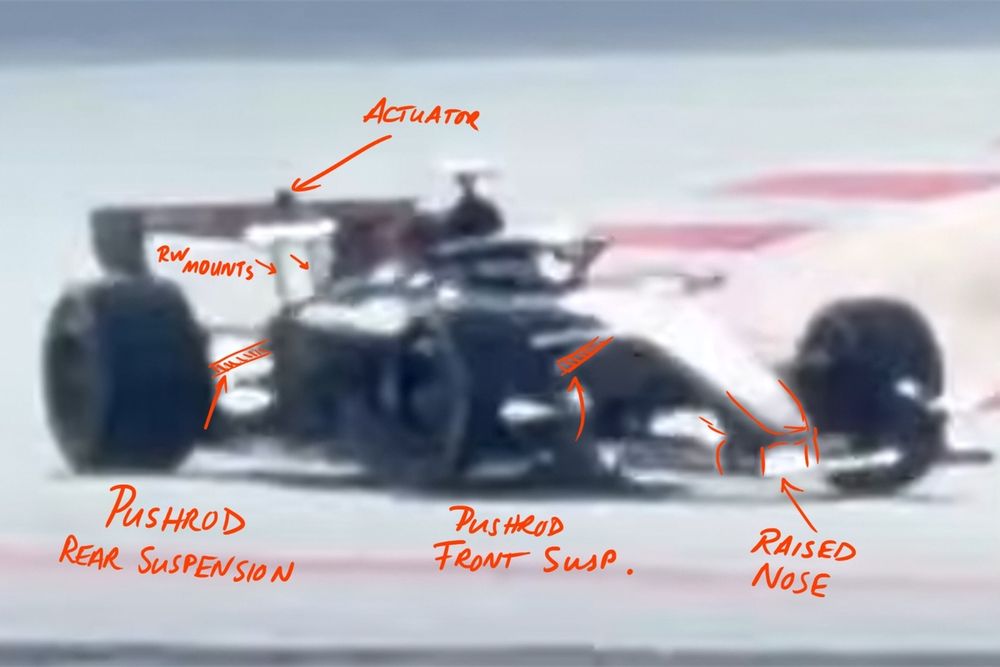
Due to the lack of clarity in the video, the precise configuration of the rear suspension is challenging to ascertain, yet it similarly appears to employ a push-rod design. Before 2022, Formula 1 constructors generally favored pull-rod rear suspension arrangements to maintain a low center of gravity; nevertheless, an increasing number of teams started to integrate push-rod rear suspension throughout the 2022-25 regulatory period.
The side bodywork is likewise noteworthy; during the 2022-25 seasons, the diverse range of sidepod designs observed in the initial phase of the regulations gradually aligned with Red Bull’s downwash concept, but Audi’s vehicle seems to exhibit an inward-flow design. This method guides the air past the sidepods to enhance the efficiency of the “Coke bottle” contour at the rear of the car’s shell.
Provided the air stream remains adhered to the vehicle, this design can draw air through the middle area, thereby preventing the turbulent wake from affecting the rear wheels.
In other observations, the sound produced by the engine is quite comparable to that of earlier power unit generations, though it possibly emits a slightly more robust tone when accelerating. The updated rear wing features a dual attachment point on its lower surface, contrasting with the solitary swan-neck fixture previously integrated with the DRS mechanism.