Charles Leclerc commented on the widening gap to Mercedes, noting it had increased from an estimated half a second to eight tenths, which was “larger than anticipated without a doubt,” after qualifying his Ferrari in fourth for the Australian Grand Prix.
“The difference was already quite substantial yesterday,” he added. “I was extremely impressed this morning during FP3; the power exhibited by George on his final lap was simply astonishing.”
“I reviewed the telemetry for the first time and had to re-download it because I suspected an error in what I was observing, but apparently not, so it’s truly remarkable.”
Indeed, the third free practice session had offered a stark preview of the impending qualifying results: as cars exited the pitlane with four minutes remaining, subsequent to Kimi Antonelli’s incident at Turn 2, the automobiles of Lewis Hamilton and Leclerc were leading the timing charts. Then, in a brilliant single lap, George Russell finally revealed the speed Mercedes had been skillfully hiding during pre-season tests, setting a time of 1m19.053s – 0.616s quicker than Hamilton, who ended the session in second.
The updated technical regulations, emphasizing energy conservation, have significantly complicated the task of determining a car’s true pace, thereby making the practice of ‘sandbagging’ simpler to mask. An optimal lap no longer solely depends on braking as late as possible and cornering at the absolute edge of grip, especially in high-speed turns.
Drivers now enter corners with the rear axle regenerating power, possibly braking later than before but generally with less pedal force, as the ERS system performs a much greater workload. Maintaining a full battery is crucial, particularly on an energy-demanding circuit like Albert Park, where substantial energy is needed for its numerous straights.
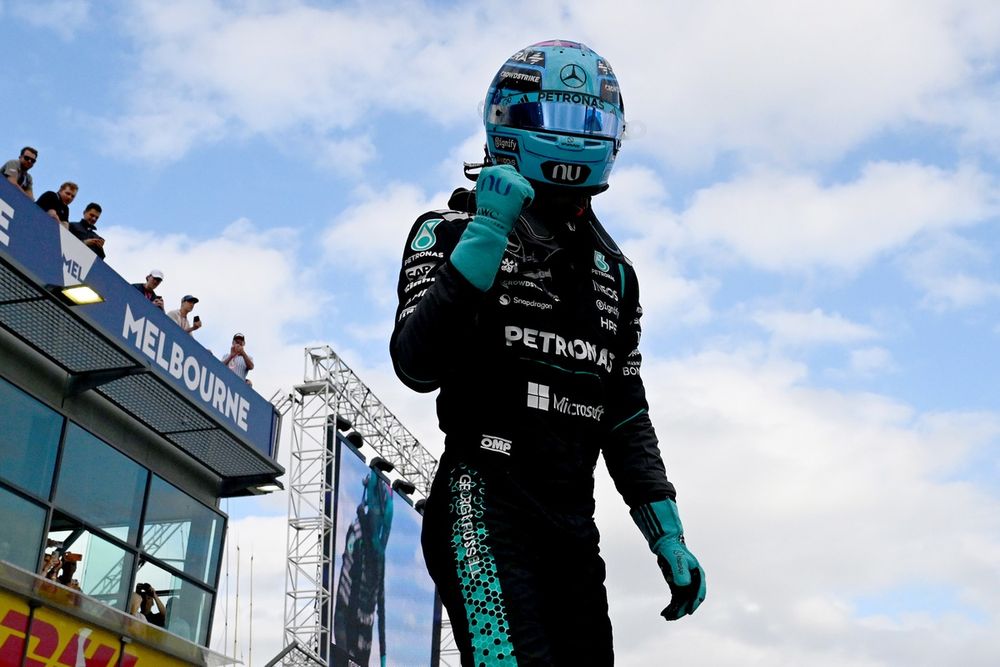
George Russell, Mercedes
Photo by: Mark Sutton / Formula 1 via Getty Images
As the data accessible to Autosport lacks specific details on battery charge status, comparing individual laps comes with inherent limitations. Energy deployment and harvesting strategies differ among teams and engine suppliers, even among those utilizing identical power units. The comparative performance of Mercedes and its client teams demonstrates that while PU efficacy is vital under the new rules, aerodynamic efficiency is equally important: a vehicle with high drag consumes more energy.
It represents, as Andrea Stella, McLaren’s team principal, remarked post-qualifying, “a novel lexicon and a fresh perspective.”
It’s probable that the cooler ambient temperatures during qualifying, which occurred at 4 PM local time, benefited Mercedes as other teams experienced fewer performance enhancements. Initially, it was Antonelli who held the advantage in Q3 in his quickly reassembled W17, overcoming a mistake at Turn 1 on his initial flying lap to take the lead with a 1m18.811s.
Russell’s response was a 1m19.084s – slower than his Q2 times – before he produced the powerful 1m18.518s that secured pole position. Only two tenths then separated Isack Hadjar’s third-placed Red Bull from Hamilton in seventh, but the difference between the quickest Mercedes and the subsequent fastest car demands closer inspection: 0.785s.
Russell avoids using highest gear in first sector
Examining the available data provides intriguing insights into the varying tactics employed at any given moment. The necessity to conserve energy means drivers are no longer at full throttle from the final corner on the lap preceding their push lap.
While Hadjar engages eighth gear soon after crossing the start/finish line to begin his lap, Russell remains in seventh, opting to lift-and-coast before applying the brakes into Turn 1; Hadjar eases off the throttle later and brakes sooner. After being 7km/h quicker on the straight, Hadjar briefly gained a tenth just before the corner’s apex as their speeds converged and overlapped, with Russell carrying more momentum through the short section to Turn 2.
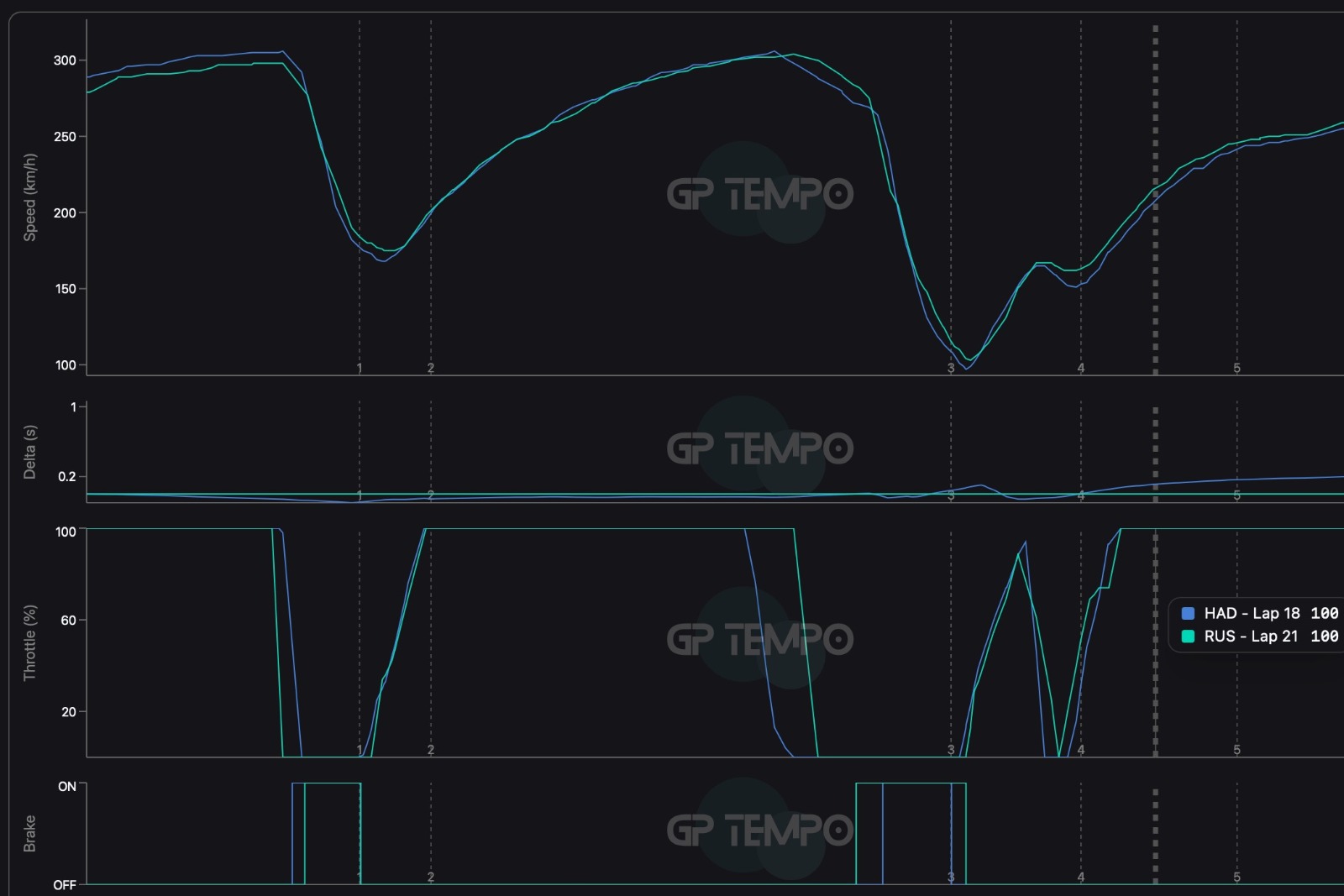
They both accelerate at roughly the same juncture upon exit, but again, while Hadjar progresses through gears from fourth to eighth, Russell stays no higher than seventh. Both drivers execute a notable lift-and-coast into Turn 3, but this time, Russell lifts off the throttle later and brakes earlier. Despite braking for a longer duration, he maintains a slight speed advantage – 10-15km/h – until just after the apex.
Russell then navigated Turn 4 with a considerably briefer throttle adjustment, allowing him to be 10km/h faster during the acceleration phase exiting the corner, which widened the gap to two tenths on the approach to Turn 6.
Integrated energy recovery in second sector
At Turn 6, both drivers disengage the throttle simultaneously, but Russell initiates braking earlier and sustains it longer. Despite this – and Hadjar disengaging brakes earlier and applying throttle sooner – Russell maintains 15km/h more speed into the apex of Turn 6, and their speeds do not equalize until they near the more open Turn 7. By this point, Russell holds a 0.331s lead.
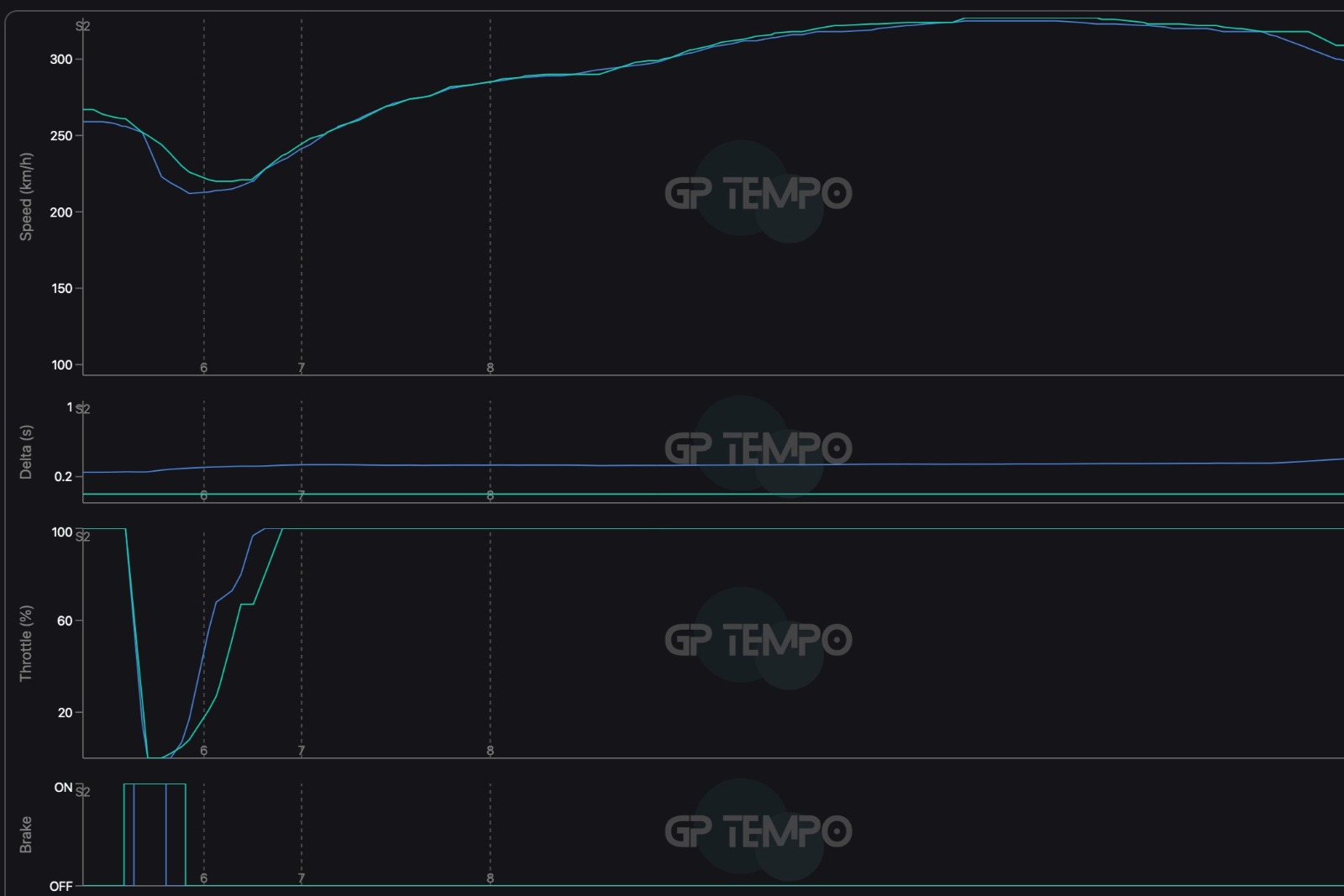
Russell passes the apex of Turn 8 considerably before engaging top gear for the first time during the lap, although a 300rpm difference between the two vehicles implies the Mercedes uses a slightly taller eighth gear. The sequence on the approach to Turn 9 is particularly noteworthy: Hadjar’s speed and engine revolutions gradually decrease towards the end of this gentle curve, whereas Russell’s drop occurs later and more suddenly, allowing him to sustain a commendable top speed for a longer period.
This strongly suggests that Russell managed to reclaim more energy throughout the first sector while still maintaining a quicker pace through the critical Turns 4 and 6.
Varied strategies for Turn 9
A captivating aspect of this weekend has been the diverse approaches to Turn 9, perfectly exemplified by Russell and Hadjar. The Mercedes achieves “super clips,” indicated by Russell downshifting to seventh while keeping the throttle fully open; he then lifts off and glides through the corner, allowing the recovery system to handle the braking effort. Hadjar releases the throttle simultaneously but also lightly taps the brakes, only then downshifting to sixth after the apex and accelerating sooner than Russell.
Nevertheless, the Mercedes maintained 15km/h greater speed through the corner, extending its lead to 0.7s and beyond. The fact that Hadjar subsequently upshifts to eighth while Russell goes no higher than seventh, yet remains approximately 5km/h faster, again points to the Mercedes possessing more electrical power for deployment on the straight between Turns 10 and 11.
At the sharp right-hand Turn 11, both drivers release the throttle at the same instant, though Hadjar is slightly delayed in fully lifting off, while Russell brakes for a longer duration and waits until after the apex to fully re-engage the power.
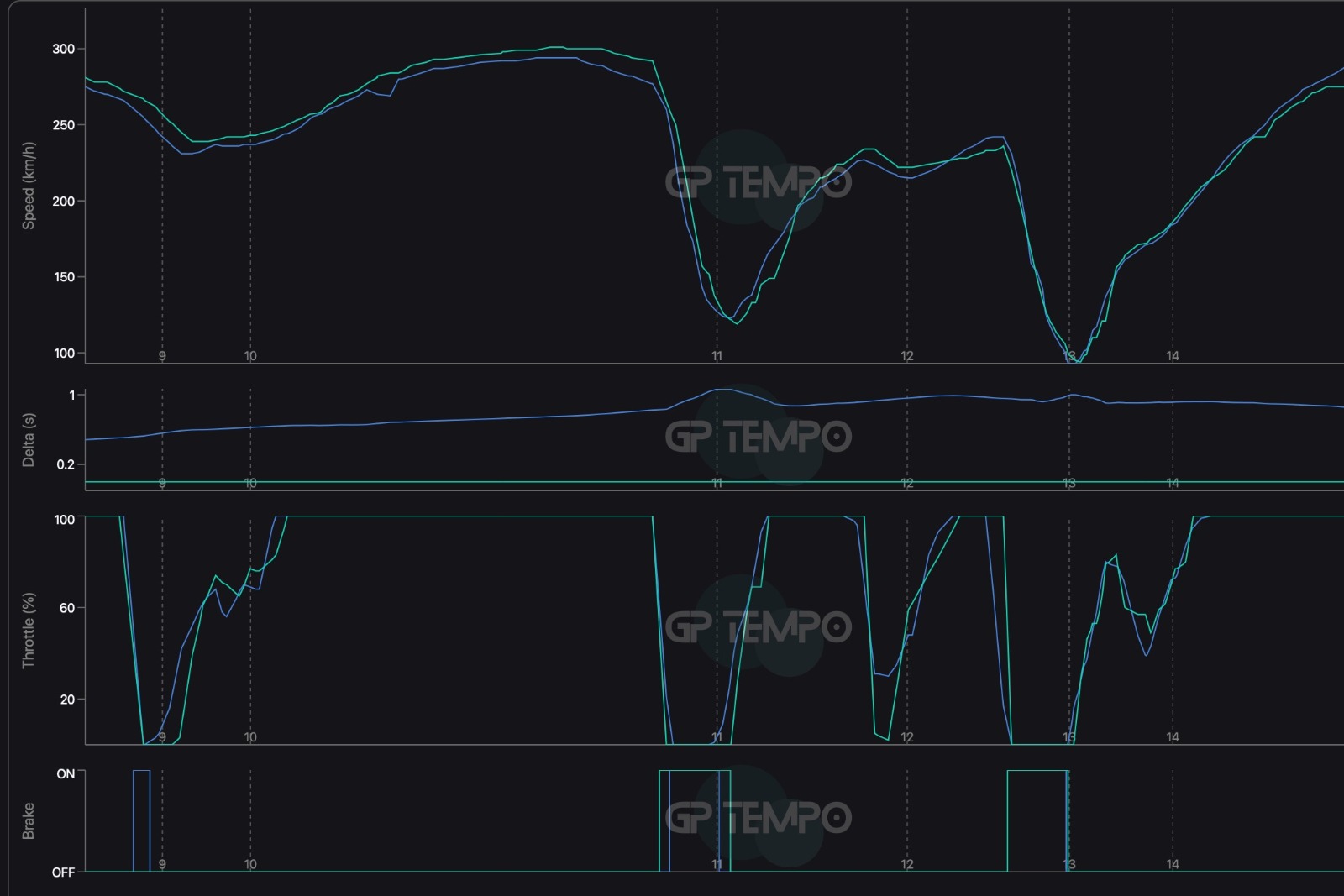
The Mercedes had established a one-second lead over the Red Bull by this juncture, but Hadjar’s earlier throttle application allowed him to reclaim a small amount of lap time before Russell matched his speed, with the sharp upward incline in the trace indicating a precise burst of electrical power.
Approaching Turn 12, Russell shed the necessary speed by completely lifting off, while Hadjar gently feathered the throttle at 30% – but, once more, the Mercedes maintained approximately 6km/h greater speed through this section, pushing the gap to nearly a full second again.
Hadjar briefly achieved 9km/h faster speed between Turns 12 and 13 due to electrical deployment, but by this point, the lap was effectively lost. The Red Bull accelerated slightly more aggressively out of Turns 13 and 14 and was 10km/h quicker on the sprint to the finish line, reducing the shortfall to 0.785s as Hadjar again selected top gear while Russell topped out in seventh.
“The conditions out there today weren’t easy; it was quite breezy and gusty, but I’m enjoying it,” he remarked later.
“It feels more akin to a go-kart compared to last year. The ground-effect car, to be honest, felt like a bouncing bus. It wasn’t as enjoyable to drive.”
“So, I believe there are many differing opinions on the new regulations overall, but I genuinely think the car rules for everyone represent a definite improvement over what we’ve experienced for, what, the past eight years now.”
This perspective on the new rules sharply contrasts with those voiced by several of Russell’s competitors, but it’s straightforward to maintain a positive outlook when holding an eight-tenths advantage over the next-quickest car. Currently, it’s evident that Mercedes possesses the most refined comprehension of how to extract maximum performance from its power unit, coupled with a vehicle sufficiently agile through corners to minimize potential drawbacks linked to the need for energy harvesting.
George Russell, Mercedes
Photo by: Lars Baron / Getty Images
Among those scrutinizing Mercedes most closely are its engine clients.
“As you can imagine, this constituted one of the primary discussion points in our post-qualifying review,” stated McLaren team principal Stella.
“Our aim was to comprehend how to optimally leverage these power units, because, as we can observe, this accounts for a considerable amount of lap time.”
“In itself, I must say, it’s partially good news, as it implies a substantial amount of lap time is attainable if you provide the correct input from a driving perspective and execute the right utilization from a control systems and programming standpoint. Consequently, a great deal of lap time is accessible.”
“We deliberated on what might have differed in what we observed from Russell’s lap. I believe we have a solid understanding.”
“Somehow, it necessitated a qualifying session, it necessitated being in identical conditions on track, with the same power unit, to truly gain a sufficient reference to grasp what is achievable…”