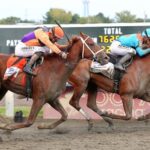
The journey from Fair Grounds to the Kentucky Derby Presented by Woodford Reserve culminates this Saturday with the Twinspires.com Louisiana Derby, a Grade 2 race offering a $1 million prize. Competitors in this event will cover a distance of 1 3/16 miles on a dirt track, establishing the Louisiana Derby as the longest preliminary contest for the Kentucky Derby in the United States.
Dating back to its inaugural running in 1894, the Louisiana Derby stands as one of the venerable preparatory races for the Derby. Its history has seen interruptions; the event did not take place during the periods of 1895-1897, 1909-1919, 1921-1922, and 1940-1942. Further cancellations occurred in 1945 due to the U.S. government’s wartime suspension of horse racing, and in 2006, when Hurricane Katrina led to the abandonment of the Fair Grounds season.
This race has consistently been classified as a Grade 2 event since 1973, apart from the interval between 1985 and 1998, when it was designated as a Grade 3. For most of its existence, the distance covered was 1 ⅛ miles, until it was lengthened to 1 3/16 miles for the first time in 2020.
We will now review the achievements of some of the most distinguished victors of the Louisiana Derby.
BLACK GOLD (1924)
LIFETIME PERFORMANCE: 35 races run, 18 first-place finishes, 5 second-place finishes, 4 third-place finishes
TOTAL PRIZE MONEY: $111,553
The striking dark-colored colt, Black Gold, belonged to Rosa Hoots, a leading figure among horse owners in the midwestern racing scene of that era. Rosa and her spouse, Al, were also the proprietors of Black Gold’s mother, U-See-It, an acclaimed sprinter during the mid-1910s, who secured 34 victories from her 122 lifetime races.
Black Gold initiated his racing journey in January 1923 at Fair Grounds, achieving eight wins out of 19 starts during his initial season. A highlight of this period was his triumph in the Bashford Manor Stakes at Churchill Downs.
Commencing his 3-year-old campaign with a pair of wins, Black Gold prompted his team to seriously contemplate the Kentucky Derby. He was entered into the Louisiana Derby as a preparatory race, where he started as the 9-5 favorite. The colt performed as anticipated, establishing a decisive early lead that he maintained throughout. Under the guidance of jockey J.D. Mooney, Black Gold crossed the finish line six lengths ahead of his rivals. The race, covering 1 ⅛ miles, concluded in a time of 1:57 ⅗.
After securing a victory in the Derby Trial Stakes, Black Gold entered the Kentucky Derby as the top betting choice. This particular year marked the 50th running of the Derby, drawing an unprecedented number of spectators to Churchill Downs. Black Gold delivered an impressive performance for the audience, recovering from a challenging race to secure the win in 2:05 ⅕. His triumph made him the inaugural winner of both the Louisiana Derby and the Kentucky Derby, and also the first horse from the “western” circuit to claim victory since Behave Yourself in 1921.
That same year, Black Gold augmented his racing achievements with two additional stakes victories, specifically in the Ohio Derby and the Chicago Derby. This made him the first thoroughbred to conquer Derby races in four distinct states.
After Black Gold passed away in 1928, his burial site was established within the infield of Fair Grounds. In 1989, he received the honor of induction into the Racing Hall of Fame.
RUSHAWAY (1936)
LIFETIME PERFORMANCE: 107 races competed, 17 victories, 14 runner-up finishes, 16 third-place finishes
TOTAL PRIZE MONEY: $47,540
Joseph Widener, credited with constructing Hialeah Park and elevating its status, bred Rushaway. Rushaway’s father, Haste, placed third in the Belmont Stakes in 1926, and his mother, Roseway, claimed victory in the 1919 British One Thousand Guineas, subsequently finishing second in the Epsom Oaks later in the same year.
Following an early demonstration of potential during his 3-year-old season, Rushaway gained national recognition with his triumph in the Louisiana Derby. As the 2-5 favorite, he secured a length victory, establishing a new track record for the 1 ⅛-mile distance, completing it in 1:50 ⅘.
Rushaway’s most remarkable achievement unfolded later in the year. On May 22, he triumphed in the Illinois Derby at Aurora Downs by 1 ½ lengths. The same evening, owner-trainer Alfred Tam transported the horse by train to Latonia (presently Turfway Park) for the Latonia Derby. Astonishing racing enthusiasts nationwide, Rushaway secured another win the following day, this time by six lengths.
While Rushaway only achieved one subsequent stakes victory in his racing career, his extraordinary feat continues to be celebrated. The Rushaway Stakes, held at Turfway Park, bears his name as a tribute.
NO LE HACE (1972)
LIFETIME PERFORMANCE: 34 outings, 9 first-place finishes, 8 second-place finishes, 4 third-place finishes
TOTAL PRIZE MONEY: $239,752
No Le Hace began to display potential towards the close of his 2-year-old racing year, winning the Sugar Bowl Handicap at Fair Grounds. He truly found his peak form as a 3-year-old, securing victory in the Lecomte Handicap at the start of his season.
Propelled by that success, No Le Hace became the strong 1-2 favorite for the Louisiana Derby. Jockey Phil Rubbicco positioned his horse in the middle of the field during the initial phase, as Fame and Power established a significant lead along the backstretch. Approaching the final turn, Fame and Power started to weaken, but Feloniously outpaced No Le Hace to take the lead, while the favorite advanced steadily from the inside. In the ultimate sixteenth of a mile, Rubbicco steered his horse outward, launching a powerful drive towards the front-runner. No Le Hace ultimately secured the victory by a nose in the very last stride.
After winning the Arkansas Derby, No Le Hace entered the Kentucky Derby as a strong contender. Despite a powerful late surge, he placed second, trailing Riva Ridge by 3 ¼ lengths. No Le Hace subsequently secured another second-place finish in the Preakness Stakes, unexpectedly bested by Bee Bee Bee, while Riva Ridge finished fourth.
MASTER DERBY (1975)
LIFETIME PERFORMANCE: 33 outings, 16 victories, 8 runner-up finishes, 4 third-place finishes
TOTAL PRIZE MONEY: $698,624
Master Derby embarked on the 1975 Derby circuit with the aim of continuing a family tradition. Robert Lehmann, the owner and breeder, had won the Kentucky Derby five years earlier with his homebred Dust Commander. Although Lehmann passed away in 1974, his widow, Verna, chose to retain their horses, among them Master Derby.
During his 2-year-old season, Master Derby claimed victory in two stakes races at Liberty Bell Park in Pennsylvania and placed among the top four in four additional events. With the ambition of securing another Kentucky Derby triumph, Verna Lehmann and trainer Smiley Adams dispatched their horse to Louisiana to commence his 3-year-old campaign.
Following a win in the Louisiana Derby Trial Stakes, Master Derby advanced to the Louisiana Derby for his subsequent race. Despite accumulating three stakes victories on the track, Master Derby was not the top choice for the Fair Grounds season’s primary event. He was bet at odds of 4.30-1, whereas Somethingfabulous, a half-brother to Secretariat, held the position of 9-5 favorite.
Somethingfabulous initiated a threatening surge as they rounded the final turn but subsequently faltered, ending up in seventh place. Conversely, Darrell McHargue skillfully guided Master Derby away from congestion before making his decisive move towards the rail at the five-sixteenths pole. Master Derby then accelerated past his competitors in the stretch to achieve a length victory. Eddie Delahoussaye, the rider of the third-place horse, Honey Mark, lodged a complaint against Master Derby, yet the outcome of the race remained unchanged.
Having secured a win in the Blue Grass Stakes, Master Derby entered the Kentucky Derby among the top contenders. Nevertheless, he delivered a subpar performance, finishing fourth, and was largely overlooked for the Preakness Stakes. However, in the Preakness, Master Derby made a strong comeback, achieving an unexpected 23.40-1 victory over the Derby winner, Foolish Pleasure.
RISEN STAR (1988)
LIFETIME PERFORMANCE: 11 races, 8 first-place finishes, 2 second-place finishes, 1 third-place finish
TOTAL PRIZE MONEY: $2,029,845
Risen Star presented himself as a significant candidate for the Kentucky Derby as he approached the 1988 Louisiana Derby. His previous outing saw him secure an impressive late-charging victory in the Louisiana Derby Trial Stakes, where he triumphed by a length as the favorite.
A notable incident occurred the day before the race. Following a standard morning gallop, Risen Star unexpectedly reared and then collapsed onto his right side. Veterinarians assessed him both that day and on the morning of the race, leading to some uncertainty about his participation. Despite being cleared to compete, the event caused apprehension among the betting public. Consequently, he was offered at 2.60-1 odds, positioning him as the second favorite in the seven-horse field, just behind Jim’s Orbit.
On Louisiana Derby day, Risen Star appeared fully recovered. Similar to his performance in the Louisiana Derby Trial, he conserved energy in the early stages before unleashing a powerful late surge down Fair Grounds’ lengthy homestretch. Encouraged by jockey Shane Romero, Risen Star propelled forward to claim victory by 1 ¾ lengths, while Jim’s Orbit concluded the race in a non-threatening fourth position.
Following his triumph in the Lexington Stakes, Risen Star started the Kentucky Derby with 5.50-1 odds. Guided by Louisiana native Eddie Delahoussaye, Risen Star endured a challenging race in Louisville, running wide on both turns. Despite an impressive late effort, he ultimately finished third, trailing the filly Winning Colors.
Risen Star recovered effectively in his subsequent two races. In the Preakness Stakes, he benefited from a considerably smoother race and pulled away to a 1 ¼-length victory at 6.80-1 odds, surpassing Winning Colors by 2 1/2 lengths. Then, as the favored horse in the Belmont Stakes, he delivered a masterful performance, securing a victory by 14 ¾ lengths. His finishing time of 2:26 ⅖ was the quickest recorded since his sire, Secretariat, achieved a time of 2:24 in 1973, which was 15 years earlier.
Despite an injury that ended his racing career prematurely, Risen Star’s victories in the Preakness and Belmont were sufficiently impactful to earn him the Eclipse Award for champion 3-year-old male from voters.
GRINDSTONE (1996)
LIFETIME PERFORMANCE: 6 outings, 3 first-place finishes, 2 second-place finishes, 0 third-place finishes
TOTAL PRIZE MONEY: $1,224,510
Grindstone was a member of a substantial group of contenders for the Kentucky Derby assembled by Hall of Fame trainer D. Wayne Lukas. In that particular Derby, Lukas would prepare five horses, setting a record that has since been equaled but not surpassed.
Grindstone raced two times during his 2-year-old season, securing his maiden victory at Belmont Park before finishing fourth in the Bashford Manor Stakes at Churchill Downs. He then took a break from racing, reappearing for a first-level allowance race at Santa Anita Park on February 16. In that event, he placed second while pursuing Budroyale, a future graded stakes winner, who maintained the lead throughout the race.
Without hesitation, Lukas dispatched Grindstone to Fair Grounds for the Louisiana Derby, an event Lukas had previously captured with Balboa Native in 1983. Grindstone was the 2.40-1 second favorite in the eight-horse lineup, while Louisiana-bred Zarb’s Magic was the 3-2 favorite. Zarb’s Magic quickly established the pace, with Jerry Bailey positioning Grindstone slightly behind.
As they rounded the final turn, Bailey maneuvered Grindstone three paths wide, challenging the front-runners. In the concluding eighth of a mile, Grindstone asserted dominance, pulling away to a 3 ½-length victory, with Zarb’s Magic securing second place, four lengths ahead of the remaining field.
Zarb’s Magic reversed their previous outcome against Grindstone in the Arkansas Derby, narrowly defeating him by a neck in an unexpected 11.20-1 upset. Both horses subsequently journeyed to Louisville for the first Saturday in May, and while Zarb’s Magic was viewed as a longshot, Grindstone attracted significant betting interest. When paired in wagering with Editor’s Note – another horse owned by William T. Young’s Overbrook Farm and trained by Lukas – they collectively represented the 5.90-1 third favorite.
In one of the most electrifying renditions of the Derby, Grindstone surged from 15th position, thundering down the stretch to pursue the leading horse, Cavonnier. The two competitors reached the finish line simultaneously, and a photo finish ultimately confirmed Grindstone’s victory by a nose. This marked Lukas’s sixth consecutive triumph in a Triple Crown event and Bailey’s second Derby win.
The Derby ultimately became the concluding race of Grindstone’s career. He was retired just a week afterward due to a bone chip discovered in his right knee.
PEACE RULES (2003)
LIFETIME PERFORMANCE: 19 races, 9 first-place finishes, 2 second-place finishes, 2 third-place finishes
TOTAL PRIZE MONEY: $3,084,278
Peace Rules initiated his racing journey on turf courses. Following a notable maiden victory at Belmont Park in September 2002, Edmund Gann acquired him through a private sale and subsequently placed him under the training of Bobby Frankel. For this new ownership, Peace Rules secured two stakes victories on turf and was narrowly defeated by a head in a third such race.
Commencing his 3-year-old season, Peace Rules entered a dirt stakes for the first time in the Louisiana Derby. Punters harbored doubts, assigning the colt 9.40-1 odds. The primary focus of attention was on Badge of Silver, the Risen Star winner, who stood as the 6-5 favorite, and Kafwain, trained by Bob Baffert, who was the 7-5 second favorite.
Edgar Prado provided Peace Rules with an exemplary ride. He positioned the horse closely behind the pace-setter, Funny Cide, and matched strides with that competitor as they entered the homestretch. In the final stretch, Peace Rules pulled ahead decisively by 2 ¼ lengths. Kafwain mounted a late charge to secure second place, Funny Cide maintained third, and Badge of Silver concluded in an uninspired sixth. This victory furnished Frankel with another formidable contender for the 2003 Derby, complementing Empire Maker.
Peace Rules built upon his Louisiana Derby success with a striking gate-to-wire win in the Blue Grass Stakes. On Derby day, he was the second betting preference at 6.30-1, behind his stablemate Empire Maker, who was the 5-2 favorite. Peace Rules tracked the early leader, Brancusi, then made his move around the turn. Although he briefly held the lead in the stretch, he was ultimately surpassed by Funny Cide, a horse previously beaten by both Peace Rules and Empire Maker during the Derby lead-up. The New York-bred gelding triumphed by 1 ¾ lengths, with Peace Rules narrowly losing the photo finish for second place to Empire Maker.
For the Preakness Stakes, Peace Rules was the second most favored horse, yet again succumbed to Funny Cide. Peace Rules ultimately went on to secure four additional graded stakes victories in his career, notably including the Grade 1 Haskell Invitational and the Grade 1 Suburban Handicap.
FRIESAN FIRE (2009)
LIFETIME PERFORMANCE: 18 races run, 5 first-place finishes, 1 second-place finish, 3 third-place finishes
TOTAL PRIZE MONEY: $679,356
Friesan Fire approached the 2009 Louisiana Derby with an opportunity to etch his name in history. No horse had ever achieved a clean sweep of all three key Derby preparatory races at Fair Grounds, but Friesan Fire was poised to potentially reach this milestone. The trainee of Larry Jones had previously secured the Lecomte Stakes by 1 ½ lengths, followed by a two-length victory in the Risen Star Stakes. Gamblers recognized his strong form for the Louisiana Derby, making him the 2.20-1 favorite on a sloppy racing surface.
Consistent with his two previous triumphs, Friesan Fire had an excellent stalking position in the Louisiana Derby. Gabriel Saez kept him in third place, trailing the early leader, Papa Clem, who was running freely. As Papa Clem started to lose momentum, Friesan Fire accelerated, taking control and extending his lead at the top of the stretch. He achieved a decisive victory by 7 ¼ lengths, solidifying his status as a top contender for the Derby.
Friesan Fire ultimately started as the 3.80-1 favorite in a closely contested Kentucky Derby, but encountered traffic issues early on and concluded the race in 18th place, which was won by the longshot Mine That Bird. Following a comparably underwhelming performance in the Preakness Stakes, he was absent from racing for several months. Friesan Fire reappeared in December of his 3-year-old campaign and subsequently claimed victory in the Louisiana Handicap during his 4-year-old season.
GUN RUNNER (2016)
LIFETIME PERFORMANCE: 19 races, 12 first-place finishes, 3 second-place finishes, 2 third-place finishes
TOTAL PRIZE MONEY: $15,988,500
Gun Runner emerged as a Derby contender during the Risen Star Stakes. He executed a strong surge for the lead, subsequently fending off a late charge from longshot Forevamo to win by half a length. Based on this performance, he was the 3.90-1 third favorite in the Louisiana Derby.
While some skepticism might have existed prior to the race, it largely dissipated after Gun Runner’s impressive victory. Guided by Florent Geroux, he conserved energy along the rail in the initial stages before advancing to challenge the leaders on the turn. He pulled clear at the eighth pole, securing a 4 ½-length win. This victory marked Steve Asmussen’s third Louisiana Derby triumph, having previously won with Fifty Stars in 2001 and Pyro in 2008.
Gun Runner placed third in the Kentucky Derby and subsequently secured two additional graded stakes victories that same year. However, it was during his 4-year-old season that he truly excelled, winning five graded stakes races in 2017, including four consecutive Grade 1 events. Following his wire-to-wire triumph in the Breeders’ Cup Classic, he was almost unanimously selected as Horse of the Year. Gun Runner concluded his illustrious career with a victory in the Pegasus World Cup Invitational in January 2018.
BY MY STANDARDS (2019)
LIFETIME PERFORMANCE: 14 races competed, 6 first-place finishes, 4 second-place finishes, 1 third-place finish
TOTAL PRIZE MONEY: $1,829,430
Despite having displayed glimpses of potential, By My Standards entered the 2019 Louisiana Derby as a largely unrefined competitor. He had achieved his maiden win on his fourth attempt in his previous race, triumphing by 4 ¼ lengths at odds of 3.90-1. On Louisiana Derby Day, gamblers remained unconvinced, making him a 22.50-1 longshot for his inaugural stakes appearance.
By My Standards delivered a remarkably improved performance in the Louisiana Derby. Gabriel Saez positioned him just behind the leaders on the outer part of the track, then initiated his move as they reached the lengthy Fair Grounds stretch. In the ultimate sixteenth of a mile, Saez urged his mount powerfully, successfully overtaking Spinoff and securing an unexpected victory.
Despite competing only one more time as a 3-year-old — resulting in a lackluster 11th-place finish in the Kentucky Derby — By My Standards truly flourished in his 4-year-old season. He captured Grade 2 stakes races at Fair Grounds, Oaklawn Park, and Churchill Downs, in addition to securing second-place finishes in two other graded stakes events.
HOT ROD CHARLIE (2021)
LIFETIME PERFORMANCE: 19 races, 5 first-place finishes, 6 second-place finishes, 3 third-place finishes
TOTAL PRIZE MONEY: $5,976,720
Hot Rod Charlie entered the 2021 Twinspires.com Louisiana Derby with a notable record, though he had not yet secured a stakes victory. He concluded his 2-year-old campaign by finishing second in the TVG Breeders’ Cup Juvenile Presented by Thoroughbred Aftercare Alliance. For his 3-year-old debut, he placed third in the Robert B. Lewis Stakes, narrowly defeated by a neck by Medina Spirit.
Trainer Doug O’Neill opted to dispatch him to Louisiana for his ultimate Derby preparatory race. On that particular day, he confronted a formidable lineup, featuring Mandaloun, the Risen Star Stakes victor, and Midnight Bourbon, winner of the Lecomte Stakes. Mandaloun was the 13-10 favorite, while Hot Rod Charlie was positioned as the 2.90-1 second favorite.
Starting from post position five, Hot Rod Charlie quickly secured the rail and the early lead as the horses rounded the first turn. With Midnight Bourbon applying pressure from the outside, Hot Rod Charlie maintained a steady pace while steadfastly holding his advantage. He engaged in a sustained battle with Midnight Bourbon down the stretch, but eventually distanced himself in the final sixteenth of a mile, winning by two lengths. His time of 1:55.06 for 1 3/16 miles established a new track record.
Hot Rod Charlie experienced continued success throughout the remainder of his 3-year-old campaign. He placed second to Essential Quality in the Belmont Stakes Presented by NYRA Bets, then was the first to cross the finish line in the TVG.com Haskell Stakes, only to be disqualified for causing interference. Unfazed, he rebounded with a commanding 2 ¼-length victory in the Pennsylvania Derby at Parx Racing.
During his 4-year-old season in 2022, Hot Rod Charlie achieved second place in the $12 million Dubai World Cup at Meydan Racecourse, secured a win in the Grade 2 Lukas Classic Stakes at Churchill Downs, and placed third in the Whitney Stakes at Saratoga Race Course, thereby increasing his lifetime prize money to over $5.9 million.
EPICENTER (2022)
LIFETIME PERFORMANCE: 11 races – 6 victories, 3 runner-up finishes, 0 third-place finishes
TOTAL PRIZE MONEY: $2,940,639
Epicenter’s journey towards the Kentucky Derby Presented by Woodford Reserve was exclusively routed through Fair Grounds, including preparatory races such as the Gun Runner Stakes on December 26, 2021 (a victory), the Grade 3 Lecomte Stakes on January 22, 2022 (a nose second-place finish), and the Grade 2 Risen Star Stakes Presented by Lamarque Ford on February 19 (a win). His subsequent challenge was the Grade 2 Twinspires.com Louisiana Derby.
For his ultimate preparation race before the Kentucky Derby, Epicenter adopted a revised strategy, deviating from his customary running style by settling behind the early pace and initiating his charge on the turn. This approach proved highly effective, as he assumed the lead upon entering the stretch and triumphed by 2 1/2 lengths. That particular contest secured him an additional 100 Derby qualifying points, positioning him as a top accumulator of points heading into the Kentucky Derby.
On May 7, Epicenter subsequently started as the favorite in the Kentucky Derby. He positioned himself behind a rapid pace before seizing the lead at the top of the stretch, appearing poised to deliver trainer Steve Asmussen his inaugural Kentucky Derby victory until the longshot Rich Strike emerged along the rail, orchestrating a stunning upset. Epicenter concluded the race in second place. A fortnight later, Epicenter was once again the strong favorite in the Preakness, the middle jewel of the Triple Crown, but again had to accept second, this time defeated by Early Voting.
Subsequently in the season, Epicenter achieved another significant triumph by winning the $1.25 million Grade 1 Runhappy Travers Stakes at Saratoga Race Course on August 27. This “Mid-Summer Derby” had been Epicenter’s target since his Triple Crown setbacks, and on this occasion, Epicenter delivered, securing the first Grade 1 victory of his career. Masterfully ridden by his regular jockey Joel Rosario, Epicenter shadowed the pace established by Cyberknife and Ain’t Life Grand, consistently staying within three lengths of the leaders before initiating his surge on the turn and surpassing Cyberknife at the beginning of the stretch. Epicenter maintained and extended his advantage down the straight, comfortably winning by a convincing 5 1/4-length margin.
Recognizing his collective achievements throughout the season, Epicenter was honored with the Eclipse Award for champion 3-year-old male in 2022.