Fernando Alonso, a two-time Formula 1 world title holder, believes that the demanding nature of driving at Suzuka will vanish under the current 2026 regulations.
The legendary Japanese Grand Prix circuit is highly regarded by drivers, known for its intricate first sector Esses and fast Degner and Spoon turns. Yet, the energy recovery requirements of the 2026 F1 rules mean drivers are navigating these turns at reduced velocities, utilizing them as points to replenish their car’s battery.
From this perspective, Suzuka shares characteristics with Melbourne’s Albert Park, posing a similar difficulty under these regulations, primarily because it offers limited heavy braking areas where energy can be recuperated organically by drivers.
The seasoned Alonso asserts that, consequently, Suzuka’s distinct test of driver skill has effectively disappeared.
“It has vanished,” he stated. “I mentioned in Bahrain that even the cook could pilot the vehicle through Turns 10/11. Perhaps not the cook, but I believe at least half of the team personnel could manage Suzuka. This is because, as I’ve noted repeatedly, fast corners have transformed into power replenishment zones for the vehicle.”
“You decrease your speed, power up the battery through the rapid sections, and then you have maximum propulsion on the straightaways. Therefore, a driver’s expertise is no longer truly essential. You merely need to ease off the accelerator or reduce the battery output to recharge it. So, indeed, the high-speed sections offer no further challenge.”
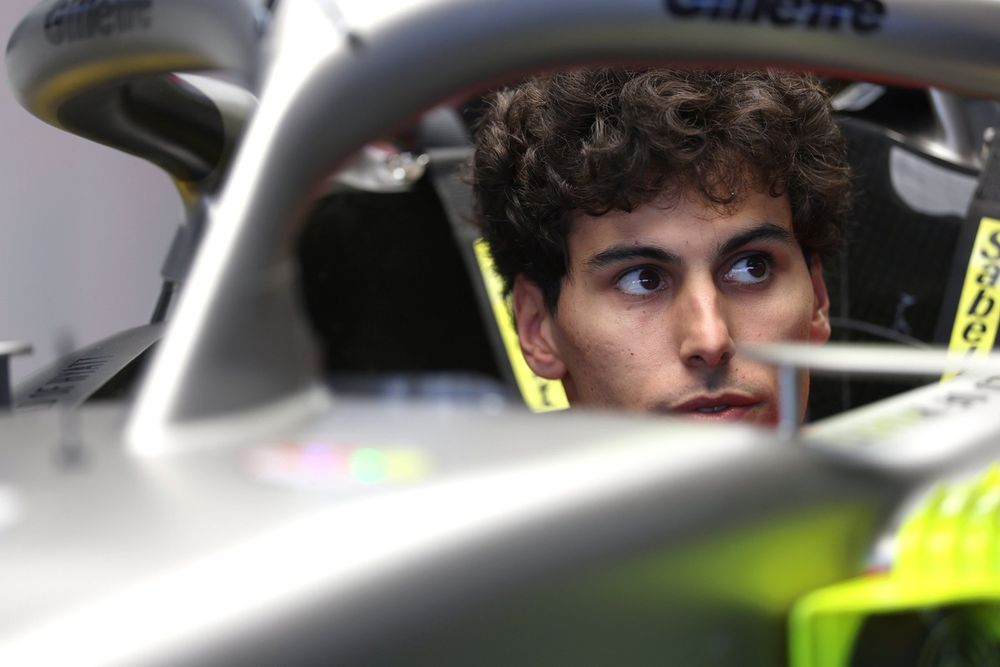
Gabriel Bortoleto, Audi F1 Team
Photo by: Andy Hone/ LAT Images via Getty Images
Gabriel Bortoleto from Audi did not entirely concur with his mentor’s perspective, arguing that executing a perfect qualifying lap still demands expertise and accuracy.
“I would say it remains incredibly satisfying. I sense that when I navigate the high-speed turns and finish that session, I even breathe more freely. The speed at which we take corners and the precision required are still astounding.”
“Furthermore, my preferred car setup is typically quite aggressive, pushing the boundaries. Thus, extreme accuracy is crucial, particularly during a Q2 or Q3 lap, to avoid errors and achieve an outstanding performance.”
Charles Leclerc of Ferrari supported the FIA’s choice to reduce the overall energy deployment in qualifying from 9 to 8 MJ for the Suzuka event, arguing that this action averted more pronounced occurrences of “lifting and coasting” and “super clipping,” a technique where drivers recharge the battery while maintaining throttle input.
“I believe the situation would have been considerably poorer if no action had been taken,” Leclerc stated. “Therefore, I feel we are progressing correctly. Whether additional measures are necessary or if something different could yield a greater impact remains to be determined. Between now and Miami, extensive discussions will take place, involving both the FIA and the teams, to propose improvements for the qualifying regulations.”
“Candidly, I consider the car quite effective in the race, and it largely resembles last year’s model. The driving approach remains similar. However, in qualifying, it’s currently a source of some annoyance.”