Fnatic aims for its item-opening platform, STASHD, to serve as “a hub for incredible acquisitions, rare discoveries, and stories genuinely worth sharing.” However, the broader community perceives it differently, viewing it as a betting system disguised as a fan engagement tool.
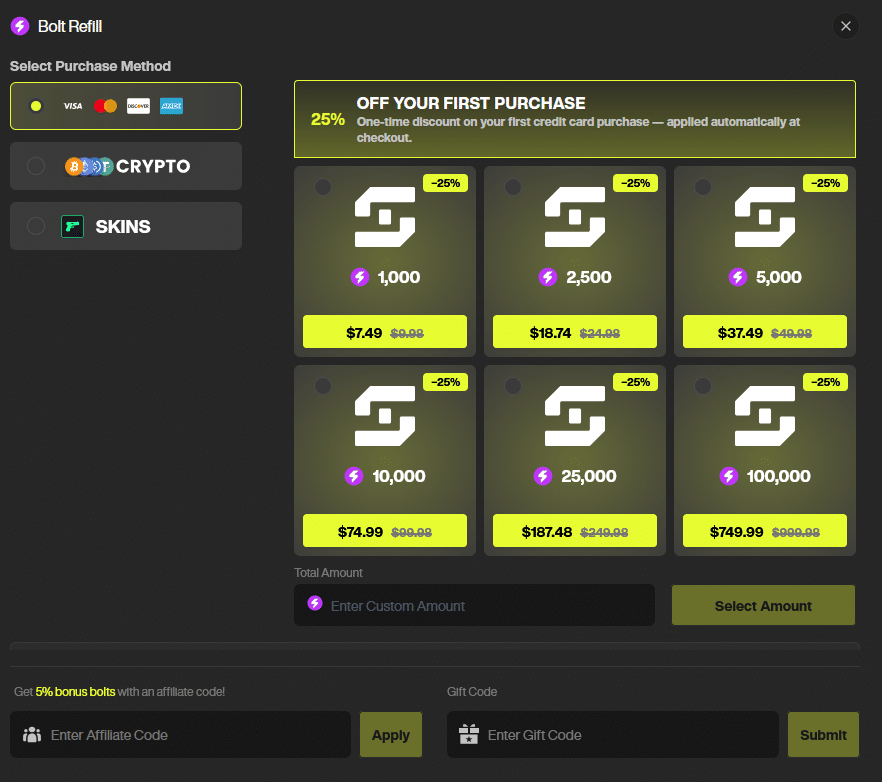
Through STASHD.gg, participants acquire a digital currency known as Bolts, which can be purchased using credit/debit cards, cryptocurrency, or Valve skins. These Bolts are then used to open virtual containers containing CS2 cosmetic items. These items can either be transferred to Steam or converted into cryptocurrency via a structured, time-restricted process. Alternatively, if direct withdrawal is not preferred, users can engage in player-versus-player duels by wagering Bolts on whose opened item yields a greater value.
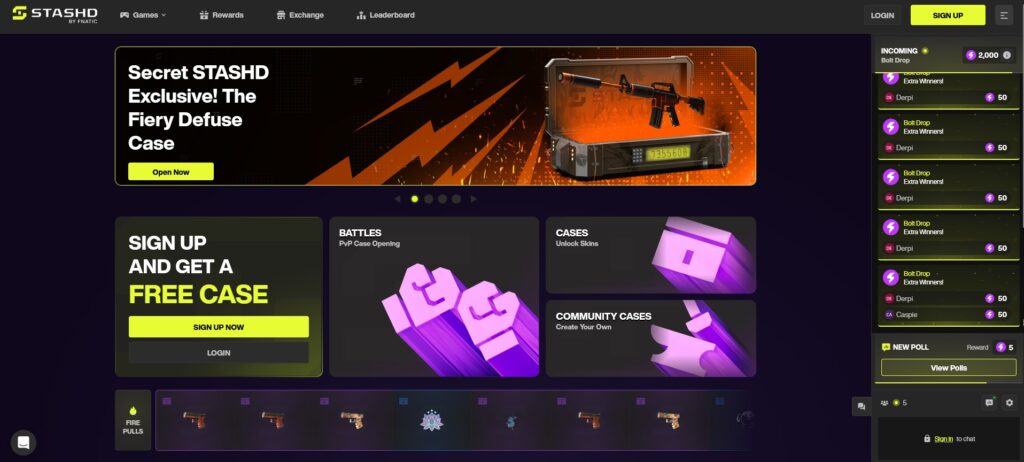
The service is styled in Fnatic’s signature black and orange palette, featuring the identifier “By Fnatic” beneath its emblem, and publicly declares its purpose is to “forge a new path to connect you more deeply with what you cherish about Fnatic.”
The initiative has drawn immediate criticism across online forums like Reddit and X. Fnatic Dragons, the organization’s recognized fan club and community, issued a social media post emphasizing its stance was focused on “safeguarding a community comprising many young and impressionable enthusiasts,” subsequently listing contact numbers for various national gambling addiction support lines.
Lootboxes, the fundamental mechanism driving the STASHD offering, represent one of the most contentious elements in gaming, a debate that has persisted for nearly a decade. In Europe, Belgian law prohibited lootboxes under its gambling legislation back in 2018.
Currently, Valve is involved in legal proceedings initiated by the New York Attorney General and a class-action lawsuit in Washington state. Both legal actions contend that lootboxes function as illegal gambling mechanisms. The New York Attorney General’s lawsuit specifically argues that lootboxes employ the identical psychological strategies found in conventional casino games: inconsistent reward schedules, manipulative engagement tactics, continuous accessibility, and absorbing reward cycles.
While the legal status remains unsettled in most jurisdictions, the prevailing trend does not suggest increased acceptance of such products. The common legal defense posits that within Valve’s own digital ecosystem (excluding external marketplaces), these cosmetic items hold no monetary value.
STASHD emerges precisely within this contentious landscape. It functions as an item-opening platform, extensively adorned with Fnatic’s branding and colors. Furthermore, it presents a distinct set of issues that extend beyond merely questioning whether lootboxes constitute gambling.
Below, we examine the actual nature of these concerns.
STASHD Accepts Fiat Currency and Disburses Funds in Crypto
A frequent defense from Valve regarding lootboxes in its titles not being gambling is that users can never convert a skin’s sale directly into real currency. This argument does not apply to STASHD, thus invalidating any claim that it is not a gambling product on these grounds. Funds deposited as traditional money can only be withdrawn as cryptocurrency or as skins.
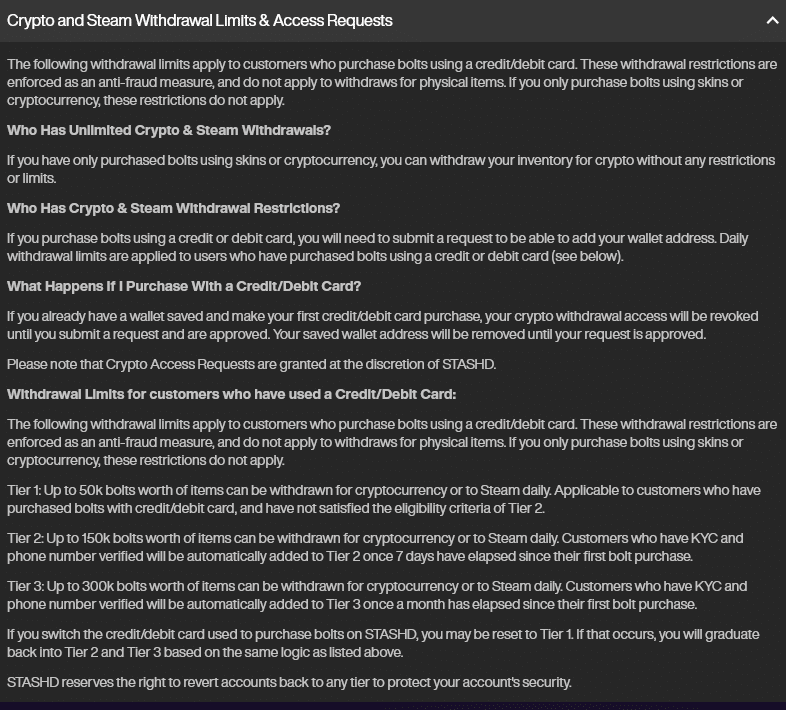
Should you transfer actual money to acquire Bolts and engage in case openings, you will be subject to phased withdrawal conditions and can only retrieve your funds in the form of cryptocurrency or skins. This information is not clearly communicated to users when they are initially encouraged to purchase Bolts. The ease of entry coupled with a more restrictive withdrawal process are intentional design elements.
The sole prerequisite for participation is a payment method, whereas the hurdles to exiting the system (especially if using a common deposit method like a debit card) include delays, demands for identification, and the need for a crypto wallet, none of which are disclosed at the point of initial transaction.
How STASHD’s Versus Modes Operate and Why They Spark Worry
The discourse surrounding lootbox gambling is fraught with disagreement and remains unresolved. The specific format of case battles, however, allows for less interpretative flexibility.
STASHD enables participants to engage in direct case-opening competitions across four distinct formats: Crazy Mode, where the losing party forfeits everything; Shared Mode, where participants distribute their revealed items; Group Uncasing, designed for collective openings among companions; and Terminal Mode, where the ultimate round determines the victor. Individual contests can involve anywhere from two to four players. Users also have the option to compete against an AI opponent.
Users pay an entry fee using Bolts (which can be acquired with debit/credit cards). Both participants then open an item case. The case containing the item of greater value secures the pooled rewards. According to the legal definition of gambling in most nations:
- Payment: Bolts expended to join the contest
- Uncertainty: Result determined by the “Provably Fair” lootbox system
- Reward: The victor claims all (or, in Crazy Mode, the vanquished party takes everything)
A typical instance of case-opening often sparks debate regarding its classification as gambling, but integrating a battle mode (even against computer-controlled adversaries) effectively transforms it into a game of chance on the platform. The fact that the platform has not introduced games like Dice or Plinko, which are overtly gambling-focused, does not negate the gambling nature of its existing battle modes.
The prizes are distributed as skins, possessing a Bolts valuation, which subsequently can be converted back into skins or cryptocurrency.
STASHD’s Policy on Age Relies on Parental Consent, Not Verification
It has been established that Fnatic, through STASHD, accepts real currency, transforms it into digital assets, and provides a direct competitive experience that would generally satisfy the legal criteria for gambling in numerous jurisdictions. The subsequent inquiry then becomes: who is authorized to engage with this offering?
STASHD’s terms and conditions state: “Individuals under the age of 18 or those not legally capable of entering into agreements in their jurisdiction of residence must obtain consent from their parents or legal guardians to utilize the Service.”
This policy hinges on parental authorization, not rigorous age validation or identity verification protocols. There is no enforced system to confirm that permission has actually been granted or that the individual making a purchase is genuinely who they claim to be. A minor, aged 13, possessing their parent’s credit card details, could begin using the service within minutes. Furthermore, the terms do not specify any regions where use is prohibited (which aligns with the absence of mandatory identity verification).
STASHD does, however, incorporate a self-exclusion feature. Self-exclusion is not a functionality typically found on platforms designed for fan interaction. It is a tool, often mandated by regulatory bodies, for products classified as gambling. The very existence of a self-exclusion mechanism acknowledges that the product inherently carries a recognized potential for harm to susceptible users.
The self-exclusion guidance reads: “Our objective is to support your responsible enjoyment of the website. If you feel the need for a break, self-exclusion offers a straightforward way to safeguard your experience and maintain its enjoyable nature.” This statement represents the full extent of responsible gaming communication available across STASHD’s FAQ and terms documents.
STASHD includes a ranking system that awards bonus Bolts weekly to users who have accumulated the most points.
The method to earn points and demonstrate ‘prestige’ involves financial expenditure. Therefore, to ascend the rankings and display prowess to the community, one simply needs to… spend money and participate in battles.
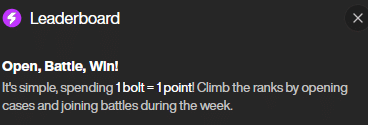
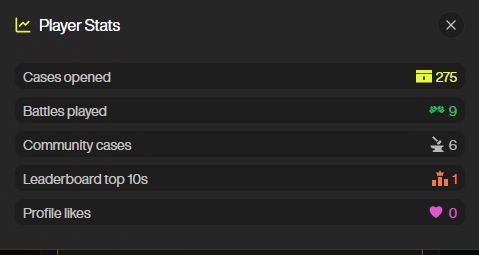
The leading participant currently holds 92,248 points (on a four-day sequence), which, calculated at the most economical rate of 100,000 bolts for $749.99, suggests spending in that approximate range. Please note: this figure represents the value spent on engaging in battles and opening cases, not necessarily the actual amount deposited.
Within that timeframe, the user has unboxed 275 cases and engaged in nine battles.
STASHD By Fnatic Stands Apart From Mere Sponsorship Arrangements
The Fnatic name has a history of engaging in gambling alliances and commercial agreements, with Dafabet, Betify, and Skinrave being among the partners previously featured prominently on the celebrated organization’s team kits.
In sponsorship arrangements, a degree of separation exists between the organization and the product, which, when issues emerge, affords room for strategic maneuver. However, accepting sponsorship funds from an entity versus directly receiving money from your own audience represents fundamentally distinct commercial strategies.
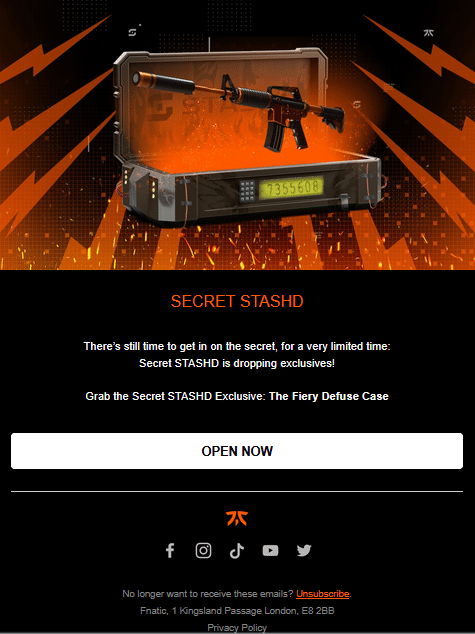
The phrase “By Fnatic” is situated directly beneath the STASHD logo, and the organization’s signature black and orange hues are prevalent across the entire homepage. Fnatic’s financial records from 2024 reveal a £4.5 million deficit, suggesting significant commercial pressures. With Valve having restricted opportunities for skin sponsorships following a policy adjustment in December, teams are actively pursuing alternative income sources in an already challenging economic climate. Nevertheless, these circumstances do not alter the nature of what has been developed here.
Fnatic holds a position on the recently established UK Esports Committee, which is tasked with collaborating with the British government to foster constructive policy evolution. It stands as one of the most recognizable esports entities across various gaming titles. The decision to introduce a product with such limited safeguards (yet a high potential for adverse effects) raises significant ethical questions.
CS2 Cosmetics Beyond a Counter-Strike Audience
The controversy might be less intense if this discussion were confined solely to the Counter-Strike community. CS possesses a long-standing and rich tradition involving cosmetic items. Its player base is culturally accustomed to practices such as case opening, item trading, skin betting, and the ambiguous zones surrounding them. As previously noted, gambling sponsorships specifically targeting the CS audience are primarily aimed at this demographic.
In reality, the extensive reach of the Fnatic brand encompasses games like VALORANT, League of Legends, Rainbow Six Siege, and includes a network of content creators active across numerous titles. Each of these games caters to a distinct demographic and exhibits varying attitudes and policies concerning gambling. Riot Games, for instance, maintains significantly stricter sponsorship regulations regarding gambling across its titles compared to Valve.
The virtual containers within STASHD offer CS2 cosmetic items. There is no compulsion to engage with the item ecosystem itself at any point. A user can deposit currency and withdraw in cryptocurrency. Bolts merely function as a digital currency whose value is pegged to CS skins. The affiliation with Counter-Strike does not restrict who can access the product.
Sam Matthews, Fnatic CEO, strategically positions Fnatic commercially as having “profound connections with highly sought-after, technologically astute, younger demographics.” This is the CEO’s own portrayal of the organization’s fan base. Consequently, by its very nature, it targets the precise demographic that STASHD is promoting to. A 14-year-old League of Legends enthusiast, having never previously engaged in a case opening, can effortlessly access STASHD, spend real money, and participate in a case battle against another player or a bot within moments.
STASHD’s Stated Purpose and Actual Function Are Not Aligned
The strong negative reaction to STASHD mirrors typical anti-gambling sentiments observed among esports enthusiasts. Adults participate in gambling. Adults open lootboxes and engage with casino-style products. The anti-gambling stance is often an easy one to adopt.
Cosmetic items and lootboxes represent a market segment that a portion of Fnatic’s fan base interacts with (some with enthusiasm, others with disapproval), so from a business perspective, it seems logical to aim to capitalize on this.
The core issue here is that the company operates a product with the potential for substantial gambling-adjacent harm (or, at minimum, consumer detriment) to its own youthful audience.
The service accepts actual money, transforms it into digital assets, allows withdrawal in cryptocurrency, and enables users to effectively engage in a game of chance to augment their balance.
It incorporates features designed to encourage participation (such as free item drops and a leaderboard where points are accumulated through active use of the service), and the sole requirement for involvement is “parental authorization if under 18.”
The community has legitimate reasons for outrage, but the fundamental concern with STASHD isn’t solely whether it can be classified as gambling. Instead, it lies in the blatant red flags from a consumer protection standpoint. It is engineered to foster an illusion of acquiring and showcasing rare items, all while incentivizing its community to spend as much as possible, with minimal to no protective measures in place.
“Our ambition is for this to feel like a natural continuation of our ethos, something that truly embodies our fundamental identity.” Indeed, Fnatic, you may have accomplished precisely that.
The post The real issue with STASHD by Fnatic transcends its potential classification as gambling