The FIA, Formula 1’s overseeing authority, has implemented further adjustments to the upcoming 2026 rules specifically designed to aid power unit developers in closing performance gaps, a change anticipated to offer struggling Honda additional support.
To prevent a recurrence of the previous regulatory period where certain engine constructors required extended periods to achieve respectable competitiveness, Formula 1 had established what is known as the ADUO framework—Additional Development and Upgrade Opportunities—for the entirely new power units slated for 2026.
Mirroring trends from the previous regulatory phase, Honda, currently collaborating with Aston Martin, finds itself in this predicament, having fallen behind in its development efforts and presenting an engine that currently lacks competitiveness and exhibits initial reliability concerns.
Integrated into the ADUO framework is a tiered system providing extra avenues for upgrades and waivers from power unit cost limitations, contingent on the extent to which a manufacturer’s V6 engine lags behind the established performance standard.
Teams receive increased budget cap allocations and dynamometer operational hours for each 2% deficit they incur; the FIA has now incorporated an extra category into the regulations for manufacturers trailing by 10% in internal combustion engine power, an increase from the prior 8% threshold. Furthermore, an extra allowance of $8 million is granted exclusively for the current year.
| Delta Performance Index deficit | <2% | 2%≤X<4% | 4%≤X<6% | 6%≤X<8% | 8%≤X<10% | 10%≤X |
| Extra Operation Hours granted per ADUO period |
0 | 70 | 110 | 150 | 190 | 230 |
The technical directives specify each particular power unit component eligible for enhancements beyond the standard homologation timeframe via this ADUO mechanism. Nevertheless, ADUO does not offer an instant solution; it remains the responsibility of the trailing manufacturers to advance their development to compete at the forefront, a process that, for Honda, is expected to be protracted.
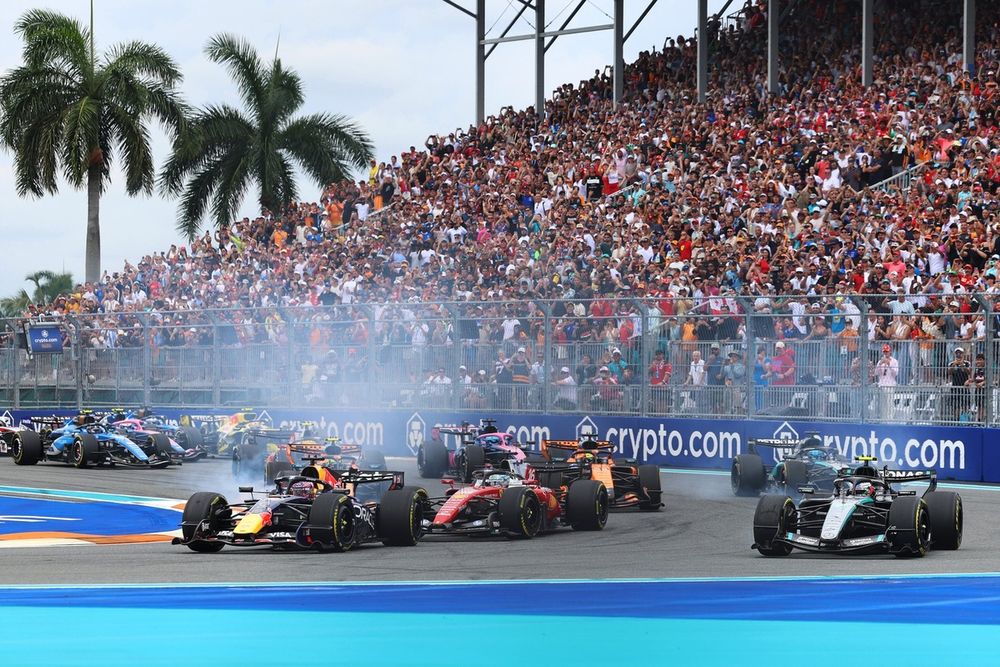
Charles Leclerc, Ferrari, Max Verstappen, Red Bull Racing, Andrea Kimi Antonelli, Mercedes
Photo by: Alastair Staley / LAT Images via Getty Images
Initial ADUO phase now commences following Canadian Grand Prix
Initially, the ADUO allocation was contingent on performance assessments conducted at three specific junctures during the season, occurring subsequent to rounds six, twelve, and eighteen. However, due to the cancellation of the events in Bahrain and Saudi Arabia, the FIA has modified this timeline. The inaugural assessment point will now occur after round five, specifically Montreal’s Canadian Grand Prix taking place later this month, succeeded by round eleven in Hungary and round eighteen in Mexico.
| ADUO period | Competition rounds |
| Period 1 | 1-5 |
| Period 2 | 6-11 |
| Period 3 | 12-18 |
The FIA communicated that both the ADUO timeframes and its methodology for performance evaluation are subject to further alterations should circumstances warrant them.
The governing body affirmed that “these intervals for additional development opportunities are subject to modification by the FIA should there be any notable alteration to the racing schedule.” It further added that “the suggested 2% benchmark and the subsequent determination of the internal combustion engine’s performance index will be confirmed or revised once current collaborations between power unit suppliers and F1 teams concerning real-world ICE performance metrics are concluded.”