The decade-long agreement to host the Spanish Grand Prix in Madrid—taking the mantle from Barcelona as that event shifts to an alternating yearly format—represents Formula 1’s newest push to integrate its racing events directly into bustling urban hubs.
Over the course of 57 laps, competitors will navigate a highly complex, dual-natured track that presents a steep learning curve for both racers and engineers.
Early visual layouts of what has been dubbed the “Madring” triggered divided opinions. There were widespread concerns that relocating the Spanish GP from Barcelona’s dedicated racing facility to the Valdebebas district close to Madrid’s primary airport would result in another uninspiring street track—a temporary concrete labyrinth destined for neglect. To find a precedent, one only needs to recall Spain’s own short-lived Valencia Grand Prix, which burned out quickly and left behind a deserted, unused circuit.
However, our initial on-site inspection in June indicated that the layout—initially drafted by Dromo and completed by Tilke—is far from those worst-case expectations. While it avoids being a dull disaster, it remains completely distinct from any current venue on the F1 schedule.
A severe test of driving skill?
Because the main straight and starting grid sit near the IFEMA exhibition complex and utilize municipal roads, the opening sector features a stop-and-go rhythm akin to street venues like Singapore or Miami.
In contrast, the newly constructed section on the former site of the Mad Cool music festival gave creators complete freedom. This zone merges demanding medium- and high-speed turns with significant elevation changes and banking variations, proving that the Madring is not a boring, repetitive track and will demand absolute concentration from the drivers.
The circuit’s signature feature, prominent in official marketing and event posters, is “La Monumental.” This sweeping, high-speed banked turn boasts a steep 24% slope, the highest permitted. Stretching over 550 meters, it eclipses Zandvoort’s final corner in length as it sweeps through a 270-degree curve at the northern end of the custom-built section.
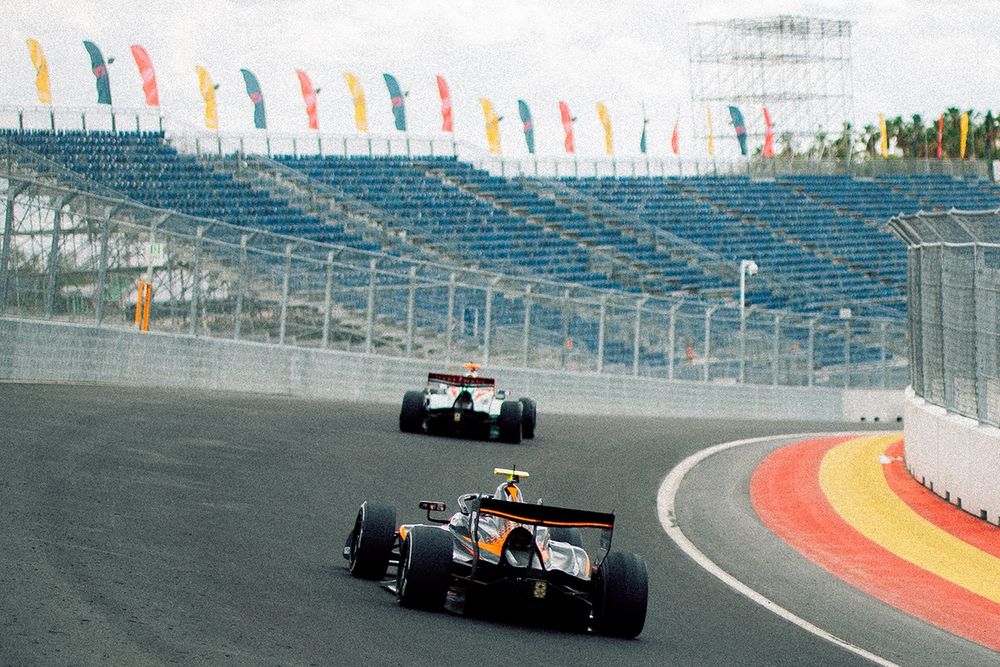
The dramatic banking of La Monumental features constantly shifting slopes and elevations
This massive turn, bordered by an external grandstand, is incredibly striking up close due to its varying slope, radius, and elevation, making it unlike conventional banked corners on the F1 tour or typical oval designs. Lacking traditional run-off areas, it is instead protected on the outer edge by a SAFER barrier system.
“It is an incredibly unique turn,” Charles Leclerc observed after driving it during a dusty promotional run with Ferrari. “I think we will need serious courage during qualifying because we’ll be pushing right to the absolute edge.
“I really think this could turn into one of the year’s most celebrated corners, particularly with the spectators right there in the stands. It will elevate the whole atmosphere. There is no doubt that total dedication is required here.”
Exiting that turn leads directly into a series of rapid switchbacks with minimal margin for error. As a disruption-heavy Formula 3 test run indicated, mastering the track during its debut season will be a formidable task.
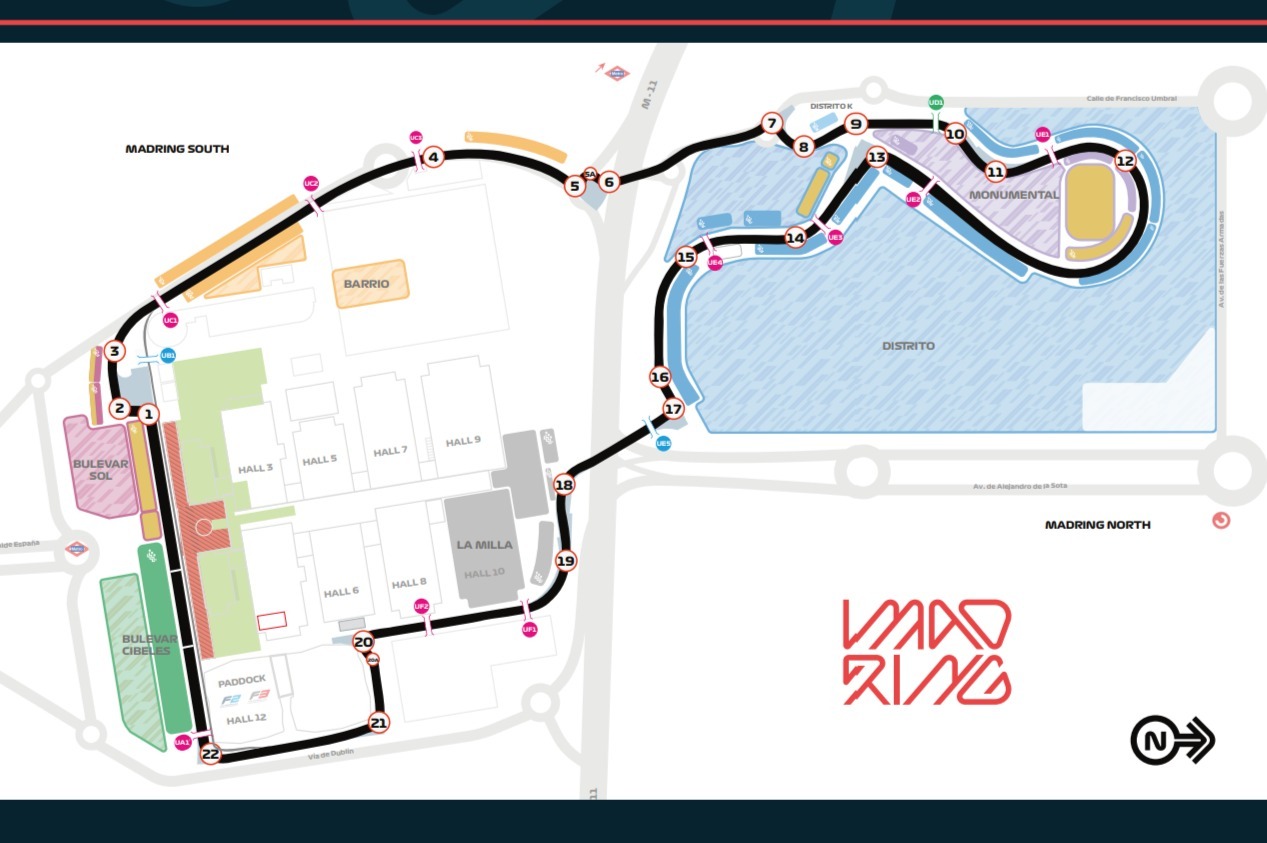
Track layout of the Madring
Will passing prove difficult in Madrid?
Initial feedback implies that while the Madring might not become everyone’s preferred track, it will provide an engaging and rigorous challenge for qualifying. However, whether it can produce exciting wheel-to-wheel racing remains to be seen. With numerous heavy braking areas, the energy-regeneration demands should be moderate. Passing looks like a tough task, with the run between Turns 3 and 5 offering the clearest chance.
“It will certainly be a demanding circuit,” Leclerc remarked carefully. “As for passing opportunities, I’m skeptical we’ll see a lot of them, though I hope my assessment is incorrect. Nevertheless, the thrill of qualifying and the sheer test of driving here will make it one of the season’s highlights.”
The advantages Madrid holds over Barcelona’s logistical challenges
Madrid’s primary selling point is transit convenience. Not only is the venue a short drive from the main airport, but it is also integrated into the city’s vast subway and regional rail systems. Event planners guarantee smooth transit to the track from any part of the city—a contrast to the recurring transit bottlenecks experienced by fans in Barcelona.
This setup aligns perfectly with the modern model favored by F1’s leadership: a city-based event woven directly into a major tourist destination, featuring excellent public transport, eco-friendly transit options, and abundant space for high-end hospitality suites.
“It is common knowledge that traveling to and from a classic, rural racetrack can be incredibly frustrating. In contrast, we feature a subway link to the south and commuter rail services to the north, offering unmatched ease of travel,” stated Carlos Jimenez, COO of IFEMA. “These rapid, direct transit routes were built to link the city center to the airport efficiently. Consequently, we believe the spectator commute will set a new standard.
“While this accessibility is a huge asset, it also means we must elevate our overall event experience. If we fail to engage them, attendees will simply head straight back to urban dining and lodging, as we are directly competing with the attractions of the city center itself.”
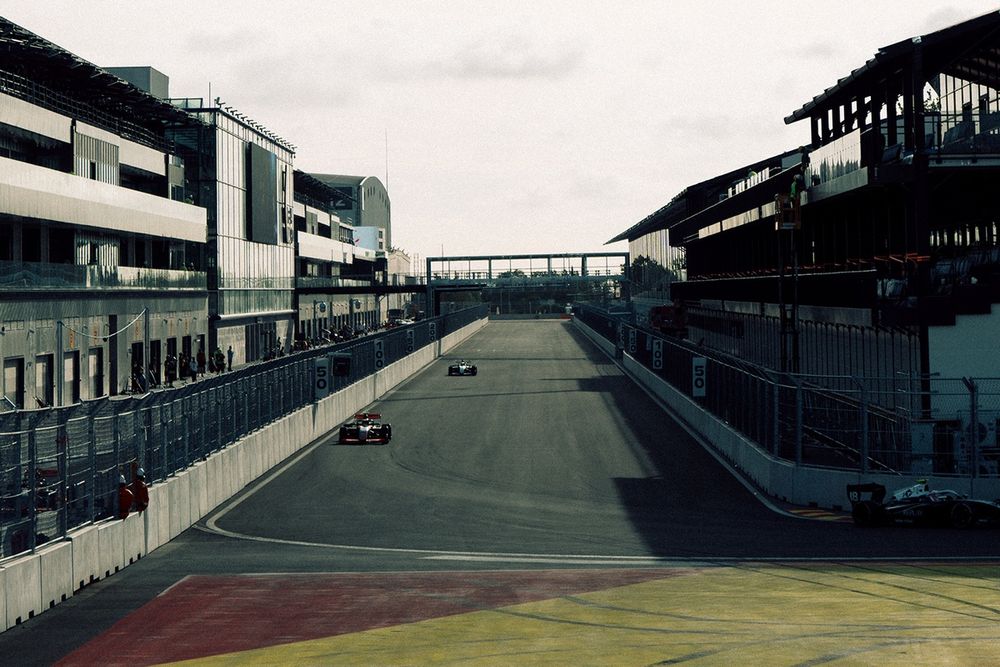
A track evaluation was carried out by Formula 3 at the venue in late August
Photo by: Madring
It remains to be seen if Madrid can deliver a seamless debut event for up to 110,000 fans. Recent inaugural races in locations like Las Vegas and Miami have demonstrated that the first year is always a learning experience. Madrid’s return to the F1 calendar will almost certainly face some initial growing pains, but local organizers claim they are fully prepared to address those challenges.
“The task is monumental,” admitted Luis Garcia Abad, the event’s managing director and former manager to Fernando Alonso. “Even with my 25 years of experience in Formula 1, the sheer scale of details that require monitoring has been eye-opening.
“In consulting with other event hosts, it is clear that constructing an event from the ground up always presents identical hurdles. Fortunately, the IFEMA infrastructure resolved many issues immediately. Although the track had to be built, we already had access to power, high-speed Wi-Fi, and a direct subway station right outside. Creating this setup at a remote track would be incredibly difficult, but utilizing this pre-existing infrastructure allowed us to make it happen.
“Our focus now is to provide the highest quality experience possible for our visitors.”
Your feedback is valuable to us!
Tell us what kind of content you want to see going forward.
Participate in our survey
– The Team at Autosport.com