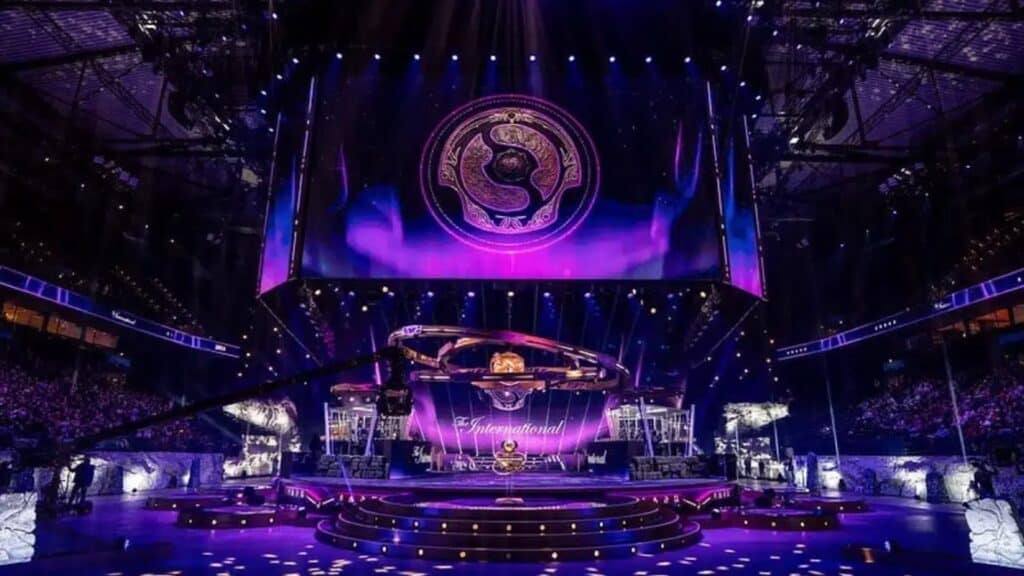
Featuring the globe’s finest 16 Dota 2 rosters, The International concluded with Team Vision claiming the Aegis of Champions. While the official tournament stakes sat at $3.32 million, the ten most successful traders on Polymarket collectively pulled in upwards of $5.3 million.
Securing $1.46 million, Team Vision added their name to the historical roster of champions stretching back to 2011. This sum is a far cry from 2021, when the tournament’s financial rewards peaked at an unprecedented $40 million, driven by Valve allocating 25 percent of all Battle Pass cosmetic sales directly to the event’s bounty.
However, Valve abandoned this funding strategy in 2023, opting instead to release game updates more evenly across the year, which triggered a massive decline in the championship’s payout.
Due to the dwindling professional rewards and the rapid growth of speculative platforms, individuals can now find greater financial success trading on match outcomes than actually competing in them.
Focus on the market, not the matches
The primary driver of earnings was active position trading rather than simply betting on final results. Throughout the competition, 21,936 distinct Polymarket wallets participated in the action, with 5,004 of those users generating more than $7.5 million by dynamically entering and exiting positions.
According to data compiled by Predictbook, the remaining 16,932 participants held their positions until the final whistle, resulting in an aggregate net loss of $7,611,971.
“Essentially, 77% of the participants tied their financial fate directly to match results, effectively subsidizing the other 23% who focused strictly on market fluctuations,” explained Afik Rechler of Predictbook. “In the end, possessing deep game knowledge proved far less lucrative than savvy market trading.”
A single user managed to secure upwards of $400,000 solely through high-speed position trading. This user executed just 17 trades across six specific markets, completing their entire run in under 13 hours.
A select few control the trading activity
An elite group of 1,640 wallets committed $157,553,967, which represented more than 86% of the aggregate transaction volume. The top 220 portfolios—comprising roughly 1% of the total user base—were responsible for 72.8% of the value. Impressively, a single account single-handedly drove over $21 million in activity, constituting about 12% of the entire volume on Polymarket.
These figures point to a heavy presence of algorithmic software, where bots execute rapid-fire trades during live broadcasts to exploit tiny price shifts or capitalize on market maker incentives.
In contrast, everyday esports fans attempting to guess match winners typically lost money. Among successful non-professional betters, the median profit was a mere $4.84, whereas the median unsuccessful participant suffered a loss of $23.15.
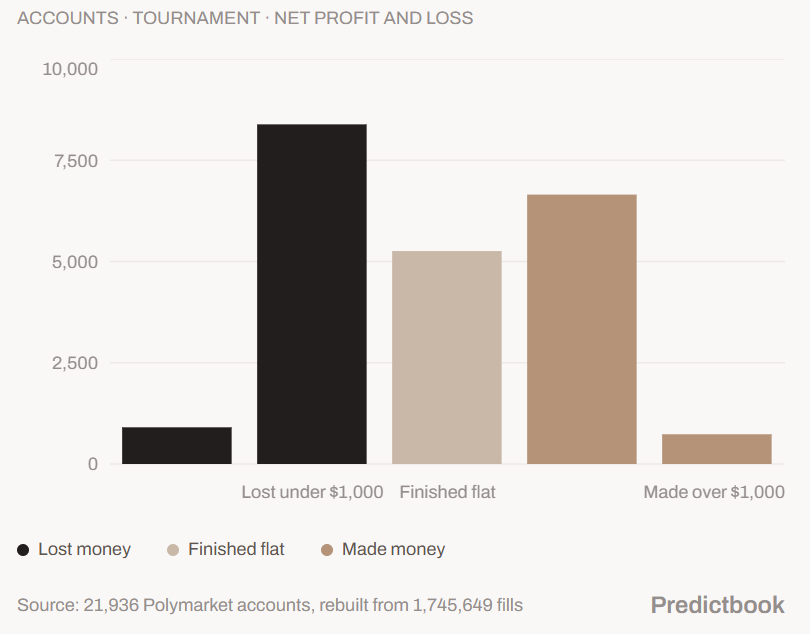
These modest individual deficits served as the primary funding source for automated setups that sweep up price differences for risk-free gains. Across the event, 8,836 wallets dropped under $1,000, while 906 saw losses exceeding that threshold. Additionally, 5,258 users broke even, and 6,652 realized modest gains up to $1,000. The remaining bulk of the profits was split among just 734 high-performing accounts.
Platforms secure massive payouts through transaction fees
Findings from Predictbook also reveal that participants transacted a combined $182 million across both Kalshi and Polymarket during the competition, with the latter capturing a massive 90% share of that total.
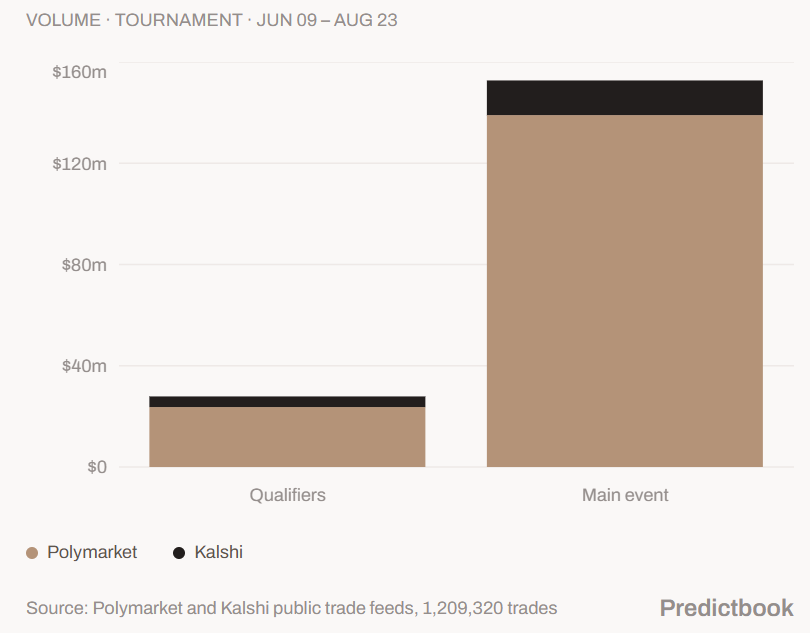
Although Kalshi has experienced a notable surge in competitive gaming speculation this year, it remains well behind Polymarket. While Counter-Strike 2 and League of Legends generate the bulk of activity across both sites, Dota 2 speculation is heavily concentrated on Polymarket.
Consequently, Polymarket collected upwards of $2.3 million in processing fees over the duration of the matches, whereas Kalshi brought in approximately $450,000.
Traditional athletic events still represent the bulk of transaction volume on these exchanges, even though—similar to this tournament—much of that activity is artificially boosted by automated algorithms. In order for these corporate-run bots to remain lucrative, they rely on a steady influx of capital from recreational users.
The legal landscape also shifted this week as the Ninth Circuit Court of Appeals issued a unanimous decision against Kalshi. Because the Third Circuit had previously sided with the platform, this discrepancy establishes a formal circuit split that may trigger a Supreme Court review. With New Jersey already appealing the Third Circuit’s ruling to the nation’s highest court, the ultimate legality of athletic wagering on prediction platforms hangs in the balance.