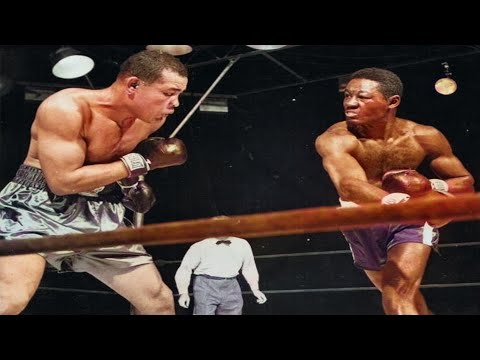
On September 27, 1950, at Yankee Stadium, Ezzard Charles defeated Joe Louis to secure the heavyweight acknowledgment that had long eluded him. While he triumphed on the judges’ scorecards, capturing the hearts of a public still devoted to Louis proved to be a far greater challenge.
Following a historic run of 25 straight title defenses, Louis had stepped away from the sport the prior year. However, a massive tax liability exceeding $500,000 forced his return to the ring. Although Charles had claimed the vacant National Boxing Association title by defeating Jersey Joe Walcott and went on to defend it three times, both the New York authorities and The Ring magazine refused to acknowledge his status. Consequently, Louis entered the bout as a 2–1 favorite, even though he had not fought professionally in over two years.
The contest required Charles to tackle a puzzle that had baffled previous generations of heavyweights: preventing Louis from planting his feet to deliver his devastating right hand. Charles countered this threat with a sharp jab, rapid-fire combinations, and constant movement following every exchange. Although Louis pursued him, the 29-year-old champion seldom lingered in one spot long enough to receive a concentrated beating. Louis managed brief moments of success during the fourth and twelfth rounds, but he was unable to parlay these flurries into sustained dominance.
Weighing in at a career-heavy 218 pounds, Louis held a substantial 33-pound advantage over the smaller Charles. This disparity highlighted Louis’s sluggish pursuit, yet size alone does not account for the outcome. Charles repeatedly forced his opponent to reset. With each passing round, the ex-champion’s formidable punching power became increasingly irrelevant, as he could seldom position himself to land clean shots. For Charles, who had previously vanquished elite light heavyweights without ever getting a shot at the 175-pound title, this heavyweight victory was engineered using the precise technical skills he had honed against swifter, lighter foes.
In a bout featuring no knockdowns, the three judges unanimously awarded the 15-round decision to Charles with scores of 10–5, 12–3, and 13–2. In front of a crowd of 22,357 onlookers, Louis experienced his first loss since 1936, marking the sole defeat of his career in a world championship matchup.
While the official scores clearly decided the winner, they did little to resolve the emotional weight of the outcome. A large portion of the audience had gathered in anticipation of Louis reclaiming his former glory, but Charles’s methodical breakdown of the legend provided no such fairy-tale ending. This disappointment largely accounts for the lukewarm reception Charles received, despite executing a textbook performance and convincingly defeating the highly regarded challenger. Ultimately, the painful sight of a fading, beloved icon overshadowed the brilliant display put on by the victor.
Following the bout, Charles finally secured recognition from both the New York athletic commission and The Ring magazine, though British authorities held out by recognizing Lee Savold until Louis knocked him out in 1951. Louis’s earnings of $100,458 did little to alleviate his massive tax burden, forcing him to continue boxing, though he would never reclaim the crown. Charles had undeniably earned his place at the top, yet he remained unable to shift the public’s longing gaze away from the former champion.