Audio playback of this article
Approximate duration: 3 minutes
This audio feature is produced using artificial intelligence. Errors in pronunciation may happen. In collaboration with our partners, we are consistently evaluating and refining the output.
Shouts declaring “Hughes, you suck” echoed throughout Rogers Arena when former Vancouver Canuck Quinn Hughes stepped onto the ice for his initial appearance following a major trade that relocated him to Minnesota.
Loud jeers and taunts filled the venue every time Hughes possessed the puck during Sunday’s contest. Furthermore, whenever Hughes hit the ice surface, spectators in the crowd responded with bursts of applause.
This marked the American-born blueliner’s inaugural match opposing Vancouver, the franchise that originally selected him with the seventh overall pick in the 2018 draft.
Previous general manager Patrik Allvin dealt Hughes away on December 12, 2025, following reports indicating the defender had no plans to execute a long-term contract extension to remain in Vancouver past 2027.
In exchange for the 2024 Norris Trophy winner, recognized as the top defenceman in the NHL, the Canucks acquired centre Marco Rossi, forward Liam Öhgren, blueliner Zeev Buium, and Minnesota’s 2026 first-round draft selection, which Vancouver subsequently utilized to pick Adam Novotny at 24th overall.
Following the conclusion of the previous season, Jim Rutherford, the team’s former president of hockey operations, stated that Hughes’ departure was not triggered by Vancouver’s poor performance, remarking that “he was leaving anyways.”
Rutherford highlighted the inclination among a segment of American athletes to compete within the United States rather than in Canada.
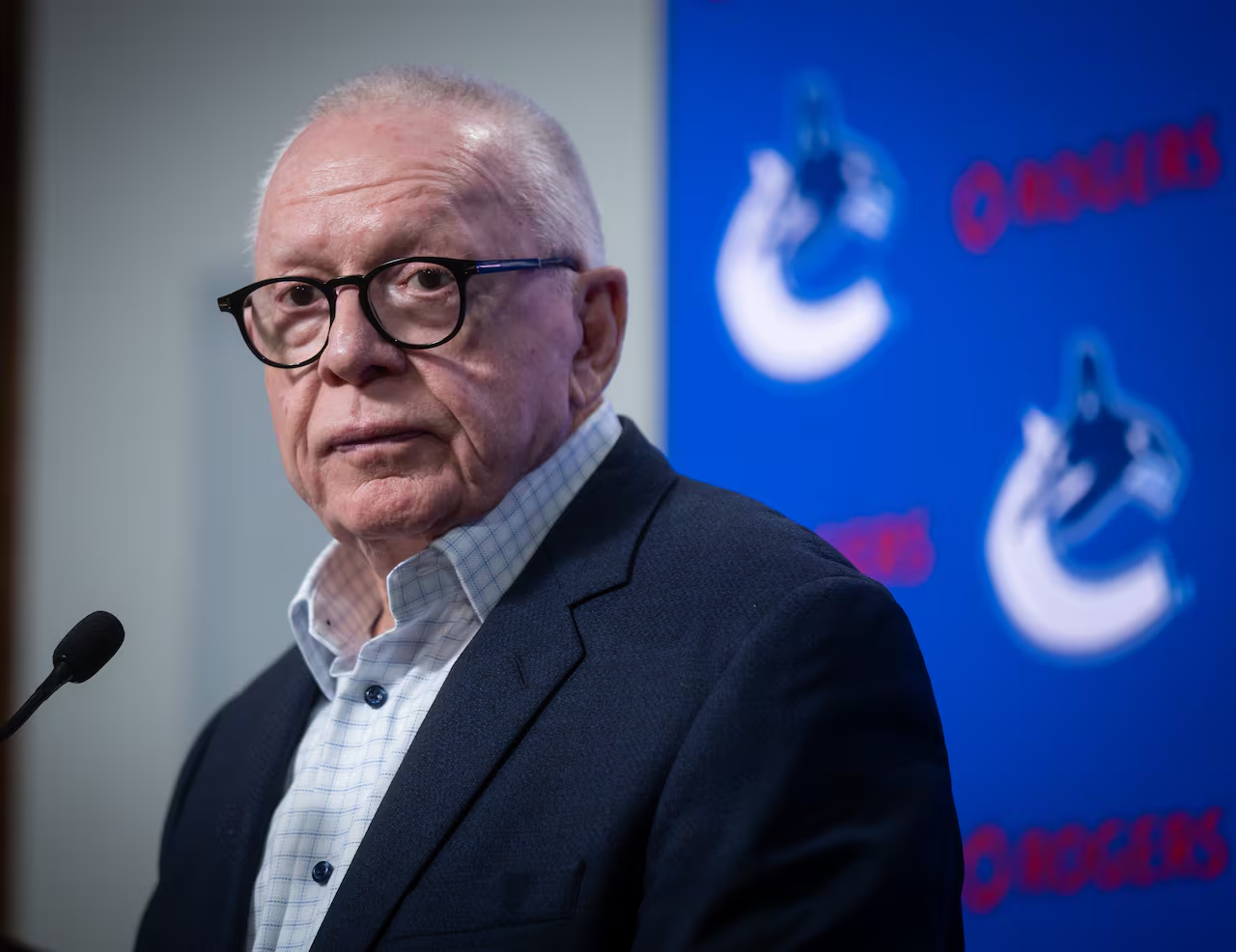
Former Canucks president of hockey operations Jim Rutherford notes that Hughes departed during a period when several American players preferred competing in their home country. (Ben Nelms/CBC)
Additionally, he mentioned that the franchise intended to reorient its strategy toward constructing a roster around its emerging talent pool.
“We have several promising young players joining us. Because of that, the franchise is moving in a positive direction. As for how much time it will take? I can’t say for sure, that would just be speculation,” he remarked.
Reaction from the fanbase
According to a survey published on X in September by the regional sports program Donnie & Dhali, approximately 66 percent of participants indicated that the Canucks ought not to recognize Hughes during the visit from the Minnesota Wild.
Nevertheless, the team broadcasted a tribute video in the opening frame, receiving a blend of cheers and jeers from the crowd before ultimately culminating in a standing ovation.
Vancouver headed into Sunday’s contest having sustained double the total amount of losses compared to Minnesota.
The host squad held an underlying record of 2-9-1, whereas the Wild held a 7-3-2 record.
Prior to Saturday’s contest versus the Seattle Kraken, Hughes commented on his highly anticipated return to Vancouver.
“Regardless of whether the crowd boos or reacts differently, my feelings about the city and my deep appreciation for my time there remain unchanged,” Hughes expressed to media members.
Over 459 regular-season appearances in a Canucks uniform, Hughes accumulated 432 points, setting a franchise record for scoring by a defenceman.
Extension remains unsigned for Hughes
At age 27, Hughes is playing through the closing year of his six-year deal valued at $47.1 million USD, having been qualified to ink a new contract extension since July 1.
However, he has not yet committed long-term to Minnesota.
The franchise lost the opportunity to secure Hughes on an eight-year agreement prior to September 16, when league regulations lowered the maximum allowed term length to seven years.
Cale Makar, widely regarded as one of the elite blueliners in professional hockey, agreed to an eight-year deal boasting an average annual value of $20.4 million USD back in August. This marked the very first contract in NHL history to top an annual average value of $20 million.
When Makar signed his extension, prominent NHL analyst Elliotte Friedman suggested that Hughes might be in line to secure a comparable yearly salary.