Following the Formula 1 Brazilian Grand Prix on Monday, Oscar Piastri and Mark Webber issued a shared statement indicating that Webber and Ann Neal would cease their management of the 25-year-old McLaren driver. While the timing of this announcement may be unexpected – occurring now instead of at the conclusion of the season – it had been anticipated for a while.
A clear indication came from Piastri during the pre-season testing in Bahrain. Although I was primarily interested in his thoughts about the 2026 cars – which elicited a revealing smile from Piastri – an Australian colleague initiated a discussion regarding Webber’s evolving role.
“There wasn’t anything specific, we just made a decision for things to look a bit different,” Piastri remarked on that notably chilly February evening in the Bahrain paddock. “Mark is still very much involved and I’ve been in contact with him a lot over the last few weeks. He just won’t be trackside as much anymore. So that’s really the extent of it. There was nothing specific that triggered it.”
While that last statement holds a degree of truth, it is evident that the 2025 season was demanding on various levels – particularly behind the scenes, at least from Webber’s perspective. This was naturally intertwined with the ‘papaya rules’ through which McLaren endeavored to ensure both drivers were treated with fairness, but which also complicated team dynamics at certain points, as Andrea Stella candidly acknowledged earlier this year.
It’s well-known that Webber occasionally expressed dissatisfaction with McLaren’s management of specific on-track episodes, as well as with the rationale behind Piastri’s performance decline during the last segment of the season, ultimately resulting in him missing out on the world title. It’s crucial to highlight, however, that a manager’s role encompasses defending their driver’s interests, albeit through various potential approaches.
Webber, having drawn from his experiences at Red Bull, aimed to prevent Piastri from being typecast as a second driver within the F1 paddock. In a recent discussion with Autosport, former Red Bull team principal Christian Horner even identified this mentality as a significant aspect of Webber’s perspective, one he believes he carried into competitive driving.
“I think probably the difficulty with Mark was, he motivated himself through adversity. He always drove better when he felt that the world was against him,” Horner reflected. “He could see this talent emerging in Sebastian [Vettel], and he was using everything in his locker to try and destabilise that, or to cause any tension in a way that would then fall back in his favour. I think as a team we were learning how to handle these dynamics.”
Watch: Christian Horner on Toto, Abu Dhabi 2021 and Life After Red Bull.
The disparities between Red Bull back then and McLaren today are quite significant. Red Bull was at that time guided by Horner and Helmut Marko, both of whom were no strangers to the political intricacies of F1, whereas McLaren now operates under a more engineering-focused leadership led by Andrea Stella, who consistently affirms the principles he wishes to uphold in racing – including fairness. This results in a different dynamic and suggests that efforts to avoid being categorized as a second driver are interpreted in an entirely different manner.
It should be noted that McLaren has never formally requested Piastri to alter his management, yet Autosport understands that the driver himself, along with some guidance from those in his circle, has formed his own perspective on what he requires moving forward.
In any case, the decision for Webber to step back and primarily operate ‘behind the scenes’ rather than being visible during race weekends was made at the beginning of the year. In retrospect, that marked an initial step towards this separation, which, according to the announcement, has been reached by mutual consent. “Following our reduced trackside involvement this season, we have collectively agreed that now is an appropriate time to bring our management agreement to a close,” Webber stated.
Piastri’s growth and a shifting landscape in the F1 driver market
In addition, it must be acknowledged that Piastri’s circumstances are markedly different now than they were at the onset of his career. Consequently, his requirements from those surrounding him have evolved as well, particularly in terms of his driving experience and the current state of the F1 driver market.
During his earlier years, Piastri relied more on Webber’s expertise as a racing competitor than he does presently. When Piastri made his F1 debut at 21 – and was, as Toto Wolff typically characterizes young drivers, still a “deer in the headlights” – having a trusted individual with extensive experience by his side was beneficial. Someone external to the team focused solely on his best interests and could assist him in steering clear of potential traps.
When Autosport spoke with Piastri in Barcelona during his inaugural season, that was precisely the added value he emphasized: “Mark’s advice was to not underestimate the challenge of F1 and how significant a step up it is, not just from the cars but from everything: the sheer number of interactions required, the media responsibilities, and the sponsor commitments. Everything is much greater than before. I think having him remind me of that prior to the season commenced was comforting, helping me to avoid being taken aback when I arrived. That’s probably been the most substantial aspect.
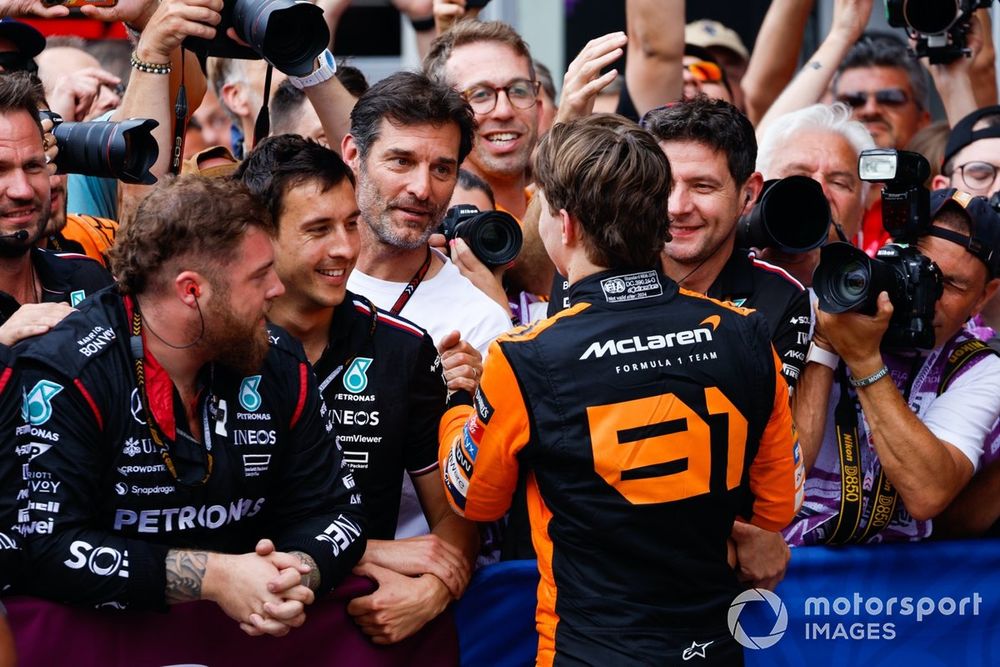
Oscar Piastri, McLaren F1 Team, 2nd position, is congratulated by Mark Webber in Parc Ferme
Photo by: Steven Tee / Motorsport Images
“But he’s very helpful with small driving tips here and there as well, and sometimes thinking of questions for the engineers that don’t even come to my head at the moment.
“He’s still very sharp. He thinks like a racing driver still and is always trying to get the best out of me.”
More than three years later, Piastri has undergone all of this firsthand and, as a result, requires that hands-on mentorship as a driver less than he did during his rookie year. Naturally, this aligns with the notion that a different style of management is now appropriate, accompanied by different priorities.
Furthermore, the landscape in the driver market has evolved. Piastri has a prolonged commitment to McLaren, with a deal that lasts until the conclusion of 2028. There has been considerable dialogue regarding Piastri’s seat this summer, particularly amidst the buzz surrounding Max Verstappen, which has been sensationalized by certain media outlets. In truth, however, the Dutch driver has indicated he is closer to stepping away from F1 than switching teams, meaning Piastri hasn’t been genuinely considering alternate options either.
He noted it was ‘flattering’ for his name to be associated with Red Bull during the summer, but the truth is this path seems closed for the foreseeable future. After all, Verstappen extended his contract, meaning Red Bull – as long as they provide him a competitive car – has its leading driver secured. And with prospects like Isack Hadjar, Arvid Lindblad, and perhaps Nikola Tsolov in the long-term, Red Bull appears more than capable of sourcing its second driver from within its own talent roster.
Also, considering that Mercedes and Ferrari still boast long-term top drivers in Kimi Antonelli and Charles Leclerc, nurturing and strengthening his relationship with McLaren appears significantly more crucial for Piastri than maintaining connections elsewhere, such as through Webber at Red Bull. These two aspects may render the timing of this decision surprising, but not the decision itself to conclude the partnership after Webber had already opted for a more subdued role.
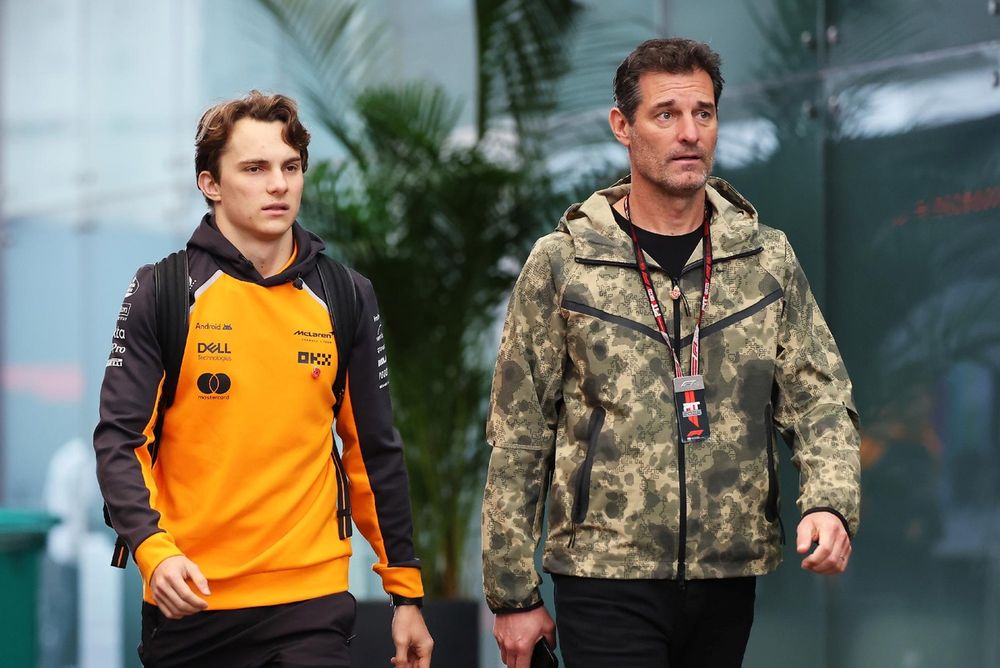
Oscar Piastri, McLaren with Mark Webber
Photo by: Getty Images
Finally, it is crucial to recognize that Webber has significantly influenced the early stages of Piastri’s journey, a fact that should not be overlooked at this juncture. Indeed, Piastri himself acknowledges this, as evidenced by his remarks in the joint announcement: “I’d like to thank Mark and Ann for all their support and guidance over the years. Their counsel has been invaluable, particularly in navigating the early days of my F1 journey. I wish them every success going forward.”
The most pivotal shift, naturally, was transitioning from Alpine to McLaren, culminating in Piastri’s now-iconic tweet. That was a period during which Webber’s ‘us against the world’ mentality, as characterized by Horner, proved especially beneficial. The transition also spared Piastri from the challenges at Alpine, particularly during that timeframe. It is a decision he continues to appreciate, yet this phase of his career demands a different approach, thus clarifying why the collaboration between two of the most recent Australian F1 drivers is concluding.
Webber played a critical role in guiding Piastri to his current status, and the present seventh-placed driver in the championship remains appreciative of that. Nevertheless, he believes that a different approach is needed for the next stage of his career, ideally one emphasizing collaboration within McLaren – and, considering all the aforementioned points, that is quite understandable.
We want to hear from you!
Let us know what you would like to see from us in the future.
Take our survey
– The Autosport.com Team