From the initial tests, racers had consistently voiced concerns, suggesting an incident akin to the collision between Oliver Bearman and Franco Colapinto at the Japanese Grand Prix was inevitable; the Haas competitor’s impact with the barriers registered 50G. This crash resulted from the substantial velocity disparity between the British and Argentine participants, a factor intrinsically linked to the operational mechanics of the current regulations.
Given a predetermined quantity of energy that can be regenerated each lap, every constructor adopts a distinct method for its application – determining the specific locations and techniques for expending and replenishing the battery – often resulting in considerable variations across different racing outfits. This tactical divergence was a contributing factor to the mishap, with both Haas and Alpine employing dissimilar plans in the track segment preceding the Spoon turn.
Indeed, during earlier circuits, Alpine exhibited a tendency for a more assertive reduction in both power and MGU-K output, initiating this process sooner than both the vehicles in front – specifically the Racing Bulls, a team known for its elevated peak velocities – and those following, particularly Bearman in this scenario.
Variations in Power Utilization Between Alpine and Haas
Fundamentally, owing to the engine’s operational efficiency, which is configured to maximize power expenditure and battery replenishment windows throughout a lap, the electric motor in Colapinto’s vehicle started delivering diminished assistance prematurely, compelling him to even shift down, consequently nearing Spoon at a reduced maximum speed compared to his competitors, occasionally by up to 20 kilometers per hour.
Bearman had observed this situation and sought to exploit it, aiming to catch Colapinto off guard before the Alpine driver could deploy his power reserves to protect his position on the extensive straight preceding the ultimate chicane. An additional element merits consideration: on that particular lap, the Argentine racer did not maintain a gap of less than one second to Arvid Lindblad, who was ahead, which would have consequently deactivated his overtake assist and restricted his energy recuperation capabilities.
The confluence of these elements underscored the inherent dangers that the updated regulations pose in specific scenarios. Aware of his superior energy deployment capability in that specific track segment, Bearman initiated his offensive, engaging the energy amplification feature that permits the MGU-K’s 350 kW output to be sustained for an extended period by drawing power from the battery.
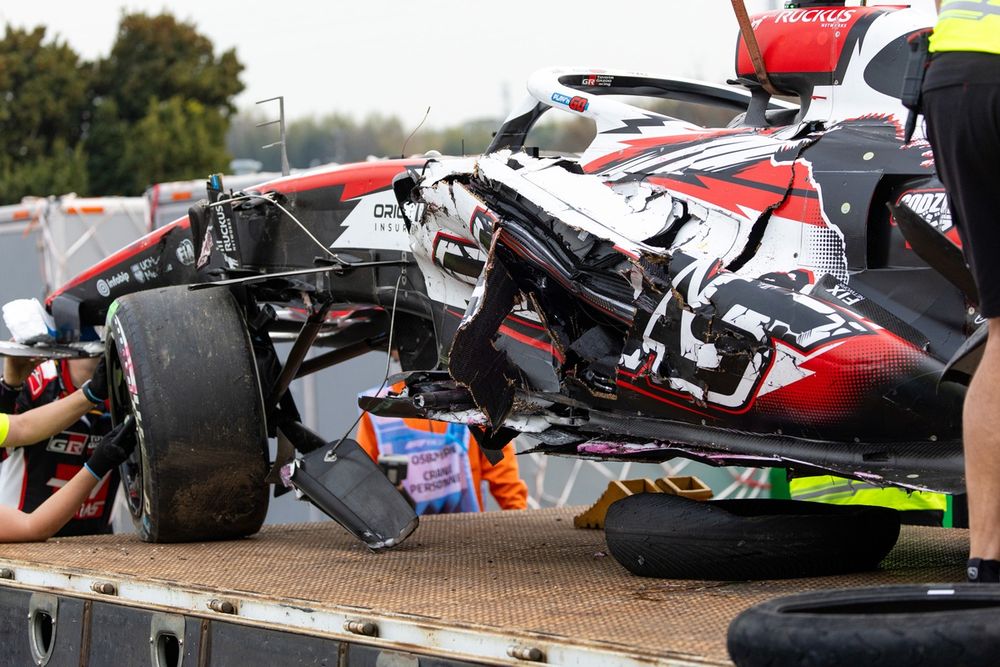
Oliver Bearman, Haas F1 Team car after his crash
Photo by: Kym Illman / Getty Images
Consequently, the velocity disparity observed in earlier laps grew significantly, registering up to 45 km/h based on FIA measurements. “Colapinto bears no blame; his performance was steady at that juncture. It’s simply that our team was utilizing more power in that region; even in preceding laps, we held a 20km/h edge,” clarified Ayao Komatsu, the Haas team principal, post-race. “That prompted his decision to attempt the maneuver. He engaged the power surge, which resulted in a 50 km/h speed differential.”
In essence, the situation resembled a Formula 1 vehicle competing against a Formula 2 counterpart, yet this dynamic also represents a fundamental aspect of the current rules. Possessing an MGU-K of such potency ensures a distinct power advantage, especially when the driver being overtaken lacks electrical assistance, but this capability is not without its hazards.
A scenario unfolded where Bearman was closing in from behind with considerably greater velocity, while Colapinto, ahead, was exclusively dependent on his internal combustion engine, as his electric power unit had ceased providing thrust and was not even regenerating. Cognizant of the need to protect his track position, the Argentine attempted to shut the racing line precisely as Bearman commenced his overtaking maneuver.
This action, under different conditions, might still have been deemed permissible, albeit slightly delayed, but the Argentine driver could not have anticipated such a vast speed variance. When Bearman attempted to steer clear, he veered onto the grass, lost command of his vehicle, and collided with the barriers. Providentially, the British driver sustained merely a superficial knee abrasion, without any bone breaks.
Racers Struggle to Foresee Such Substantial Velocity Discrepancies
“Truthfully, it felt quite peculiar; I was somewhat a vulnerable target. The speed differential, in my opinion, is immensely vast. It’s almost as if one is on an out-lap while another competitor is pushing hard. It’s genuinely unusual. This is a corner we take flat out, and he was over 50km/h faster than me,” remarked the Alpine pilot, who had received a radio alert moments prior indicating Bearman’s impending offensive.
“I believe the situation becomes very precarious when the straights aren’t truly straight and the opponent is cornering, since our trajectory isn’t a direct line; we’re somewhat turning. I think these are aspects to re-evaluate going forward because at times it presents a certain level of peril. Particularly when one cannot gauge the superior speed of the other vehicle, as there’s no mechanism for us to ascertain it. We glance in the mirror once, and abruptly, the other car has already overtaken. You tend to lose your bearings in such instances.”
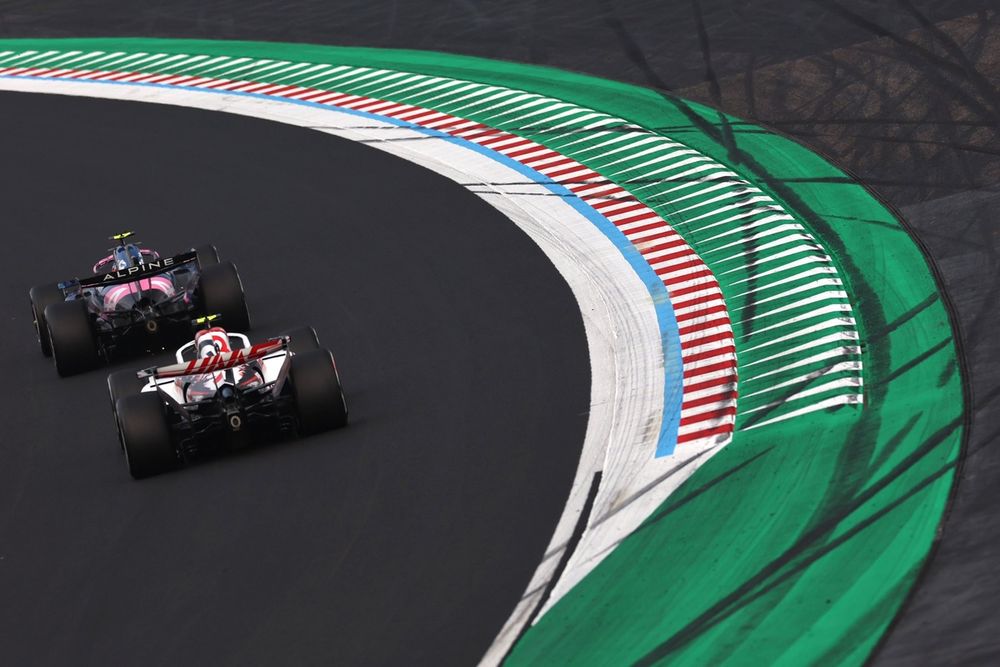
Franco Colapinto, Alpine, Oliver Bearman, Haas F1 Team
Photo by: Alastair Staley / LAT Images via Getty Images
Such significant velocity discrepancies during a competitive engagement were unprecedented, making it challenging for drivers to evaluate the circumstances instantaneously, particularly amidst a direct contest.
“‘Mistake’ is quite a forceful term, frankly. One might describe it as a minor miscalculation, but nonetheless, that closing speed is alarming. Reviewing the GPS data from the preceding lap, one can see it was entirely justifiable and the appropriate choice to attempt the move at that point, but the impact was simply immense,” Komatsu stated.
“This marks only the third event under these regulations, making it an entirely novel experience for him. Thus, I wouldn’t even label it an ‘error.’ Instead, I believe it’s an aspect the F1 community should acknowledge and potentially explore ways to ameliorate, given the potential for a far more severe outcome, wouldn’t you agree?”
This concern has been a subject of conversation for a considerable period, as it is widely understood that the power boost proves excessively potent if an opposing driver possesses low energy reserves or is deprived of electric motor assistance. However, this particular occurrence will serve as the impetus driving teams and the FIA to seriously consider the drivers’ observations to avert such extreme speed differentials.
Through an extensive declaration, the FIA has verified its intention to evaluate the circumstances collaboratively with the participating teams: a conference is scheduled for mid-April to deliberate on potential rule modifications, initially focusing on qualifying procedures, though this matter might also be added to the discussion.