The commencement of Formula 1 races in 2026 brings with it many ambiguities, but one aspect is practically assured: the scene of both Audi cars, despite strong qualifying efforts, losing ground more rapidly than John Lithgow’s character near the conclusion of the film Cliffhanger.
Inadequate starts are merely one symptom of a deeper problem affecting every facet of the Audi power unit’s performance, and the team has acknowledged that there is no immediate remedy – even though the new rules incorporate a system for manufacturers who have fallen behind to catch up. The initial benchmark for evaluation under the ADUO (Additional Development and Upgrade Opportunities) framework might not occur until the Monaco Grand Prix in early June.
Taking Japan as an illustration, Gabriel Bortoleto and Nico Hulkenberg qualified in eighth and thirteenth positions, respectively, but by the end of the opening lap, they found themselves in thirteenth and nineteenth. It is understood that Audi’s power unit features a comparatively large turbo compressor, where the trade-off for higher boost pressure is increased inertia – thus, the boost takes longer to engage.
Beyond contributing to sluggish launches, this also impacts performance throughout the race lap because it places greater demands on the electrical component of the powertrain to deliver the necessary torque while the turbo is spinning up. Given the constraints on how much power can be collected and deployed per lap, this effectively compels the Audi PU to ‘expend’ a portion of that energy to cover deficits in the internal combustion engine’s output, which places it at a disadvantage compared to its competitors.
“The race [in Japan] began poorly,” remarked Mattia Binotto, who assumed the responsibilities of team principal last weekend following Jonathan Wheatley’s departure.
“And this is not an isolated incident, so it is definitively not a strong point for us. Presently, the reason it has not been resolved yet is because it is not an obvious problem to fix.
“However, on the other hand, we know it is a critical priority for our team. Because, again, we had a strong qualifying session, and there is no benefit in securing good starting positions if we lose all those places at the very outset.”
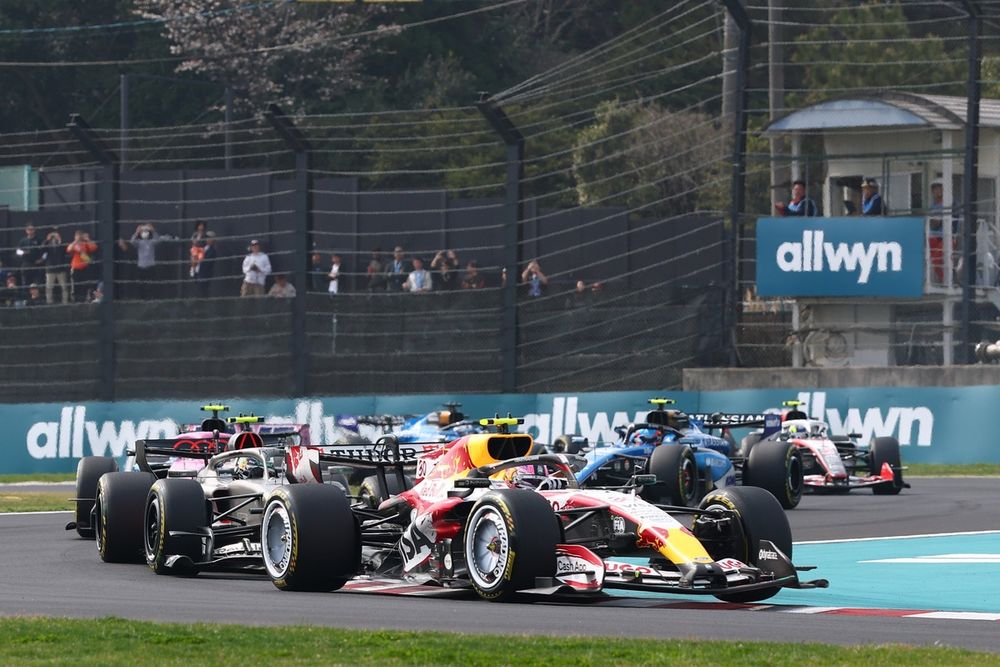
Bortoleto dropped five positions during the Japanese GP start
Image by: Simon Galloway / LAT Images through Getty Images
Audi’s challenge lies in the restricted opportunities for modification, not just because design choices like compressor dimensions are not easily reversed mid-season given the intricate connection between the chassis and engine. While the FIA’s ADUO framework offers some scope for alterations, these are limited in quantity and confined to a specific time period.
Internal combustion engines determined to be between 2% and 4% below the benchmark engine, according to the FIA’s performance metric, are immediately permitted one specific change. Those exceeding a 4% deficit receive additional concessions, including increased dynamometer time and greater flexibility under the cost cap.
However, ADUO is neither an avenue for a quick solution nor was it intended as such. Engine development is a more protracted process than advancing a car’s design, so ADUO is structured to enable a gradual shift, preventing competitive advantages and disadvantages from becoming ingrained from one season to the next.
For this reason, the assessment points were initially set quarterly throughout the season – originally every six races when 24 Grands Prix were scheduled. Now, due to the cancellation of the Bahrain and Saudi Arabian GPs, the precise timing of the first ‘review point’ is under discussion – it could be the Miami GP, which is now the fourth rather than the sixth event, or it might be Monaco.
Therefore, reports circulated this week suggesting that Ferrari has already received an ADUO concession are inaccurate.

Mattia Binotto currently serves as Audi’s team principal
Image by: Jakub Porzycki / NurPhoto via Getty Images
Even when allowances are approved within the ADUO system, their implementation may not be instantaneous.
“The periods required for engine advancement are considerably extended,” Binotto clarified.
“Our evaluation suggests, in my opinion, that the majority of our performance deficit compared to leading teams originates from the power unit, which was not unforeseen. We understood this would represent the most significant hurdle.
“Furthermore, we possess a strategy for improvement. However, engine development, particularly concerning certain design principles, can require more time. It is no coincidence that we have designated 2030 as our target [for contending for the world championship].
“This is because we are aware it will be a lengthy process. And I believe what is required from us now is also patience.
“We hold considerable aspirations and would prefer to witness resolutions within a few races. Yet, occasionally, that simply isn’t feasible.
“Therefore, I believe we must grasp our precise standing as a team, comprehend our initiatives, and importantly, adhere to those initiatives. This is because miraculous turnarounds are unattainable.
“Our purpose here is not to conjure miracles. That is not within our capabilities. Instead, we are here to devise appropriate strategies to tackle issues and to progress moving forward.
“And I believe that outcome is also achievable.”
We want to hear from you!
Let us know what you would like to see from us in the future.
Take our survey
– The Autosport.com Team