The prospects for any contenders unseating current FIA head Mohammed Ben Sulayem this December seem increasingly remote, as it seems none of his challengers will be capable of presenting a qualified team.
Ben Sulayem is vying for a second four-year stint as FIA president during the governing body’s General Assemblies on December 12 in Tashkent, Uzbekistan.
Besides the 63-year-old from the United Arab Emirates, three additional potential candidates have publicly announced their intentions, including former F1 official Tim Mayer, Swiss racer Laura Villars, and Belgian TV personality Virginie Philippot.
All candidates have from October 3 to 24 to submit their proposals, which involves naming a presidential list – a group of nominees who will accompany them in the roles of president of the senate, deputy president for automobile mobility and tourism, and deputy president for sport.
The list also encompasses seven vice presidents for sport; two from Europe and one from each of the remaining regions – MENA, Africa, North America, South Africa, and Asia-Pacific.
Candidates for the aforementioned positions may only be featured on one presidential candidate’s list, and they must all be eligible for the World Motor Sport Council. The list of eligible WMSC member candidates is now public, and significantly, it contains only one potential representative from South America – Fabiana Ecclestone.
Ecclestone, the Brazilian spouse of former F1 head honcho Bernie Ecclestone, is Ben Sulayem’s current VP for the region and is also part of his re-election team, meaning no other presidential candidate can assemble a presidential list that meets all requirements.
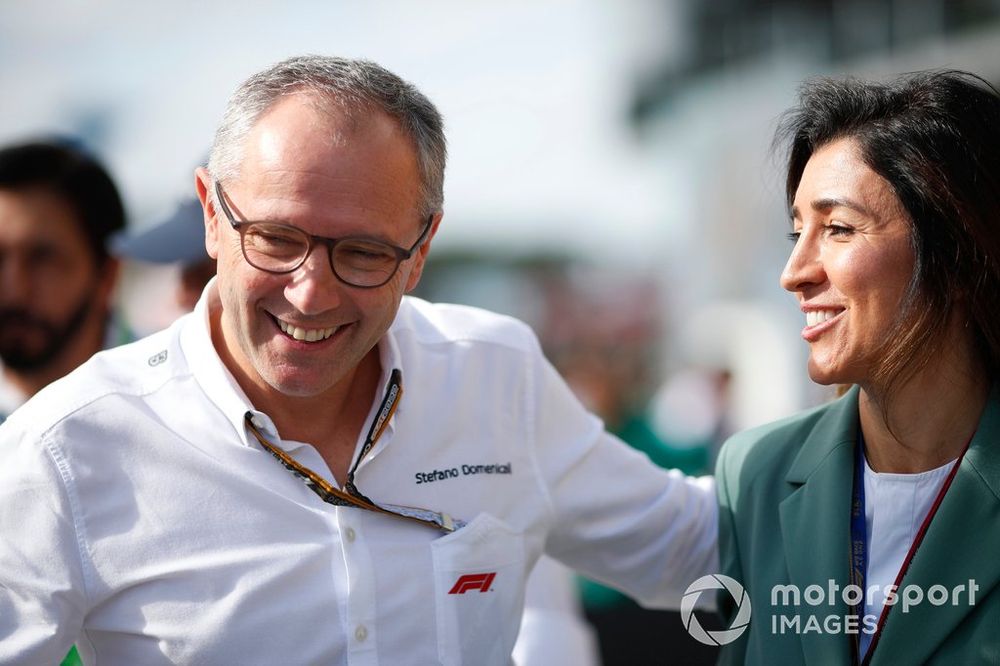
F1 CEO Stefano Domenicali and Fabiana Ecclestone
Photo by: Zak Mauger / Motorsport Images
Candidates for the WMSC can be nominated by their country’s relevant ASN. On June 13, the FIA communicated to all FIA members, specifying a September 19 deadline for submitting such nominations for the council. As that deadline has passed, there’s no other means for members to apply to the council, and thus no other avenue for a South American representative to be chosen by a presidential ticket.
According to the FIA’s published guidelines, WMSC candidates must be under 75 years old on the day of the election, and nothing in their record should cast doubt on their professional integrity.
This indicates that either Mayer and the other presidential aspirants failed to enlist a South American official for the vice president position in time, or such a nomination was proposed but turned down by the designated FIA Nominations Committee.
Ben Sulayem’s South American kingmakers
Due to confidentiality agreements, the FIA cannot reveal such information, but occurrences from earlier this year provide insights into why Mayer’s defeat seemed inevitable all along. His team has been contacted for comment.
In May, rally legend Carlos Sainz Sr voiced interest in running for president. Sainz ultimately didn’t act on those intentions, but the Spaniard’s high-profile candidacy attracted considerable media attention.
Weeks later, a group of 36 Spanish-speaking FIA members and automobile clubs from the Americas sent a joint letter to Ben Sulayem expressing their endorsement for his re-election bid. Fabiana Ecclestone also signed the letter.
Crucially, every president of the 11 South American federations signed the letter, demonstrating that any challenger to Ben Sulayem would struggle to convince one of them to switch allegiance – which was necessary to put forward a WMSC candidate willing to join a different presidential ticket.

Tim Mayer
Photo by: Clive Mason/Getty Images
Mayer recently toured the continent as he travels the globe to gather support for his campaign. “I recently spent a few, extremely busy days in South America visiting our member clubs in Chile, Bolivia and Argentina,” he shared on the campaign website. “The welcome was warm in each country and the topography is individually spectacular, but my visit further reinforced FIA Forward’s opinion that the FIA needs to provide unique solutions to each region’s unique challenges, whether those are in sport or mobility.”
However, with Ben Sulayem also enjoying robust support in Asia and Africa, Mayer had already implied when announcing his candidacy that surpassing the president at his own game of retaining member clubs on his side would be difficult. At the election, each of the FIA’s 149 member countries has an equal vote, divided between the sport and mobility sectors.
“We are in a situation where it’s very important for the member clubs that they see the value, that they see that they can get value,” Mayer stated in July. “To be honest, Mohammed has been quite good at explaining to them what he’s doing for them. But he needs to do it top to bottom, not just here and there for member clubs. It needs to be universal within the organisation.”
Ben Sulayem’s first term proves divisive
In the earlier mentioned letter of support, Ben Sulayem’s advocates credited him with offering strong leadership and boosting the FIA’s financial status after the COVID-19 pandemic. However, the former rally driver has also faced criticism concerning his governance approach.
This year in March, Motorsport UK head Dave Richards accused Ben Sulayem of consolidating power, writing in an open letter that “the governance and constitutional organisation of the FIA is becoming ever more opaque and concentrating power in the hands of the president alone”.
The letter followed a series of high-profile resignations and dismissals within the FIA, including Mayer and CEO Natalie Robyn, technical director Tim Goss, sporting director Steve Nielsen, compliance officer Paolo Basarri, and Deborah Mayer, president of the FIA’s Women in Motorsport Commission.

David Richards and Mohammed Ben Sulayem, President, FIA
Photo by: Mark Sutton / Motorsport Images
The most significant upheaval occurred in April when Ben Sulayem’s running mate – deputy president for sport Robert Reid – resigned due to what he perceived as a “breakdown of governance standards” and “critical decisions being made without due process”. Reid was succeeded as deputy president by Malcolm Wilson, founder of rallying powerhouse M-Sport.
There was also opposition in June against changes to the FIA’s statutes and ethics code initiated by Ben Sulayem, which have expanded the president’s impact on the FIA Senate membership and made the vetting procedure for WMSC candidates more stringent.
At the time, the FIA stated that these changes, approved by a super majority at its General Assembly in Macau, were “designed to further strengthen processes around governance and confidentiality” and would “grant the Nominations Committee more time to examine the eligibility criteria of candidates, and help to ensure consistency and rigour in the electoral process.”
We want to hear from you!
Let us know what you would like to see from us in the future.
Take our survey
– The Autosport.com Team