It happened during the morning of the lavish season presentation at London’s O2 Arena in February when the whole of Formula 1 was taken by storm. It’s been mentioned that during a gathering of the F1 Commission, Christian Horner – who was then the team principal of Red Bull – placed his mobile device at the center of the table.
The voice on the other end of the line bellowed, “Bring back V10s!” It was the former ‘ringmaster’ of F1, Bernie Ecclestone. And just like that, the crowd began stampeding towards that objective, only to be stopped by the lack of enthusiasm from F1’s engine manufacturers during a crucial meeting that took place before the Bahrain GP.
Nevertheless, FIA president Mohammed Ben Sulayem, who was among those who got a bit carried away on that brisk day in February in London, continues to stand by the idea of going back to naturally aspirated engines. He clearly stated his position during a media conference before the British GP in July.
The updated strategy takes into account the worries voiced by the majority of engine manufacturers during the Bahrain summit. These concerns included the unsuitability of V10s for various reasons, especially when it comes to relevance to road vehicles. It was decided that some form of electrification should be incorporated to create collaborations with road car technologies.
For many years, a disagreement has been going on among people in the paddock: should F1 follow the patterns of road cars without question, or should it use a strategy that focuses only on sound and power, even if that causes manufacturers to lose interest? Many fans prefer the latter, but they know there are lots of practical problems, like what would happen to the teams that are based on manufacturers and who would actually make the engines.
V8s, which Ben Sulayem now supports, are more appealing to manufacturers because many of them still have engines with that configuration in their lineup. At the same time, there’s a growing interest in internal combustion because of new technologies and changes in the global economy.
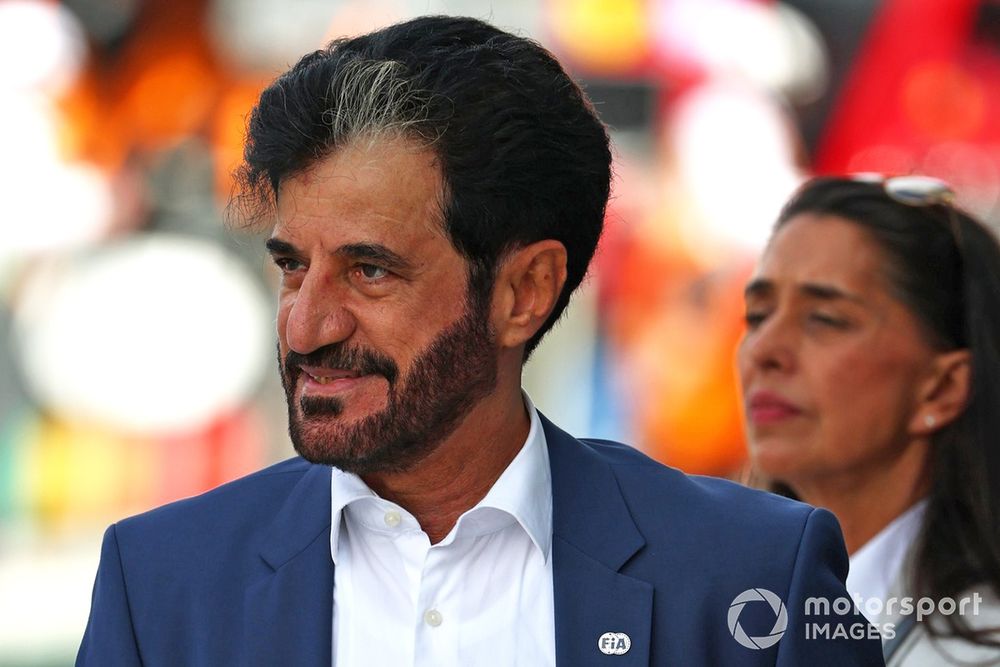
Mohammed ben Sulayem, FIA President
Photo by: Sam Bloxham / Motorsport Images
The automotive industry has been heading towards full electrification for a while, encouraged by government rules. However, many consumers are still not convinced, thinking that electric cars are too expensive. And of course, there are those who worry about their image if they’re seen driving something other than a car with a loud, powerful engine.
Because of this, and the arrival of cheaper, government-supported cars from China, the car industry in the West is getting worried. Luca de Meo, who used to be the boss of Renault Group, basically said this before he left.
So, there’s still a place for the internal combustion engine, as long as we can make enough of the new types of synthetic fuels at a reasonable cost.
If F1 does switch back to using V8 engines, there would be some details to figure out, like the size and how much electrification there should be. Next year, the split will be 50:50, but this has caused some debate, and the technical rules have had to be changed to include adjustable aerodynamic parts to make up for possible power losses on the straight parts of the track. The FIA is supposedly thinking about changing the ratio to favor the ICU, making it 80:20 or even 90:10.
The new setup would be introduced after the 2026 technical package has been used for a while, probably around 2030. But the president has mentioned it could happen sooner.
He said at Silverstone, “We need to do it quickly. You need three years, so hopefully by 2029 we will have something ready.”

2026 Formula 1 rules
Photo by: FIA
Ben Sulayem has also talked about drastically cutting costs by making parts like the gearbox and hybrid system standard. At the end of 2008, during the global financial crisis, Max Mosley, the former president, tried to push through something similar. He started a bidding process for a standard drivetrain, which Cosworth and Hewland eventually won. The plan also included creating new spots on the grid and having the teams that used the standard powertrain compete in their own championship tier, with a budget limit.
However, that idea turned out to be too complicated and lost momentum when Mosley stepped down. Jean Todt, who became the next president, completely scrapped it.
It could be argued that gearboxes are costly to design, develop, and build, and they don’t really make a difference in performance anymore. So, having a standard part isn’t necessarily a bad thing. There might be some complaints about whoever wins the bidding process, but F1 has dealt with this before. McLaren Applied Technologies won the contract to provide all the teams with standard Engine Control Units, and concerns about unfairness and cheating turned out to be unfounded.
Standardized hybrid parts might be harder for the engine manufacturers to accept. But, this is also a system that the audience doesn’t really see. If it can be made cheaper, it will probably get support. The FIA believes that cutting costs is still a top priority, even when F1 is doing well financially. This is because the situation could change at any time due to global politics and the economy.
FIA single-seater director Nikolas Tombazis mentioned to Autosport earlier this year, “As the FIA, we help guide the discussion about the rules, keeping in mind the need to control costs and create a fair environment for everyone.”
“There is often strong opposition from teams or PU manufacturers who are protecting their own interests or investments. Cutting costs and having technological freedom don’t really go together. It’s hard to have both.”
“The PU manufacturers [came to the discussion about the 2026 regulations] with many ideas for reducing costs on different parts of the engine. They focused on making things simpler and getting rid of certain materials, processes, and technologies.”
“The amount of cost-cutting we’ve achieved isn’t as much as we would have liked. Although we are in a good place as a sport, financially and in terms of popularity, we should never take that for granted. Cutting costs should always be a main focus.”
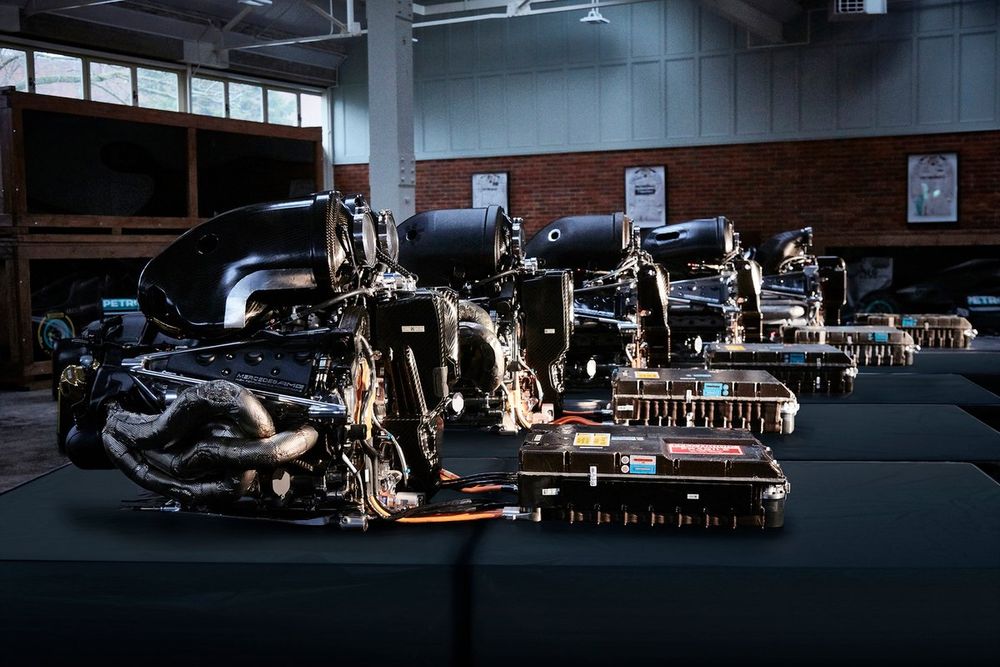
The Formula One Championship-winning Power Units: Mercedes-AMG F1 M09 EQ Power+ (2018), Mercedes-AMG F1 M08 EQ Power+ (2017), Mercedes-Benz PU106C Hybrid (2016), Mercedes-Benz PU106B Hybrid (2015), Mercedes-Benz PU106A Hybrid (2014)
Photo by: Mercedes AMG
Ben Sulayem stated at Silverstone, “A lot of the manufacturers have V8s in their cars, so from a business point of view, it makes sense. How much will it cost? The aim is to reduce costs by more than 50 percent in every area.”
This could be done not just by making parts standard, but also by requiring the use of cheaper materials. For example, it’s known that the FIA wanted to switch to aluminum pistons, but the engine manufacturers initially supported the idea and then changed their minds together.
Another problem that F1 faces in its push towards ‘net zero’ is the cost of the fully sustainable fuel that will be required next year, which is said to be around $275-$300 per liter. This is because of the R&D investment that has gone into developing these fuels and the energy-intensive ways they are produced. Right now, there’s no solution for producing them in large quantities and at a reasonable cost.
Since all the teams have deals with fuel and lubricant suppliers, it’s hard to figure out who will actually cover these costs, and it will probably depend on how the individual deals are set up. This is why another suggestion from Ben Sulayem is likely to be met with resistance: having only one fuel supplier.
The type of fuel used doesn’t affect performance as much as it used to. The chemical makeup of the fuel is now required to be close to that of regular pump fuel, and it must also have a sustainable element. However, fuel brands still depend on performance to tell their stories. For instance, Shell has built the identity of its VPower fuel around its partnership with Ferrari.
Would that story still work if the Ferrari was just a moving ad for Shell, while the fuel inside was actually from somewhere else? Maybe it would, since we live in a time when appearances are very important.
In the end, if costs can be lowered as much as the president wants, the entire grid will benefit. And hardly anyone will care if you have a certain brand of fuel in your car.