The significant alterations coming to Formula 1 regulations in 2026 are not only creating various engineering obstacles for the teams but are also posing “one of the most demanding” challenges for designs related to braking systems.
The most substantial regulatory transformation in contemporary F1 will witness a shift in the equilibrium between combustion and electric energy, moving from approximately 80/20 to an even 50/50 split. Currently, Formula 1 vehicles employ a 120-kilowatt (161-horsepower) Motor Generator Unit-Kinetic (MGU-K), but in the approaching year, the MGU-K’s power will be enhanced to around 350 kW (469 hp), while the MGU-H unit will be discontinued.
In conjunction with active aerodynamics, these alterations in power distribution will modify how quickly grand prix cars accelerate. However, they will also have an impact on deceleration capabilities, with a considerably enhanced capacity for regenerative braking, as Brembo’s Formula 1 customer manager, Andrea Algeri, conveyed to Autosport.
“This marks my 15th season involved in Formula 1, so I have witnessed various alterations in the configuration of brakes, vehicles, tires, and diverse wheels. Honestly, this stands out as one of the most demanding [regulation adjustments] for our company,” expressed Algeri, whose organization serves as the primary supplier for Formula 1.
Fundamentally, there exist two primary factors contributing to the extensive overhaul of the actual brake hardware slated for 2026. These comprise the evolving requirements stemming from the amplified energy recuperation facilitated by the MGU-K and a rule framework that is notably more accommodating compared to its predecessor.
The FIA stipulates that front brake rotors must possess a diameter ranging from 325 to 345 mm, while rear rotors should measure between 260 and 280 mm. Each rotor must maintain a maximum thickness of 34 mm. This constitutes a broader spectrum of dimensions for both front and rear brakes, thereby enabling the possibility of employing larger brakes at the front and smaller ones at the rear.
Furthermore, the revised regulations authorize the incorporation of up to three attachment points for the calipers, as opposed to the previous allowance of two, in addition to accommodating a greater number of pistons and pads. Algeri characterizes this as the most significant modification to the caliper aspect in two decades and asserts that it “unlocks a degree of autonomy for our engineering teams.”
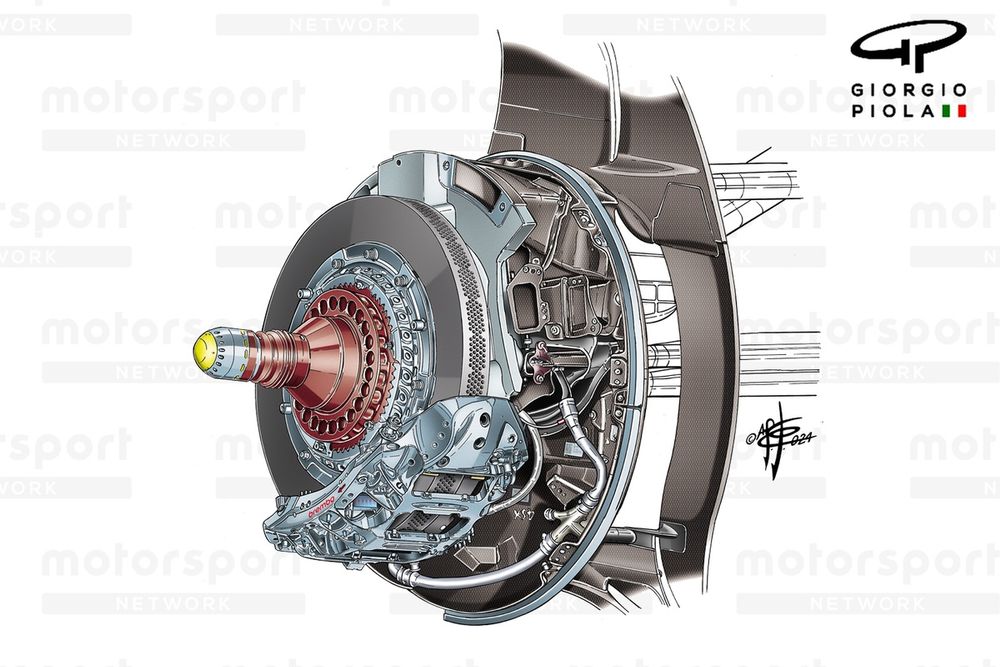
Ferrari SF-24 Brembo calliper
Photo by: Giorgio Piola
The operational mechanism of the braking apparatus remains conceptually consistent with its configuration since 2014. Front brakes are exclusively hydraulically driven, whereas the rear brakes employ a brake-by-wire system. The driver’s depression of the pedal is interpreted as a torque command, which the vehicle subsequently translates into a fusion of frictional and regenerative braking.
The critical weight battle
In addition to considerations pertaining to aerodynamics and power unit performance, a further crucial arena of contention in 2026 will encompass the substantial challenge confronting teams as they endeavor to adhere to a stringent revised weight threshold. Despite the augmentation in battery size and mass, the aggregate minimum weight restriction has been diminished from 800 kg to 768 kg.
Within the Formula 1 sphere, a prevailing sentiment suggests that few, if any, teams will manage to conform to the weight constraint from the commencement of the season, thereby initiating a supplementary developmental competition for the design departments. This has consequently exerted an influence on brake designs, as teams are eager to eliminate superfluous grams wherever feasible. Augmentation in size is no longer inherently advantageous.
“The teams are endeavoring to attain the optimal equilibrium,” Algeri articulated. “Refraining from substantial enlargement beyond the current season’s dimensions, as the utilization of the maximum permissible dimensions could result in excessive weight. Conversely, differing teams espouse divergent perspectives regarding energy recuperation strategies.”
Algeri disclosed that certain teams are electing to employ substantial front brakes—albeit not reaching the maximum permissible size—while simultaneously opting for diminished rear brakes. Other teams are adopting alternative approaches. While refraining from explicitly naming specific entities, he implied that a minimum of three teams have demonstrated “considerable audacity” in their pursuit of weight reduction, an approach that is poised to be emulated throughout the grid should it prove efficacious.
Nevertheless, the extent of diminution permissible for rear brakes remains constrained. This limitation stems from both regulatory considerations and the imperative for rear brakes to retain the capability of decelerating the vehicle independently of regeneration. For safety imperatives, the FIA mandates a braking torque capacity for the rear axle amounting to a minimum of 2500 Nm of pressure for 150 bar of pedal pressure, exclusive of power unit assistance.

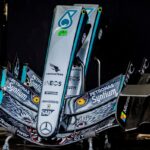
Mercedes W15 front brake duct comparison
Photo by: Uncredited
“This primarily serves to avert an implausible scenario involving excessively slender or diminutive rear brakes, wherein any malfunction could precipitate substantial complications,” Algeri elucidated. “The design will mirror extreme circumstances. A disc of sufficient dimensions is indispensable to endure conditions in which the track configuration or energy strategy compels the utilization of brakes akin to that of preceding eras.”
“We will probably observe distinct cooling specifications tailored to individual tracks,” Algeri appended. “For instance, a track imposing minimal braking demands will feature fewer perforations in the disc to sustain a marginally elevated temperature, thereby ensuring the carbon remains within the appropriate operational threshold, whereas alternative circuits will necessitate highly cooled discs incorporating a greater density of perforations.”
Why brake manufacturers will have to rethink their circuit ratings
Generally, an increased dependence on engine braking suggests that rear discs will experience diminished utilization relative to their present usage patterns, consequently necessitating less extensive cooling measures. Given that carbon-carbon discs require thermal energy to function optimally, Algeri posits that rear discs may feature a reduced quantity of cooling apertures or distinct ducting configurations to facilitate temperature maintenance. Conversely, teams are projected to require enhanced cooling for front discs, owing to the anticipation of elevated straight-line velocities in these 2026 vehicles.
The challenges associated with energy deployment that Formula 1 is presently addressing will additionally imply that the demands placed upon the brakes will exhibit heightened variability between circuits such as the high-velocity Monza and the circuitous street layout of Monaco, for instance. However, these disparities may not necessarily manifest as anticipated.
“We must reevaluate the evaluation of braking requirements for circuits, given that this metric is now more intimately associated with energy recuperation,” Algeri asserted. “A track characterized by minimal braking torque demands, exemplified by Monaco or Singapore, will present intensified demands for the brakes due to the extended duration available for energy recuperation. At a certain juncture, the battery will attain full charge, thereby necessitating the utilization of the brakes.”
The braking strategy highlighted by Algeri will constitute a pivotal element of performance in the forthcoming year, with substantial lap time improvements achievable solely through the optimized utilization of the power unit, independent of hardware considerations. With an increased reliance on regenerative braking, teams will possess a multitude of adjustable parameters capable of influencing vehicle deceleration during cornering maneuvers, as well as optimizing the system’s capacity to harvest energy for subsequent deployment via the MGU-K.
The 2026 Formula 1 season will constitute an amalgamation of both software and hardware considerations, and the unfolding dynamics are poised to be captivating.
We want to hear from you!
Let us know what you would like to see from us in the future.
Take our survey
– The Autosport.com Team