Although the primary updates to the power unit rules for the upcoming 2026 Formula 1 season primarily concern the balance of output between combustion engines and electric systems, the method by which the FIA monitors, governs, and understands the fuel delivered to the engine via the flow meter is also undergoing a transformation.
A significant overhaul of the two-pronged authentication mechanism became necessary due to the transition to entirely sustainable propellants. As previously detailed regarding the revised fuel delivery system, the baseline metric will continue to be kg/h (representing the fuel’s mass flow rate); however, starting this season, that measurement will be instantly translated by the Engine Control Unit into an energy flow rate, utilizing the energy concentration and heat content of each fuel, which must be independently verified prior to the vehicle’s operation on the circuit.
Collectively, the ultimate figure is capped at 3000 MJ/h, calculated using equations that factor in the engine’s RPM, exertion, and the power unit’s operational state. Fundamentally, this marks a genuine change in approach: the emphasis shifts from the volume of fuel measured by weight to its inherent energetic value. This reorientation also explains why innovation and development efforts demand significantly increased investment.
Components need reconsideration for synergy with synthetic fuels
The molecular makeup of the upcoming e-fuels diverges from traditional petroleum-based variants, presenting a much more intricate structure than initially obvious, necessitating comprehensive investigation to identify suitable chemical compounds. From a practical standpoint, these fuels exhibit heightened corrosiveness towards mechanical components, a reality that has compelled both engine builders and the firm manufacturing the flow meters to adjust their designs to accommodate the properties of these novel fuels.
Allengra, the organization awarded the contract for manufacturing the officially approved new fuel flow meter, encountered a dual set of significant hurdles in creating a durable device to handle the increased reactivity of the new fuel’s chemical makeup: given that the apparatus resides inside the fuel reservoir, the fluid both traverses and encases the component.
“As an illustration, consider the challenge posed by the connector,” Niels Junker, co-CEO, informed Autosport.
“Because the flow meter is positioned inside the tank, the fuel doesn’t merely flow through the sensing element; it also bathes the exterior of the sensor. Consequently, employing substances genuinely impervious to e-fuels is imperative, and this presents a substantial departure, given that material compatibility with current fuels is comparatively straightforward.”
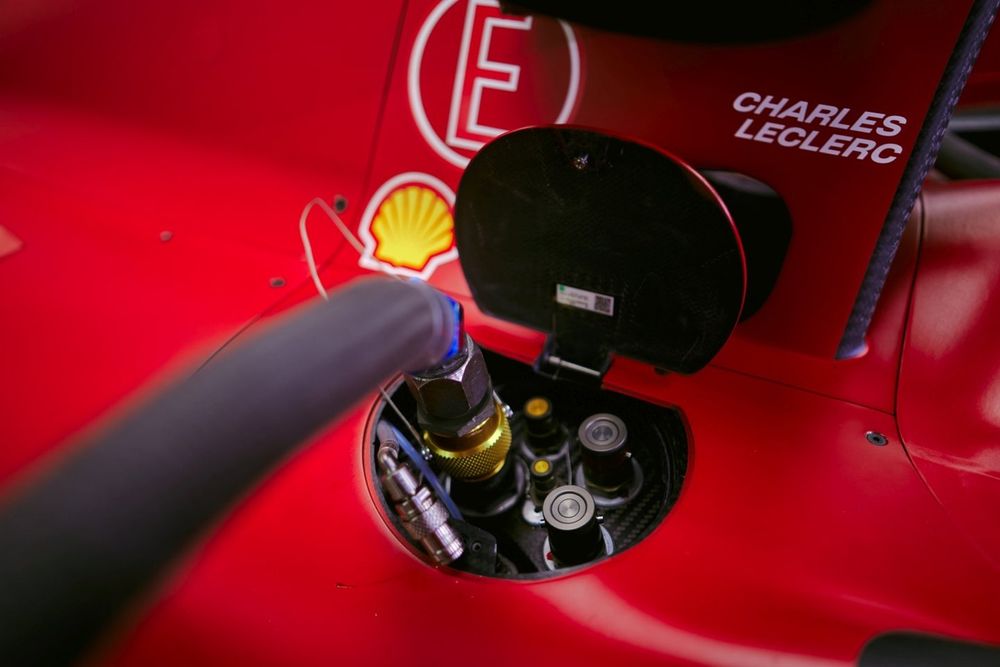
Ferrari SF-24 refuel detail
Photo by: Shell Motorsport
Contributions from both providers and the FIA
Considering these updated rules serve as both a demonstration for environmentally friendly fuels and a catalyst for technological advancement, it was vital that components directly exposed to the fuel did not impede progress. Following discussions with the FIA and fuel vendors, the firm opted to construct the external housing of the fuel flow meter from stainless steel.
Similarly, the sensors located within the flow meter are likewise safeguarded by a strengthening layer of stainless steel. However, this is only part of the solution.
“Our aim is to reduce the quantity of O-rings or gaskets, as in competitive racing, each wire and seal is not deemed entirely impenetrable to e-fuels; while initially effective, this might cease to be the case after five to ten events. Such changes are possible, and they introduce a hazard,” Junker further commented.
“Even when discussing the electrical connections extending from the flow meter to the ECU, they are not deemed suitable for e-fuels; thus, they require hermetic sealing and full compatibility from the electronic terminal throughout the entire wire harness.”
“Our team devised a method by sealing the whole interior of the coupling, yet a challenge also lay in sourcing appropriate connectors, given that our previously utilized ones worked with conventional fuel but failed to do so with e-fuels.”
“Consequently, we were compelled to seek out alternative vendors. This is a process spanning several months. It encompasses not only material suitability but also factors like safety protocols and procurement schedules. Our obligation is to ensure equitable conditions for all participants, which precludes us from providing a component susceptible to failure or delayed arrival.”
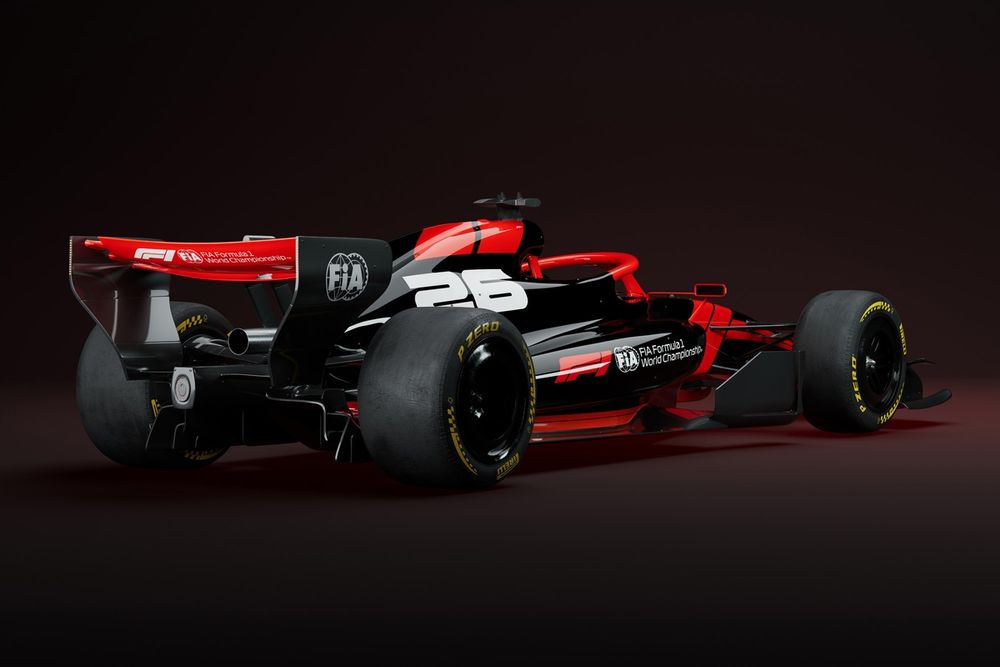
F1 2026 car renders
Photo by: Liberty Media
“Eventually, a method was discovered to render the cabling impervious to fuel, but concurrently, the racing teams are also required to contribute to preventing any seepage, and indeed, they have implemented particular quality control measures. How each team handles this facet varies.”
“Concerning e-fuels, the teams supply the fuel to us, and we are then responsible for calibrating the sensor and conducting validation procedures with that precise fuel type.”
Investigation into supplementary agents establishes a novel (and expensive) development sector
The advancement of e-fuels has unveiled a new domain that extends significantly beyond merely substituting conventional petrol. The objective is no longer to refine an established commodity but to construct an altogether fresh propellant, compound by compound. In this context, parallel to the evolution of the fuel itself, the study of supplemental components is emerging as a critical battleground for rivalry and inventive progress.
And it is exactly at this point that the FIA’s rules establish a vital difference. Supplementary substances originating from non-renewable origins are permissible, yet only under exceptionally rigorous constraints and exclusively if they belong to classes that do not inappropriately modify the combustion process, thereby preventing concealed performance benefits. This presents a considerable challenge, as the most effective additives typically come from unsustainable sources.
The circumstances surrounding sustainable additives diverge. Should these be verified and tracked throughout their complete production chain, they are exempt from the identical restrictions applied to non-sustainable counterparts. This represents a key area of focus for suppliers’ investigations, as they endeavor to create sophisticated, eco-friendly compounds designed to enhance constancy, anti-knock properties, and the efficiency of combustion.
It is quite telling that manufacturers mention conducting as many as a million simulations in pursuit of the optimal blend.
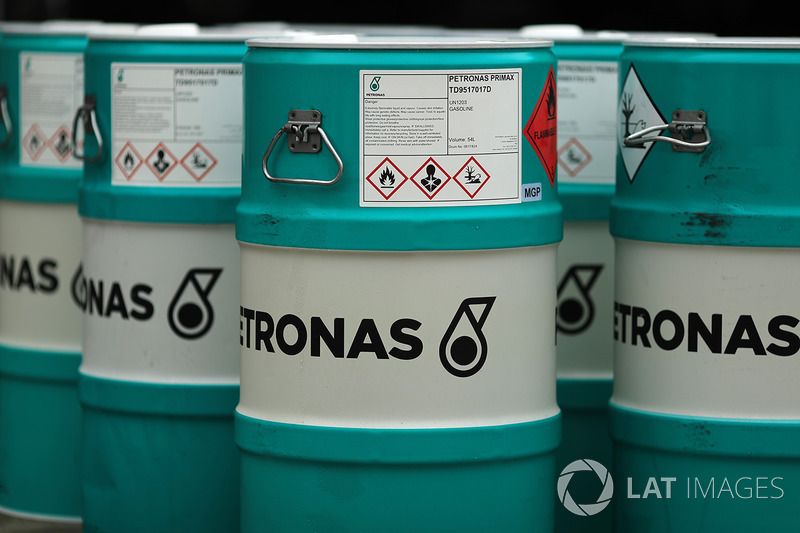
Petronas fuel
Photo by: Sutton Images
This undertaking is intricate, as each constituent must satisfy environmental sustainability benchmarks, guarantee reliable access, and also demonstrate material compatibility. Nevertheless, it constitutes a domain of immense promise, one where providers have also pursued collaborations with outside firms holding specialized proficiencies in particular areas. This also contributes to the anticipation that expenses will surpass €250 per liter.
The monetary worth is attributed not solely to the fluid itself; it encompasses the extensive scientific investigation supporting it, along with a production and distribution network that must be completely environmentally conscious, with certification at each phase—from its origin to the total life cycle’s atmospheric output—all of which is overseen by the FIA. Enhancing propellant excellence signifies, for instance, the capacity to yield an identical energy output with a marginally reduced mass, thereby decreasing the volume of fuel required to be transported by the vehicle.
This undeniably offers a significant benefit, particularly in a period where, at the outset, numerous teams are anticipated to considerably exceed the regulatory minimum weight.