The financial regulations in Formula 1 have received attention once more following the FIA’s announcement of their conclusions regarding the 2024 season.
According to the declaration, every team, in addition to the power unit producers, complied with the spending limitations. However, Aston Martin was discovered to have made a “procedural violation” with regard to the required documentation.
However, there has previously been a circumstance in which a team broke it and was penalized for doing so. Therefore, here is everything you need to know about the F1 cost restrictions.
What is the F1 cost cap?
The Formula One cost limitations specify the maximum amount that a team is allowed to spend on its vehicles within a calendar year. This regulation was initially put into place in 2021. The initial strategy, which was created before the outbreak, was for the spending limit to be $175 million. However, when COVID-19 caused damage to the 2020 season and placed certain teams in a difficult financial situation, it was lowered to $145 million, with the intention of decreasing it by an additional $5 million per season for 2022 and 2023.
The base cost limits for 2024 and 2025 were set at $135 million, with a supplementary allowance of $1.8 million for each race beyond the minimum of 21 Grand Prix events per season. Due to the fact that there are 24 races scheduled for both years, teams will have an additional $5.4 million to spend. The $135 million figure is also subject to indexation in order to account for inflation.
Why does F1 have a cost cap?
Some teams historically had very large budgets, while others worked with smaller amounts of money. This had an impact on the track, making it hard for “poorer” teams to catch up and participate.
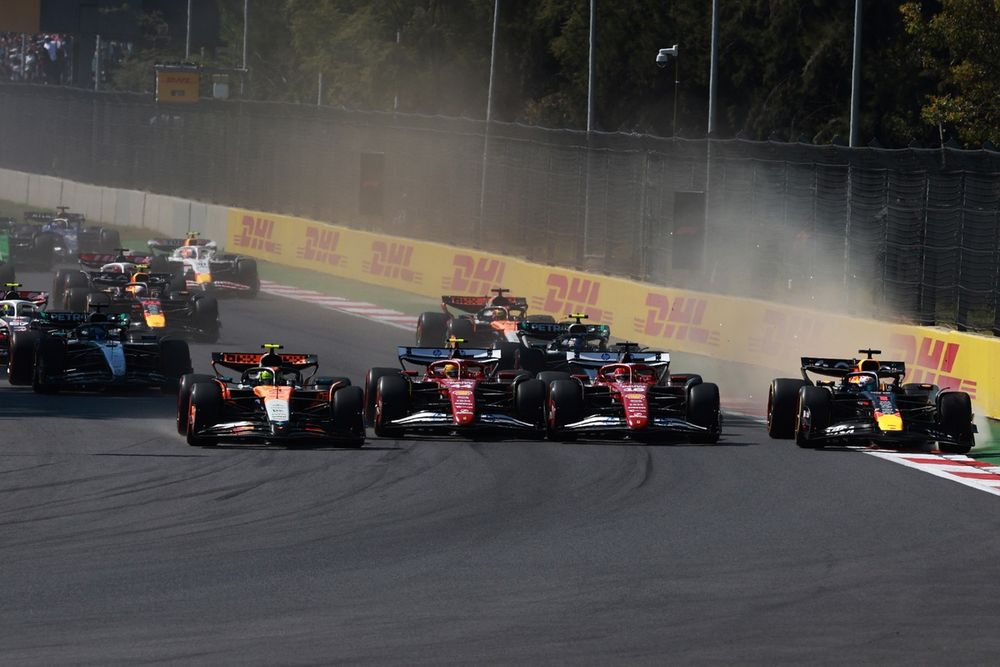
Charles Leclerc, Ferrari, Lewis Hamilton, Ferrari, Lando Norris, McLaren, Max Verstappen, Red Bull Racing
Photo by: Daniel Cardenas / Anadolu via Getty Images
The cost cap was mostly an effort to level the playing field that was long overdue, but it also made sure that enough teams stayed to form a grid. Many teams have been able to break even or make money, and their values have soared as they’ve become valuable franchises. After a stake sale in September 2025, McLaren was valued at $4.1 billion, a huge increase over the pre-cost cap era.
What comes under the F1 cost cap?
Every expenditure that is connected to the performance of a car, excluding engines, is significant in determining the cost limit. This comprises:
- All of the parts that make up the car, including the steering wheel and wheel nuts.
- Every item needed to operate the vehicle.
- The vast majority of the team’s staff.
- Tools for the garage
- Spare parts
- Expenses associated with transportation
- Everything in the space in between
Car development costs are the primary area of emphasis, with teams having to consider what is developed, how much is spent on each item produced, and how many of the parts are required and affordable without exceeding the budget.
What doesn’t come under the F1 cost cap?
There are a few pricey items that are not covered by the cost cap, some of which are mentioned below:
- Salaries of drivers
- The wages of the three staff members who are paid the most
- Costs of travel
- Spending on marketing
- Costs associated with property and the legal system
- Fees for entry and licenses
- Any activities that are not related to F1 or street cars
- Parental leave and sick pay payments
- Bonuses for employees and healthcare benefits for staff
The cost cap will be raised from $135 million to $215 million for 2026 and beyond. However, rather than representing a net rise in the amount that teams are able to spend, the action will mean that a great number of items that were previously exempt will now be included.
From the following year, Sauber, which is based in Switzerland, will also be eligible for a cost cap offset depending on OECD compensation data. This is to account for the increased cost of living and higher wages in Switzerland in comparison to the United Kingdom and Italy, where the majority of other teams are based.
Since 2023, F1’s power unit manufacturers have also been subject to a cost cap to keep the cost of engine development under control.
What are the penalties for breaching the F1 cost cap?
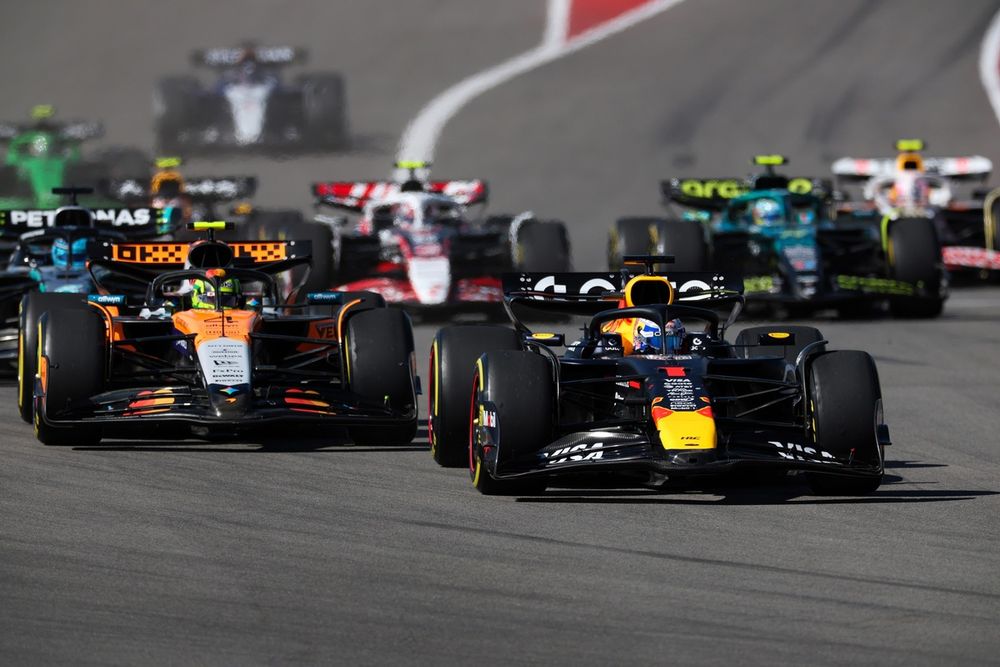
Lando Norris, McLaren, Max Verstappen, Red Bull Racing
Photo by: Sam Bloxham / LAT Images via Getty Images
Other than administrative offenses pertaining to reporting, there is a clear distinction with regard to cost cap violations: going over the allotted sum by 5%. It is officially categorized as a “minor overspend” if it falls below that threshold.
Teams enter “material overspend” territory after exceeding it. However, the precise consequences that may be imposed are rather hazy on either side of the line. Because spending is a difficult subject to regulate after you get into the specifics, the rules have been deliberately designed to allow for punishments to be determined on a case-by-case basis.
As a result, the range of possible penalties that may be assessed is comparable for both minor and major rule infractions, including point deductions, race exclusions, fines, and wind tunnel testing limitations.
However, there is one significant distinction if you have spent more than 5% of your budget: you are at risk of being eliminated from an entire world championship.
What happens when an F1 team breaches the cost cap?
A Cost Cap Administration will analyze F1’s documents. The Cost Cap Administration conducts a comprehensive assessment of the teams’ reporting documentation before issuing a certificate to those who are successful. The procedure can be very time consuming due to the immense complexity of F1’s financial laws and the accounting efforts made by teams to extract every dollar without breaking the regulations, as was the case for 2024.
According to the FIA regulations, “the CCA has several options available to it when dealing with an alleged breach of the Financial Regulations.”
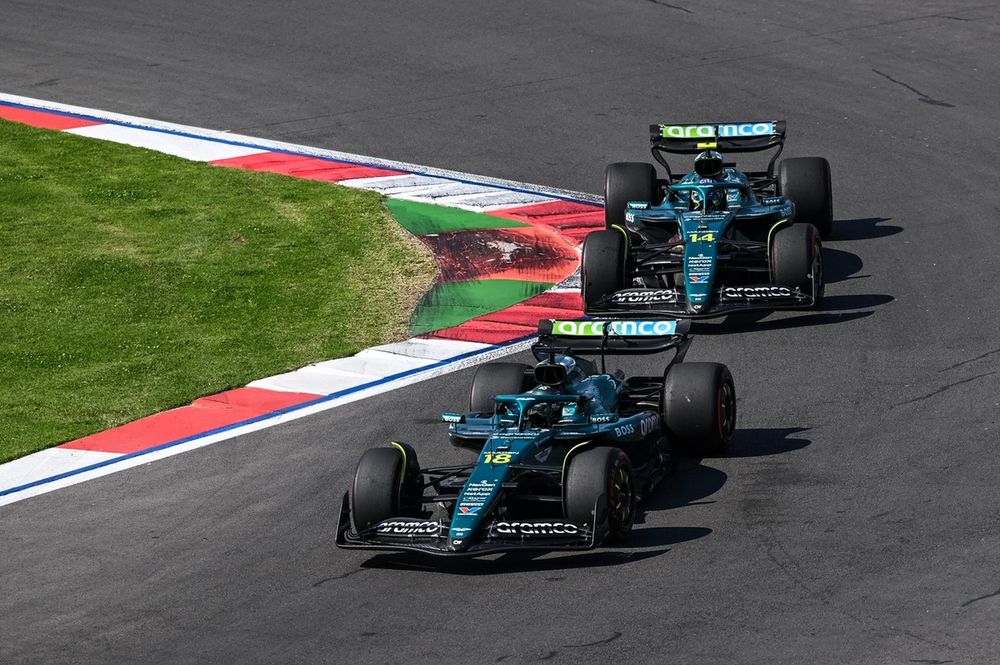
Lance Stroll, Aston Martin Racing, Fernando Alonso, Aston Martin Racing
Photo by: Sam Bagnall / Sutton Images via Getty Images
“In the event of a Procedural Breach or Minor Overspend Breach, the CCA may, if deemed appropriate, enter into a settlement with the F1 Team or PU Manufacturer concerned, referred to as an Accepted Breach Agreement; alternatively, if no agreement can be reached or the CCA considers it more appropriate, the CCA may refer the case to the Cost Cap Adjudication Panel. The CCA must refer the case to the Cost Cap Adjudication Panel in the event of an alleged Major Overspend Breach.
“The FIA General Assembly elects a panel of 12 judges to serve on the Cost Cap Adjudication Panel…from candidates proposed by either the FIA Sport Member Associations entitled to vote, or a group of at least five F1 Teams, or a group of at least three PU Manufacturers.”
Which F1 teams have breached the cost cap?
Only once before had an F1 team failed to adhere to the cost restrictions entirely, and that occurred in 2021 when Red Bull exceeded its spending limit by 5%. As a result, Red Bull was given a 10% reduction in wind tunnel and CFD testing in addition to a $7 million fine.
More recently, Aston Martin was determined to be in “procedural breach” of the 2024 cast cap because its paperwork was approved too late. The team was assessed a modest administrative fee rather than a penalty because it did not actually exceed the limit itself.
Regarding the power unit, Renault and Honda were the two parties that committed a procedural breach in 2023, and they both accepted an ABA as part of the power unit cost cap filings. Every one of F1’s power unit suppliers—Mercedes, Ferrari, Honda, Renault, and Audi—was determined to be in compliance for the year 2024.
We want to hear from you!
Let us know what you would like to see from us in the future.
Take our survey
– The Autosport.com Team