The latest Formula 1 vehicles have altered the method of navigating Suzuka’s initial segment: in addition to decreased downforce, which reduces cornering velocities, drivers now barely engage the brake pedal, as the hybrid mechanism slows the car during changes to optimize energy recuperation in a critical part of the track.
Throughout history, Suzuka has captivated due to its aesthetically pleasing design, featuring medium- and high-velocity turns that thrill both competitors and spectators globally. Nevertheless, since the introduction of the modern power units, the difficulties have transformed dramatically from previous eras—consequently, the driving approach at Suzuka has also shifted, possibly more profoundly than at other tracks.
A primary consideration is the Japanese circuit’s scarcity of extensive braking areas, which restricts chances for continuous battery replenishment to handle numerous acceleration periods—some of which, furthermore, cannot utilize DRS for safety protocols. Consequently, at least for qualifying sessions, the FIA has opted to decrease the peak retrievable energy from 9 MJ to 8 MJ.
This change is expected to lessen instances of lift-and-coast and extreme clipping, yet it remains evident that teams must still capitalize on the 8 MJ capacity, determining optimal recovery locations and methods. Therefore, where is this energy retrieved? The most compelling aspect involves analyzing the occurrences within the initial sector. Last year, after track resurfacing, adhesion levels rose, enabling drivers to achieve greater speeds through turns.
This season, however, the circumstances have partially shifted. Firstly, these updated vehicles produce reduced aerodynamic downforce, making it harder to sustain identical speeds—particularly through medium- to high-velocity corners where ground-effect automobiles formerly outperformed. Additionally, a second element exists: how the modern power units have transformed the approach to this segment, an aspect previously noted when examining the consequences of merely two active aerodynamic areas.
This phenomenon is apparent from the entrance to the Esses, where distinct speed variations among teams become visible. It’s not solely a matter of downforce, but rather the quantity of energy expended upon exiting Turn 2. Certain drivers opt to preserve energy, considering the brief straight leading directly into the series of bends; conversely, others adopt a more assertive strategy, deploying more energy initially to maintain greater velocity through the section.
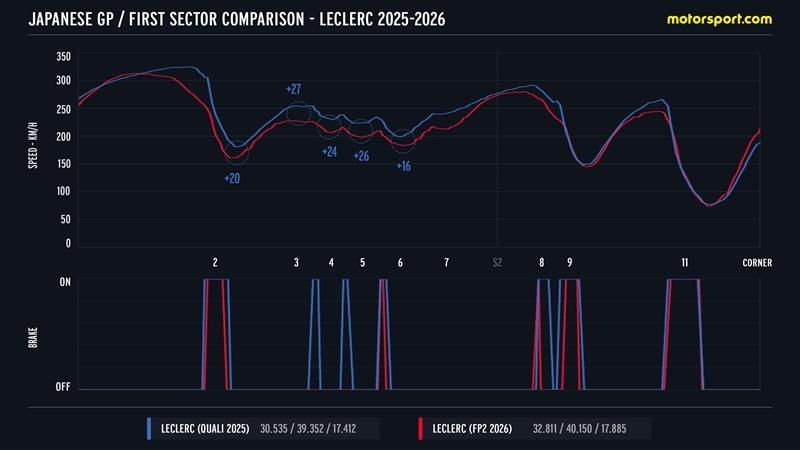
Comparison Leclerc Suzuka 2025-2026
Highly distinct driving approaches exist—however, what is even more fascinating is the current application of the MGU-K during transitions as an actual braking mechanism. It serves not only to slow the vehicle and lessen understeer but also to recuperate energy for subsequent use in the lap. While this concept isn’t entirely novel, the MGU-K’s current ability to supply and collect triple the power significantly amplifies its impact.
Predictably, constructors possessing substantial downforce in the previous year, including Red Bull and McLaren, typically utilized the brakes less frequently. Conversely, teams with a disadvantage, such as Ferrari and Mercedes, were compelled to engage both pedals to offset diminished front-end traction and assist the car during corner entry and mid-turn periods.
Taking Ferrari as an example—considering its comparative consistency between 2025 and 2026—it’s evident that in this particular segment, the brake pedal sees minimal use. The MGU-K undertakes the majority of the braking function, decelerating the vehicle and assisting rotation without needing the driver to press the pedal.
Parts of the track previously navigated in sixth gear are now tackled approximately 30 km/h slower, in a reduced gear and with decreased throttle application, even while sustaining elevated engine revolutions. This alteration should not be unexpected: the FIA has determined that between Turn 3 and Turn 6, power reduction can surpass 150kW, leading to a dual impact.
Firstly, in specific regions, even when the driver is accelerating, the MGU-K refrains from supplying power and instead stays in recuperation mode. This occurs because the primary constraint is not the engine’s output, but rather tire adhesion and aerodynamic pressure—thus, the FIA permits teams to practically “nullify” electric deployment and enable the MGU-K to persist in gathering energy without contributing to forward movement.
This mechanism facilitates energy storage for subsequent portions of the circuit and, as expected, vehicles have been observed departing Turn 6 with a greater energy reserve than they possessed entering Turn 3. In practical terms, this operational pattern mirrors the “one-pedal driving” feature found in conventional automobiles: when the driver eases off the accelerator, the electric motor simultaneously regenerates power and applies a braking force.
This signifies an entirely novel approach to navigating this particular segment. While it doesn’t profoundly modify the driver’s intuitive response regarding throttle control, it fundamentally transforms the internal workings of the car: the electric motor is employed in an altered manner and ultimately substitutes nearly all mechanical braking. “It’s not catastrophic, but it’s unlike before. F1 shouldn’t operate this way,” commented Sainz on the subject.
The method for approaching 130R has also evolved. In actuality, the speed through the corner doesn’t vary significantly from previous times, but it is achieved by different means, with velocity decreasing as the vehicle enters derating mode due to insufficient electric motor assistance. Maximum speeds are attained sooner—exceeding 20 km/h faster, partly thanks to DRS—but subsequent to that peak, an extended deceleration period ensues, shedding over 50 km/h prior to braking for the chicane.