It has been a longstanding custom for those predicting doom in the F1 paddock to forecast grim weather from Thursday of a race weekend, specifically for Sunday’s conditions.
In Miami, this concern has gained heightened importance, not merely due to the Sunday race starting time being advanced from 4 PM to 1 PM local time in anticipation of predicted thunderstorms.
Currently, Formula 1 finds itself in a less-than-ideal state of readiness for races held in wet conditions. This is primarily due to the modification in tire dimensions this season and the limited amount of real-world running under comparable conditions during recent races and testing sessions. Even the increase in tire blanket temperatures for the intermediate compounds, raised from 60°C to 70°C, a change agreed upon in the pre-Miami rule adjustments, is still considered experimental.
During the initial pre-season trial period in Barcelona in January, teams and drivers first noticed some unusual characteristics of the newly designed intermediate tires. The second day of these trials saw wet conditions, and only Red Bull and Ferrari fielded a single car each on the circuit.
The main discovery from this session was that the new intermediate tire appeared to take longer to reach its optimal operating temperature and become effective. While Pirelli has maintained its underlying philosophy for a range of tire compounds, these compounds required structural and material changes to accommodate the new sizing: the wheel diameter remains constant, but the front tires are now 25 mm narrower (at 280mm), the rear tires are 30 mm narrower, and both have a slightly reduced profile (by 15mm overall at the front and 10mm at the rear).
With a reduced contact patch on the track surface, combined with a slightly diminished internal volume, a different distribution of energy passes through the tire’s structure and tread. A portion of this energy is naturally converted into heat as the rubber deforms under strain. The prevailing sentiment within the F1 community is that while Pirelli has successfully transferred the attributes of the preceding generation of slick tires to these new, narrower versions, the intermediate tires might be somewhat excessively durable.
Furthermore, the full wet tires remain an ongoing development project. Historically, these tires are highly effective at dispersing significant volumes of water but tend to overheat rapidly. Consequently, by the time track conditions worsen sufficiently for them to be a practical choice, a red flag interruption is often imminent regardless. Pirelli has been endeavoring to enhance the ‘raceability’ of these tires, yet opportunities for testing are rare and frequently lead to political disagreements, as teams often view rivals gaining track time with current vehicles with suspicion.
Therefore, since January, F1’s tire provider has been striving to accelerate its understanding of how the intermediate tires perform. This included a recent two-day session in April where a Ferrari was run at an artificially watered Fiorano circuit. Additionally, a post-race test in Japan, originally intended for Pirelli to gather more data on its dry compounds since most previous running involved the C3, was affected by rain, which at least allowed for some testing of wet and intermediate tires.
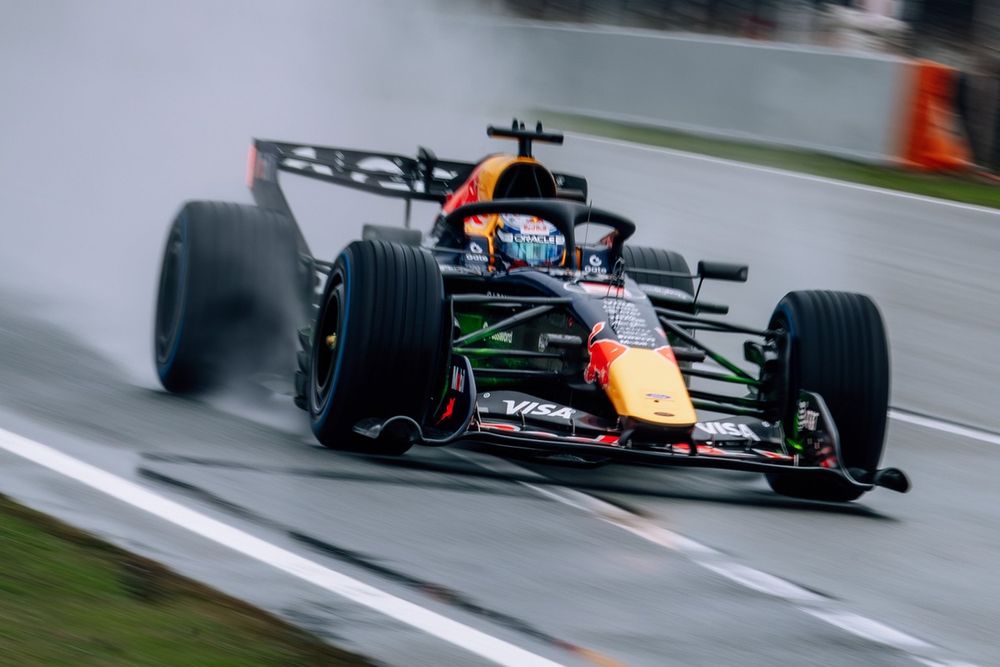
Teams faced damp conditions in the Barcelona shakedown
Photo by: Formula 1
However, even these efforts, while beneficial, do not provide an extensive range of relevant, comparable data. For that, more vehicles need to operate on the track under representative conditions. Rain during a Grand Prix practice session would be optimal; if not, a race itself would also be valuable, though competitors might hold a differing view.
“We began in Barcelona [during the January shakedown] with Ferrari and Red Bull participating in testing on the second day,” stated Pirelli’s chief engineer, Simone Berra, in Miami.
“Conditions were quite cold, and there was a substantial amount of standing water. We gathered initial feedback from them. This was a very early stage, and teams were beginning to comment on the warm-up process being somewhat difficult under these circumstances. However, with only two teams involved and very cold conditions, we decided to await another significant test.”
“In Japan, misfortune struck as it rained on both days, preventing us from testing the dry tires. Nevertheless, we did get the chance to test intermediate and wet tires. Even in Japan, with less standing water and slightly higher temperatures, driver feedback still pointed to somewhat challenging warm-up characteristics, particularly on the front axle, where maintaining temperature within the operational range proves difficult.”
“So, if you commence at 60 degrees [blanket temperature], there’s a risk that without sufficient energy input on the tires, you’ll continue to lose temperature. This then makes it hard to generate energy and increase temperature – creating a compounding problem. We began to consider how to better assist drivers in this regard, leading to our decision, in agreement with the teams and the FIA, to conduct testing in Fiorano with tire blanket temperatures set at 70 degrees.”
“An 80-degree proposal was made, but our preference was to take a cautious initial step, assess its outcome, and then determine our position before moving forward.”

Tyre blanket temperatures have been tweaked
Photo by: Pirelli
“At Fiorano [where the circuit was artificially dampened], the test proceeded well, but the conditions were somewhat distinct, being noticeably warmer. Consequently, following the test and after receiving positive feedback that the warm-up performance had improved and we were on the right track, the decision was made to increase the blanket temperature from 60 to 70 degrees. We now await the first wet event to assess if this adjustment yields a significant impact, eliminates further warm-up issues, and places us in a generally improved situation.”
“This now represents our immediate objective, as we also aim to evaluate the intermediate tires with 70-degree blankets involving more teams. While a test offers a controlled environment, we are keen to observe performance during a race weekend, specifically during a race, when 11 teams are competing. This would provide us with broader feedback and a comprehensive understanding of our current status.”
From a perspective purely focused on gathering data, a wet race in Miami would therefore prove to be a valuable data-collection opportunity. Although the tires are approved for the entire season, cultivating a deeper comprehension of their performance traits under varying conditions will facilitate more informed decisions on their operation, whether through vehicle setup, pressure adjustments, or blanket temperature settings.
The fundamental reason for elevating blanket temperatures is to give the tires a preliminary heat advantage. As a tire rotates, energy passes through it during compression at the contact patch and subsequent rebound. In this transitional phase, some of this energy is dissipated as heat.
Formula 1 tires are specifically engineered to deliver peak performance within a designated operational temperature range. For intermediate tires, this range (80-100°C) is marginally lower than that of slick tires (90-110°C), reflecting the conditions for which they are designed. The standard protocol involves pre-heating race tires in blankets to 60°C, with the remaining necessary temperature generated by hysteresis (the process of compression and rebound during rolling).
The observation thus far indicates that the intermediate compound does not deform sufficiently under load to generate the required warm-up. Therefore, increasing the blanket temperature to 70°C is a logical adjustment. However, its efficacy must be thoroughly evaluated across a wide spectrum of operating conditions before any further modifications are implemented.
“Let’s consider that it rains on Sunday; this would still represent a different scenario compared to all prior tests and analyses, given that the temperature would be higher than what we encountered previously,” Berra remarked.
“So, it’s not truly a conclusive test. We’ll observe how things unfold this weekend, for instance, if it rains. In Montreal, it could be cold and wet, and the circuit’s energy [abrasion] isn’t particularly high.”
“Thus, we can accumulate additional information, and then, in collaboration with the teams, decide on the next steps, as our clear intention is to offer support if there’s anything we can do in that regard.”