Have you ever been in a position where you are viewing the Champions League and felt incomplete because you don’t get to constantly ponder the question of ‘who provided the assist?’ following each and every goal?
Well, there’s no need to fret, as you can recapture that sensation by engaging with a Champions League-themed fantasy league.
Many aspects will immediately feel familiar and mirror the structure of a well-known domestic fantasy league. However, it’s crucial to understand the unique guidelines before you start selecting your team.
How a Champions League-Themed Fantasy League Functions
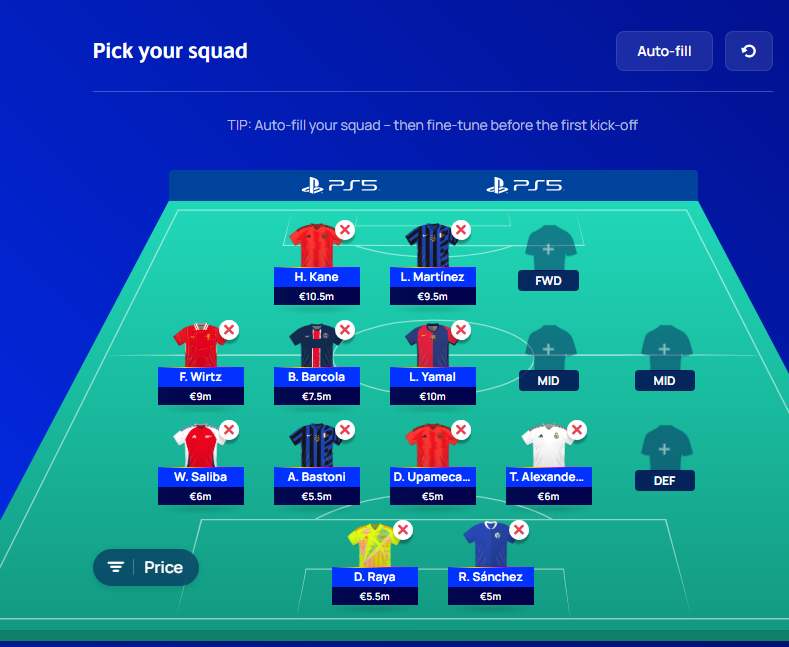
The foundational components will resonate strongly with those acquainted with fantasy leagues: you’re provided with a €100m budget for assembling a 15-player team composed of two goalkeepers, five defenders, five midfielders, and three forwards.
Each game week, you’re granted a set number of free transfers, with a four-point reduction applied for each player exceeding the limit. Points are exclusively earned by players within your starting eleven. If a player doesn’t participate, they are automatically substituted from the bench (with a caveat to be discussed). Captains secure double points.
Up to this point, the formula remains consistent. However, there are some significant differences that merit consideration. To begin, the deadline for implementing changes aligns with the commencement of the first match of the day.
Perhaps the most substantial difference lies in the option to manually execute substitutions or modify your captain selection, contingent on their prior performance if you’re unsatisfied with their contribution.

Meaning, if your striker or designated captain underperforms on Tuesday evening, you have the option to replace them and/or transfer the captain’s armband to another player scheduled to participate on Wednesday evening.
The trade-off is that once this adjustment is made, it is irreversible; there’s no option to revert, and automatic substitutions will be disabled entirely, even if a player ends up not playing.
Be mindful that even actions such as reassigning the captain or altering the order of substitutes will be treated as a manual modification, preventing any automatic substitutions from being executed as they would be otherwise.
The other distinction is how the knockout stage of the Champions League is accounted for. It influences the number of transfers permitted each week and the quantity of players you’re allowed from any one club. Additionally, you gain an extra €5m to augment your team during the knockout phase, acknowledging that numerous lower-priced players will have already been eliminated.

In the league segment, you’re granted two transfers per matchday, but this increases to five prior to the initial legs of the quarter-finals, semi-finals, and final.
Between the legs of the last-16, quarter-finals and semi-finals, an additional three free transfers are allotted ahead of the second leg. (Between the two legs of the knockout phase play-offs, only two free transfers are provided).
A single unused free transfer from each game week can be carried forward to the subsequent game week, though they do not accumulate across the season, negating any advantages from attempting to stockpile them.
There are also two periods where you can make unlimited changes: after the league stage concludes, and ahead of the round of 16. This essentially enables you to curate an entirely new squad particularly for the knockout phase play-offs, which is sensible given that eight of the remaining teams bypass that stage entirely, moving directly to the round of 16.

We won’t delve into the complete scoring breakdown, as it closely mirrors that of the fantasy league system. You can review it at your convenience.
Prizes are available, though the specifics of what they are or how to earn them remain undisclosed at this time. The league is sponsored, however, so it gives a potential indication.