Frederic Vasseur has acknowledged that Ferrari might have misjudged the level of adjustment required for Lewis Hamilton to integrate successfully into the Scuderia in Formula 1.
Vasseur, the Ferrari team principal, secured Hamilton’s move from Mercedes for the 2025 season. Previously, Hamilton had enjoyed the most extended and fruitful partnership in F1 history with the Anglo-German team. Spanning 12 seasons, their collective achievements encompassed an impressive 78 pole positions, 153 podium appearances including 84 victories, and six drivers’ titles.
Since the inception of the ground-effect era in 2022, Hamilton’s performance has seen some fluctuations, and his recent transition to Ferrari hasn’t consistently delivered the anticipated outcomes, despite clinching a sprint victory in Shanghai. In head-to-head qualifying sessions against his new teammate Charles Leclerc, Hamilton trails 13-5, accumulating 109 points compared to Leclerc’s 151, and is yet to secure a podium finish in Ferrari colors.
“I’m uncertain if we fully appreciated the magnitude of this transition,” Vasseur reflected on the Beyond The Grid podcast. “He was part of McLaren for 10 years [14, considering six as an F1 driver] and subsequently spent 12 years with Mercedes. However, there was a degree of continuity, with both teams being UK-based, utilizing the same engine, and sharing a similar operational environment.
“Consequently, this represents a profound shift in his life, encompassing the team’s culture and all facets involved. To accomplish this within a brief three-day testing period during the winter is notably challenging. I believe the expectations were very high, but we must establish the right conditions. This process requires time, and we must also handle the anticipation and the external pressures surrounding the team.”
Vasseur emphasized that while Leclerc often outperforms Hamilton, the performance gap between them is typically minimal.
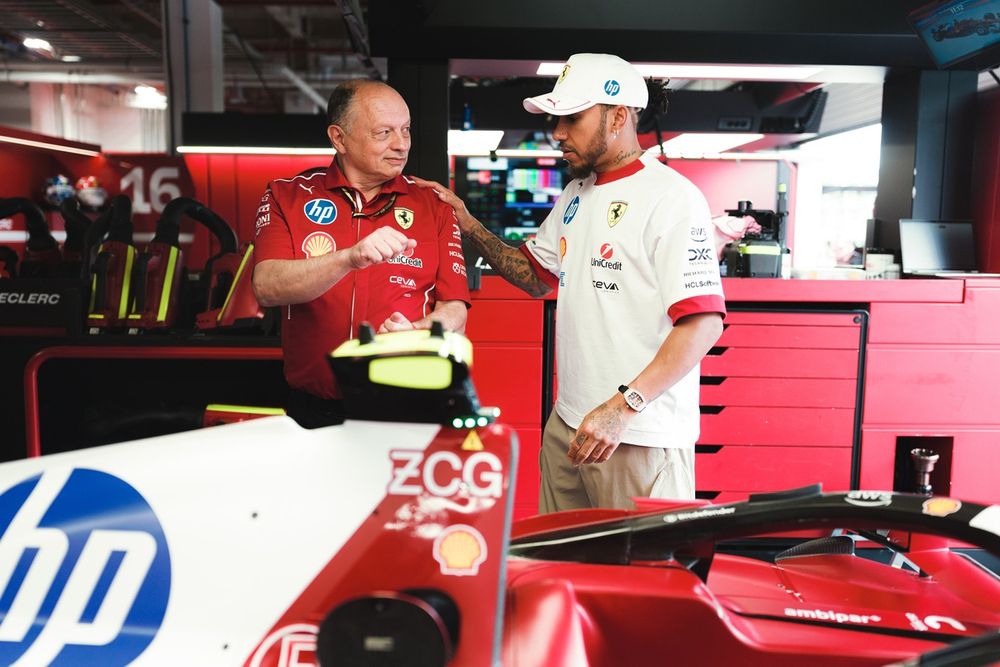
Lewis Hamilton, Ferrari, Frederic Vasseur, Ferrari
Photo by: Ferrari
“We’re talking about fine margins,” the Frenchman clarified. “The feedback, whether positive or negative, often revolves around a tenth of a second, a minor front wing adjustment, or some similar detail. These adjustments are always marginal. This is what we must remember.
“If we fail to integrate all the elements, from weekend preparations and simulator adaptation to the race itself, a tenth of a second here or there can be lost. This can drastically affect the final outcome.
“We must remain composed. He performed exceptionally in China. We demonstrated a significant recovery in Monaco, where he was among the top four in qualifying until the penalty [a three-place grid drop for obstructing Max Verstappen] was applied. In subsequent races, our pace improved, although circumstances in Spa and Budapest prevented it from translating into results. The pace was there, nevertheless.”
Data supports Vasseur’s perspective to some extent. Across the first 18 qualifying sessions of the season, including sprints, the average gap favoring Leclerc is 0.177 seconds. This is slightly skewed by Hamilton’s occasional driving errors. Hamilton has also concluded five Grand Prix races immediately behind his teammate, outperforming him in only two instances.
As the season progressed, Hamilton’s public statements became increasingly subdued, highlighting his struggles. This culminated in his suggestion that Ferrari might consider replacing him following a Q2 exit at the Hungaroring, which followed Q1 incidents at Spa-Francorchamps.

Lewis Hamilton, Ferrari
Photo by: Simon Galloway / LAT Images via Getty Images
“He experiences emotions, and it is our responsibility to support him during his struggles, as well as to encourage him when he is facing challenges,” Vasseur stated. “Spa and Budapest proved difficult for him. However, he can be assured of the unwavering support from everyone at Maranello, aiding his recovery and return.
“I am confident he will succeed, and we must provide him with continuous support. I am committed to supporting Lewis every step of the way.”
Vasseur: Informing Wolff about Hamilton’s Arrival Was “Not the Easiest Call of My Life”
Vasseur also touched upon his enduring relationship with Mercedes team principal Toto Wolff and how pivotal hires like Hamilton and Loic Serra, Mercedes’ former performance director who became Ferrari’s chassis technical director last year, have influenced it.
“We consistently strive to maintain a clear distinction between our personal relationship and the competitive aspect on the track,” Vasseur clarified.

Peter Bayer, CEO, RB F1 Team, Frederic Vasseur, Team Principal and General Manager, Scuderia Ferrari, Toto Wolff, Team Principal and CEO, Mercedes-AMG F1 Team
Photo by: Sam Bagnall / Motorsport Images
“It’s true that when I was with Sauber [as team principal], we weren’t rivals every weekend. Today, we’re rivals, particularly when it comes to recruitment. But I believe we’re mature enough to remember our 25-year friendship. Even when we’re competing on Saturday or Sunday, we know we can start fresh on Monday.”
When asked about personnel movement between the teams, Vasseur remarked, “This is the reality of Formula 1, and we can’t be upset by it. Telling Toto about Lewis was not the easiest thing for me, knowing how much they had helped me in the past. I try to keep things separate.
“Toto is my friend. He will remain my friend for the next 30 years. We are rivals, and I hope that Toto will continue to be my friend.”
In this article
Be the first to know and subscribe for real-time news email updates on these topics