During the Formula 1 pre-season testing, Ferrari emerged as the team that genuinely astonished the paddock with its inventive engineering solutions.
At the Bahrain tests, the Scuderia unveiled a novel component positioned behind the exhaust, engineered to exploit the volumetric allowances of the upcoming 2026 regulations, alongside a pioneering rear wing system capable of a full 180-degree rotation.
However, the SF-26 presents further intriguing elements, beginning with a complete overhaul of the wing’s movement control apparatus. To facilitate a full half-turn rotation, Ferrari’s engineering team needed to conceptualize an entirely distinct actuator; the traditional central unit on the mainplane was unsuitable due to the spatial constraints it imposed on movement.
Consequently, the engineers incorporated the flap-controlling actuator directly into the endplate. This represents a highly intricate arrangement, required to endure substantial forces. Typically, rear actuators are quite large, leading some constructors to attempt to mitigate any performance penalties from their control mechanisms by modifying the final element’s central portion.
This design echoes Mercedes’ 2011 approach, where the Brackley team introduced an endplate-situated actuator, causing debate as it foreshadowed the German brand’s later prohibited double DRS. While Ferrari clearly did not derive its rotating rear wing from that specific antecedent, the recurrence of historical design philosophies is noteworthy.
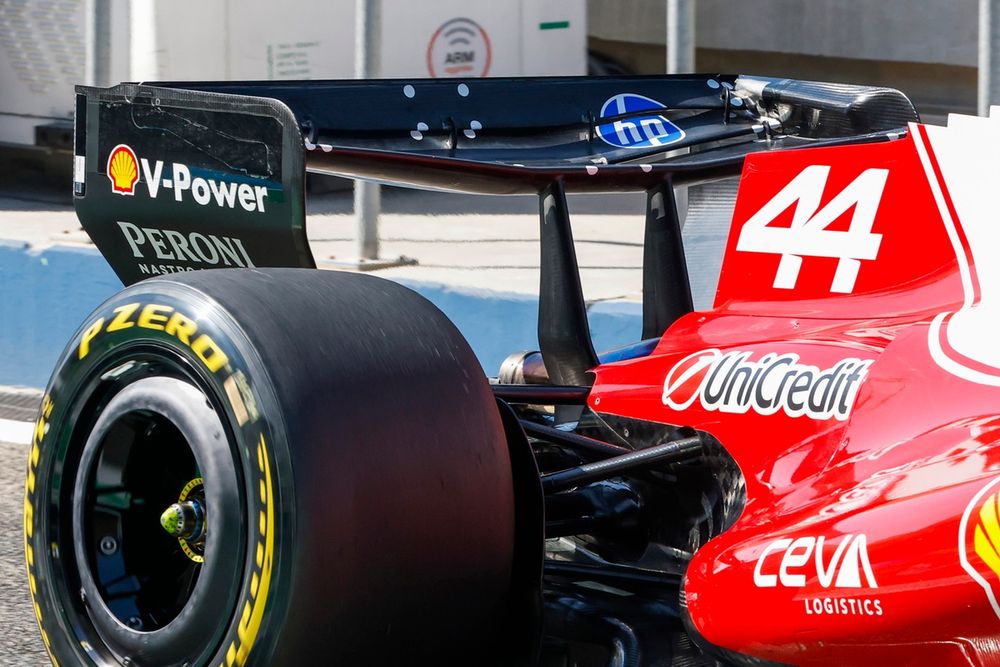

The fundamental principle and its execution diverge, given that the SF-26’s control mechanism is required to achieve a half-circle rotation and, in its retracted state, manage considerably greater forces – attributable to both increased maximum velocities and substantially larger flap dimensions.
Furthermore, with the system potentially engaging up to four times per lap on certain circuits, its operational frequency will surpass previous iterations, elevating reliability to a crucial concern. This extensive usage challenges the entirely miniaturized control unit within the endplate, which, as per regulations, must incorporate a fail-safe to revert the adjustable flaps to their closed state should a fault occur.
However, Ferrari’s development of the novel wing involved more than just relocating the actuator. Observing the design, the pivot point for the wing’s rotation has been shifted centrally, aligning with its connection to the actuator, and the leading edge of the initial element has been expanded to fit this updated configuration.
Regarding compliance, concerns were raised that this wing might surpass the permissible volume limits, particularly as it approaches a near-vertical orientation during rotation. Nevertheless, the updated regulations, specifically in their aim to allow teams greater latitude for drag reduction on straights and conserve energy, have enabled novel design avenues, with the FIA officially endorsing this specific approach.
Currently, a specified volume dictates where the wing must reside in its closed state; however, when deployed, the rules permit certain deviations. A significant change is that the wing is no longer mandated to stay completely within the prescribed regulatory envelope throughout its motion, thereby allowing increased rotational flexibility.