One of the clearest understandings from the 2025 campaign is that achieving race victories demands embracing unconventional methodologies, particularly concerning the implementation of the underbody, which serves as the vehicle’s primary downforce generator. McLaren’s performance serves as validation: their initial advantage during the year originated precisely from novel approaches informing the architecture of the MCL39.
Red Bull’s recent resurgence indicates their belated adoption of a parallel approach, having initially struggled (under previous management) by incorrectly accusing McLaren of improper conduct.
Ferrari also embarked on this strategic path, instituting a revised design ethos with the SF-25 to surpass the inherent constraints of the SF-24, which had reached its development zenith. To triumph, it necessitated more audacious decisions, with the intention of both mechanical and aerodynamic revisions to foster innovation throughout the season.
Herein lies the conundrum: those precise adjustments, intended to unlock novel possibilities, have instead become a developmental impediment. The objective was to commence the season with a highly competitive car, yet those design choices, which impeded Ferrari from the outset, ultimately constrained its potential for advancement throughout the championship.
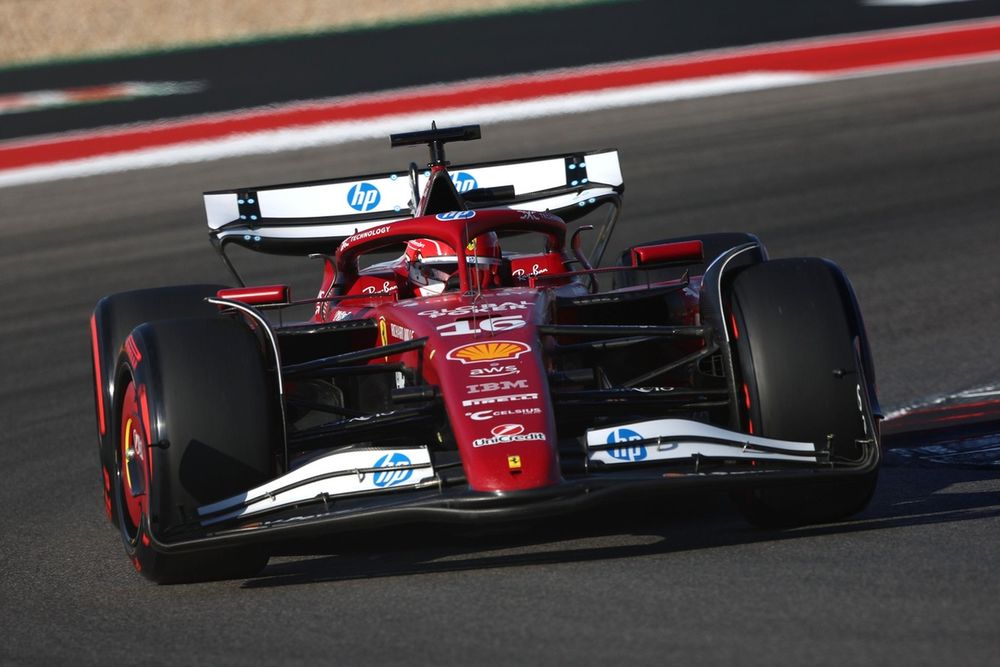
Charles Leclerc, Ferrari
Foto di: Andy Hone/ LAT Images via Getty Images
It’s widely understood that the SF-25 exhibits extreme responsiveness to fluctuations in ground clearance. While this characteristic is typical of all ground-effect vehicles, in Ferrari’s instance this year, it has emerged as an even more restrictive factor, precipitating a cascading sequence of effects from the Australian Grand Prix onwards.
This issue was particularly evident at the Circuit of The Americas, a venue notorious for its irregular asphalt surface, a consequence of its construction on reclaimed marshland susceptible to subsidence.
The events of Friday serve as a microcosm of Ferrari’s entire season. Notwithstanding the disparaging commentary from the Italian press, the team exhibited resilience, both technically and operationally, in response to an underwhelming initial day.
However, despite Ferrari’s commendable data analysis and interpretation, evidenced by setup adjustments and detailed pre-qualifying briefings for drivers, these efforts were essentially ameliorating a pre-existing issue. This underscores the fundamental challenge: the management of ground clearance has significantly influenced Ferrari’s season, evolving into an insurmountable constraint.
Managing ride heights is more complex than it seems
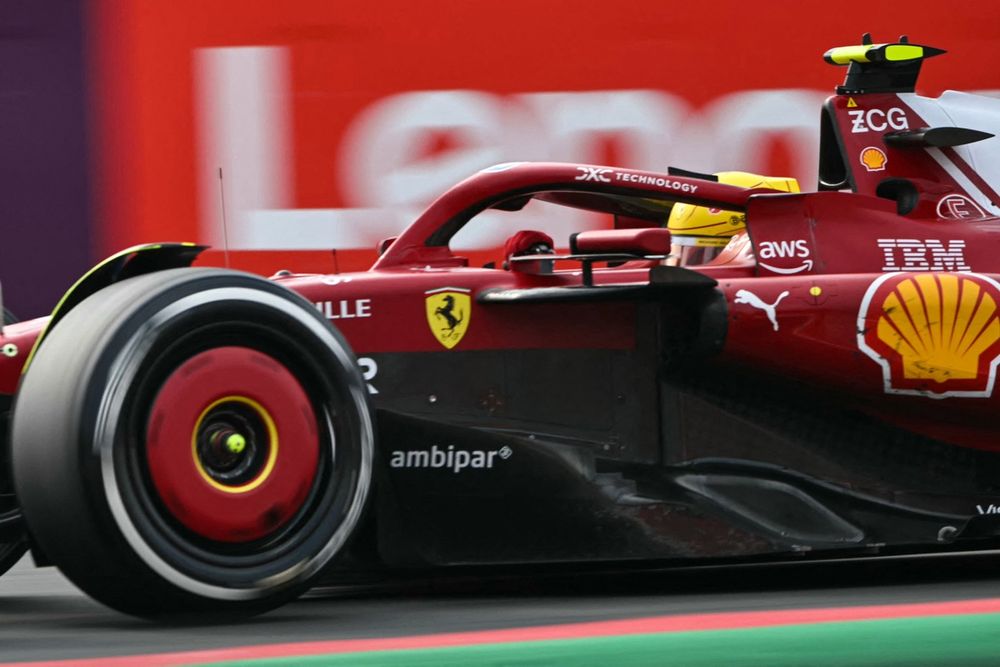
A critical point of understanding is that the challenge extends beyond merely minimizing vehicle height. Each vehicle exhibits unique wear patterns on its skid block, even at identical ride heights, reflecting individual aerodynamic profiles. This signifies that the distribution of pressure and downforce beneath the underbody varies across different vehicles.
Lewis Hamilton, Ferrari
Foto di: Hector Retamal – AFP – Getty Images
It is noteworthy that the FIA conducts inspections on multiple skid block regions, acknowledging that certain areas may experience closer proximity to the asphalt with varying load peaks.
This represents a delicate equilibrium, more intricate than perceived, integrated into the foundational design phase of a Formula 1 car, encompassing both mechanics and aerodynamics. Preliminary testing indicated that Ferrari had strategically reallocated the vehicle’s equilibrium during the off-season, achieving redistribution via specific chassis, mechanical configuration, and aerodynamic choices.
These integrated elements, notably the revamped rear suspension (further refined during the season), reshaped pressure zones beneath the floor to enhance the consistency of downforce generation compared to prior iterations, thereby unlocking amplified performance. However, these modifications precipitated an unintended consequence: anomalous skid block attrition, a phenomenon absent from simulation models.
Where teams work to find an advantage
Inaki Rueda, formerly with Ferrari and currently the sporting director at Sauber, articulated the disparities in ride height management among teams.
“Numerous teams encounter difficulties with rear skid block wear,” he stated during the FIA technical briefing at the Austin GP weekend.
“However, teams capable of optimizing wear distribution by shifting it forward can achieve lower ground clearances. This strategic maneuver confers a competitive edge. The objective is to generate downforce from the rear while ensuring forward contact.”
This explains McLaren’s capacity to operate at lower ground clearances without analogous limitations, exemplified by pronounced porpoising in Barcelona, resulting in ground contact during high-velocity corners. Consequently, Andrea Stella, the team principal, characterized the vehicle as extensively innovative, with Red Bull also optimizing performance via ride height enhancements.
Lewis Hamilton, Ferrari
Foto di: Andy Hone/ LAT Images via Getty Images
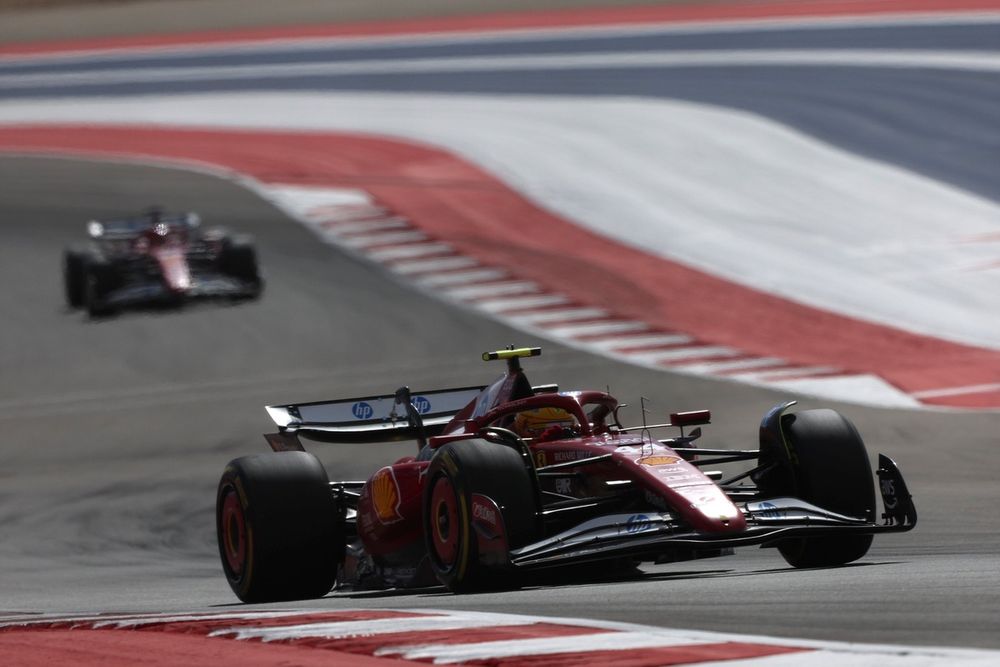
Consequently, the generation of sparks beneath the vehicle, resulting from the titanium skid plates on the plank’s forward section, provides only a partial indication of the vehicle’s ground clearance. Floor wear is neither uniform nor consistent across vehicles, although teams cannot deviate excessively. This necessitates achieving a precise equilibrium.
An issue rooted in the project and difficult to fix
Excessive floor wear concentration, particularly at the rear, compels teams to elevate the vehicle, thereby reducing downforce as air is drawn from the sides, including turbulent air from rear tire ‘squish’. This issue particularly affected Ferrari early in the season, even on nominally smooth circuits, underscoring the team’s attempts to minimize ground clearance for marginal gains.
This pronounced sensitivity to ride height impacts both downforce generation and other setup aspects, especially suspension, which can be adjusted for stiffness based on circuit demands. This can create a chain reaction, potentially exceeding the vehicle’s optimal operating parameters, resulting in a significant performance decline and necessitating mid-race adjustments during pitstops (Hungary) or altered racing lines.
This problem stems from the vehicle’s design and is difficult to rectify mid-season. Ferrari has attempted interventions on both aerodynamic (new floor) and mechanical fronts to broaden the operating window and regain margin. However, this is a complex undertaking, requiring time and resources.
Consequently, and recognizing the unattainability of initial objectives, Maranello curtailed SF-25 development early to prioritize next season’s project.
We want to hear from you!
Let us know what you would like to see from us in the future.
Take our survey
– The Autosport.com Team