As a consequence of actions taken in the minutes leading up to the Dutch Grand Prix, Ferrari’s Lewis Hamilton will be subject to a demotion of five grid positions at the upcoming Monza race, his team’s home event. The F1 officials also rendered their judgement regarding an incident involving his teammate, Charles Leclerc (seen below).
Approximately 45 minutes before the race commencement, during the standard assessment laps, Hamilton was found to have exceeded the permissible speed limit while approaching the pit lane. This contravened a specific directive issued by the FIA’s race director, Rui Marques. Marques had implemented heightened safety measures in response to Zandvoort’s steeply banked, full-throttle final corner, which necessitated drivers to swiftly commit to the pit entry road should they opt to enter.
Consequently, the race director’s briefing communicated to all drivers that double yellow flags would be displayed at the final corner during the laps leading to the starting grid. This was intended to further reduce vehicle speeds in light of the personnel assembling on the starting grid.
However, the officials concluded that Hamilton had not sufficiently reduced his speed in compliance with the double yellow flag condition during two successive out laps. As such, they imposed a five-place grid penalty, to be enforced at the Italian Grand Prix the following weekend.
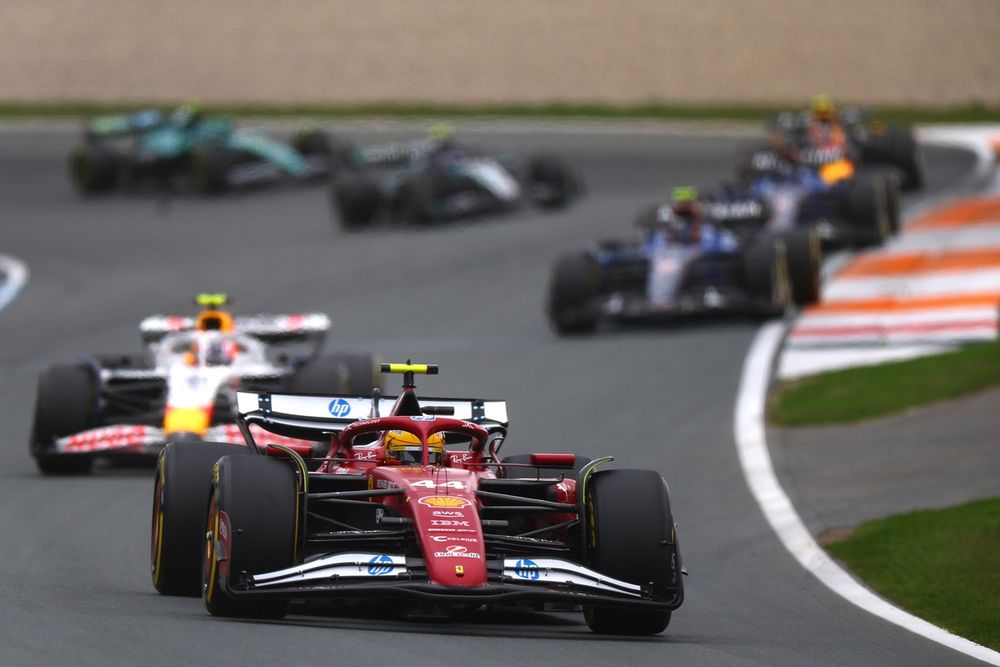
Lewis Hamilton, Ferrari, Liam Lawson, Racing Bulls
Photo by: Bryn Lennon / Formula 1 / Getty Images
According to the stewards’ verdict, “Given the track’s unique characteristics, the Race Director had communicated to all participants that double yellow flags would be in effect at the final corner preceding the pit lane.”
The verdict continued, “This measure was implemented to ensure the safety of individuals present on the grid and within the pit lane. Regulations stipulate that any driver traversing a marshalling sector displaying double waved yellow flags must ‘reduce speed significantly…’. We reviewed the available telemetry data within the FIA system. Additionally, we requested telemetry data from the team. This comprehensive process consumed considerable time, leading to a delay in rendering this decision.”
“Furthermore, Article 44.1 mandates that all drivers completing more than one reconnaissance lap must navigate the pit entry road at a ‘greatly reduced speed’. Data analysis revealed that the driver entered the double yellow sector approximately 20kph slower than during practice sessions, reduced throttle application by approximately 10% to 20%, and initiated lifting and braking 70 meters earlier upon entering the pit lane.”
“We determined that a 20kph reduction in speed within a double waved yellow sector did not constitute a ‘significant’ reduction in speed. We also concluded that the driver’s speed upon entering the pit entry road was not ‘greatly’ reduced.”
“The standard penalty for such a violation is a demotion of 10 grid positions at the subsequent race. However, considering the driver’s attempt to reduce speed and brake earlier, we deemed these as mitigating circumstances and consequently imposed a five-place grid penalty.”
Hamilton, who withdrew from the race following a crash at Turn 3, also incurred his initial two penalty points within the preceding 12-month timeframe.
Charles Leclerc and George Russell: No Further Action (NFA)
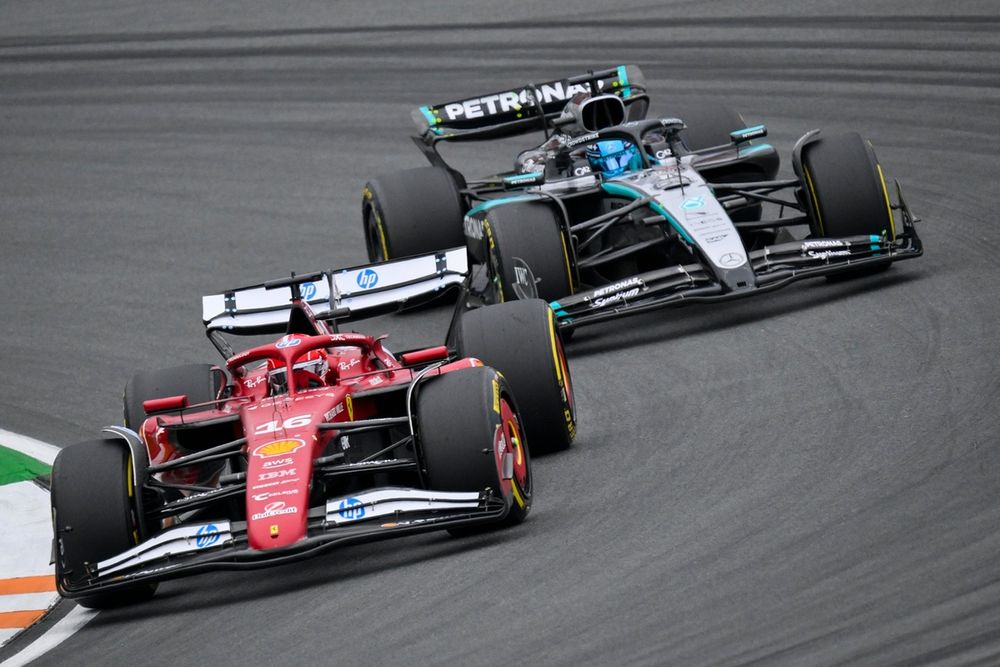
Charles Leclerc, Ferrari, George Russell, Mercedes
Photo by: John Thys / AFP via Getty Images
Charles Leclerc, the teammate of the British driver, did not receive any penalties in regards to his incident with George Russell at Turn 12. Leclerc made an ambitious move on the inside of the banked left-hand corner which resulted in a minor collision between the two. Additionally, there was suspicion that the Ferrari driver may have exceeded track limits when making his maneuver.
The officials declared that they did not have sufficient evidence to support the claim that Leclerc had left the track, and therefore they did not hold either driver accountable for the contact. This resulted in no further action.
The officials commented, “We conducted a review, while adhering to the guidelines for driving standards, to assess whether either driver could have acted differently. We also examined whether Car 16 remained within the boundaries of the track or exited at Turn 12. The available data did not offer a definitive conclusion as to whether Car 16 left the track. Representatives from both teams concurred that there was no conclusive proof indicating that Car 16 had left the track.”
“Both drivers expressed the opinion that this was a racing incident, and they did not feel further consequences were necessary for either driver. Upon examining all available evidence, we came to the same conclusion. Therefore, we decided to take no further action.”
Later in the race, Leclerc had to withdraw due to a collision with Andrea Kimi Antonelli, George Russell’s teammate, which resulted in him hitting the wall. Antonelli was given a 10-place grid penalty and two penalty points, bringing his total to four.
The penalty was determined before the race concluded and was reflected in the official results, which meant the Italian driver was moved out of the top 10.
In this article
Be the first to know and subscribe for real-time news email updates on these topics