The date of March 20, 2016, stands out as a moment when Formula 1 instilled fear yet simultaneously showcased its ongoing dedication to safety advancements and its relentless pursuit of improvement. A decade has passed since the dramatic incident involving Fernando Alonso at the Australian Grand Prix, an event that remains striking in many recollections.
During the seventeenth lap of the competition, as he vied for the nineteenth position in his less-than-optimal McLaren-Honda, the celebrated two-time world champion tried to pass Esteban Gutierrez on the exterior of Turn 3. However, he collided with the rear wheel of the Haas vehicle. This impact instantly propelled him towards the outer barrier, and with no ability to steer, his car veered onto a grassy and gravelly area, where it lodged itself.
The vehicle subsequently started to tumble, eventually settling inverted close to a tire wall. Alonso promptly emerged from the twisted remains without apparent injury. Despite being visibly shaken, he was standing. Despite this initial appearance, he later experienced a collapsed lung and fractured ribs, necessitating his absence from the subsequent Grand Prix.
At the time of this incident, Formula 1 was actively exploring methods to enhance head protection for drivers. The “halo” system had already undergone testing for several months, having been initially presented by Ferrari during that year’s winter trials and assessed alongside an alternative mechanism, the Aeroscreen. Given the remarkably small opening through which Alonso managed to extricate himself from his McLaren, concerns rapidly surfaced, simultaneously providing an opportunity for critics of the halo to fault the FIA.
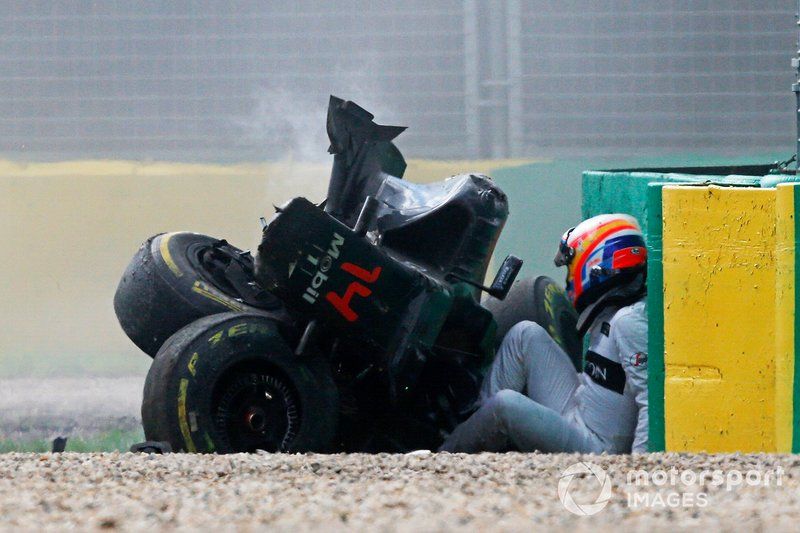
Fernando Alonso, McLaren MP4-31, crash
Photo by: James Gasperotti / Motorsport Images
The regulatory organization predictably initiated an inquiry into the Spanish racer’s crash and, for the inaugural time, leveraged video recorded by the advanced ultra-high-speed cameras that had been fitted in F1 vehicles since 2015. This footage significantly aided in clarifying what the consequences might have been if the halo system had been in place during an event of this nature.
Remarkable Statistics
Within three months, the findings were released. The initial revelations involved astounding data points. The video footage, coupled with information from accelerometers, laid bare the extent of the collision.
Upon impact with Gutierrez, Alonso’s speed was 313 km/h; his collision with the barrier registered a lateral deceleration force of 45G; a comparable force of 46G was subsequently registered as the car rolled. The vehicle was entirely airborne for 0.9 seconds, and upon its return to the ground, the rear sustained a longitudinal acceleration of 20G. The renowned high-speed camera further indicated that the driver’s head contacted the left side of his headrest on two occasions.
“Our objective is to grasp the precise movements of the head, neck, and shoulders during a collision involving significant g-forces, and to comprehend their interplay with other components of the cockpit, including head protection, the HANS device, safety harnesses, and any other elements within the driver’s immediate surroundings,” Laurent Mekies, who was then the managing director of the FIA’s research institute and is now the team principal at Red Bull, elaborated in his findings.
“This particular camera provides us with enhanced insight into the precise forces exerted on the head during a specific motion, the degree of neck extension, its interaction with the headrest, the functionality of the headrest itself, and the necessary adjustments for future cockpit designs.”
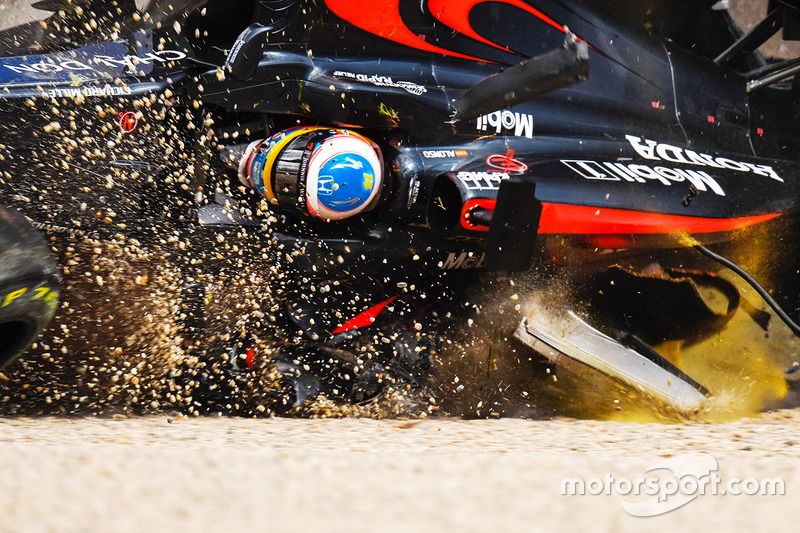
Fernando Alonso’s crash in Melbourne in 2016.
Photo by: Sutton Images
Aside from this vital area concerning cockpit safety components, the FIA subsequently integrated the conclusions from its inquiry into its wider investigation into safeguarding drivers’ heads. The administrative body pursued its quest for resolutions with utmost rigor. It even undertook simulations of Alonso’s crash scenario incorporating the halo device. The outcomes, which were made public in early 2017, proved highly promising and swayed numerous drivers upon their disclosure.
“We inverted one of our vehicle chassis equipped with a halo,” Mekies elucidated back then. “We positioned Andy Mellor [an FIA technical consultant] within to evaluate the most adverse circumstances and instructed him to exit, specifically replicating Fernando’s orientation. Astoundingly, he succeeded,” Mekies remarked with a smile. “Thus, we believe that in such an event, the halo offers sufficient clearance for the driver.”
This signified a further hurdle overcome in the FIA’s prolonged endeavor, which aimed to implement the halo in F1 before progressively rolling it out across other single-seater racing divisions. Similar to this challenge, other impediments incrementally vanished, occasionally amidst profound discussions that sparked extensive debate.
Regardless, by the winter period of 2018, the updated F1 vehicles were officially presented, featuring the halo system. From that point onward, the inclusion of this protective apparatus has remained undisputed. One need only refer to Romain Grosjean, among others, for confirmation.