The Formula 1 season in 2026 will introduce a completely fresh rulebook, bringing alterations to both the vehicle’s frame and its power unit, with the engine adjustments attracting the most attention.
This is due to the increased dependence of an F1 power unit on electric power, achieving almost an even distribution with the internal combustion engine, which elevates the significance of battery oversight to unprecedented levels.
Drivers might frequently find themselves deviating from their established methods for achieving optimal lap times, as vehicles could now employ strategies like lifting off the throttle and coasting, or downshifting on straights, all for the purpose of accumulating energy.
This subject has undeniably generated considerable debate – with Max Verstappen famously describing the 2026 rules as “Formula E on steroids” – primarily due to the intricate nature of this new regulatory period, sparking fears of potential fan disengagement.
However, spectators can gain clearer insight into the unfolding events, particularly concerning energy handling, by observing the rear LED indicators, which have assumed a significantly expanded function compared to previous seasons.
In prior iterations, these lights would illuminate when the MGU-H was replenishing power or when the MGU-K was recuperating energy during deceleration. With the MGU-H’s removal, the primary rear light has been re-engineered, and together with the twin lights on the rear wing’s extremities, it can now signal a car’s current energy management state.
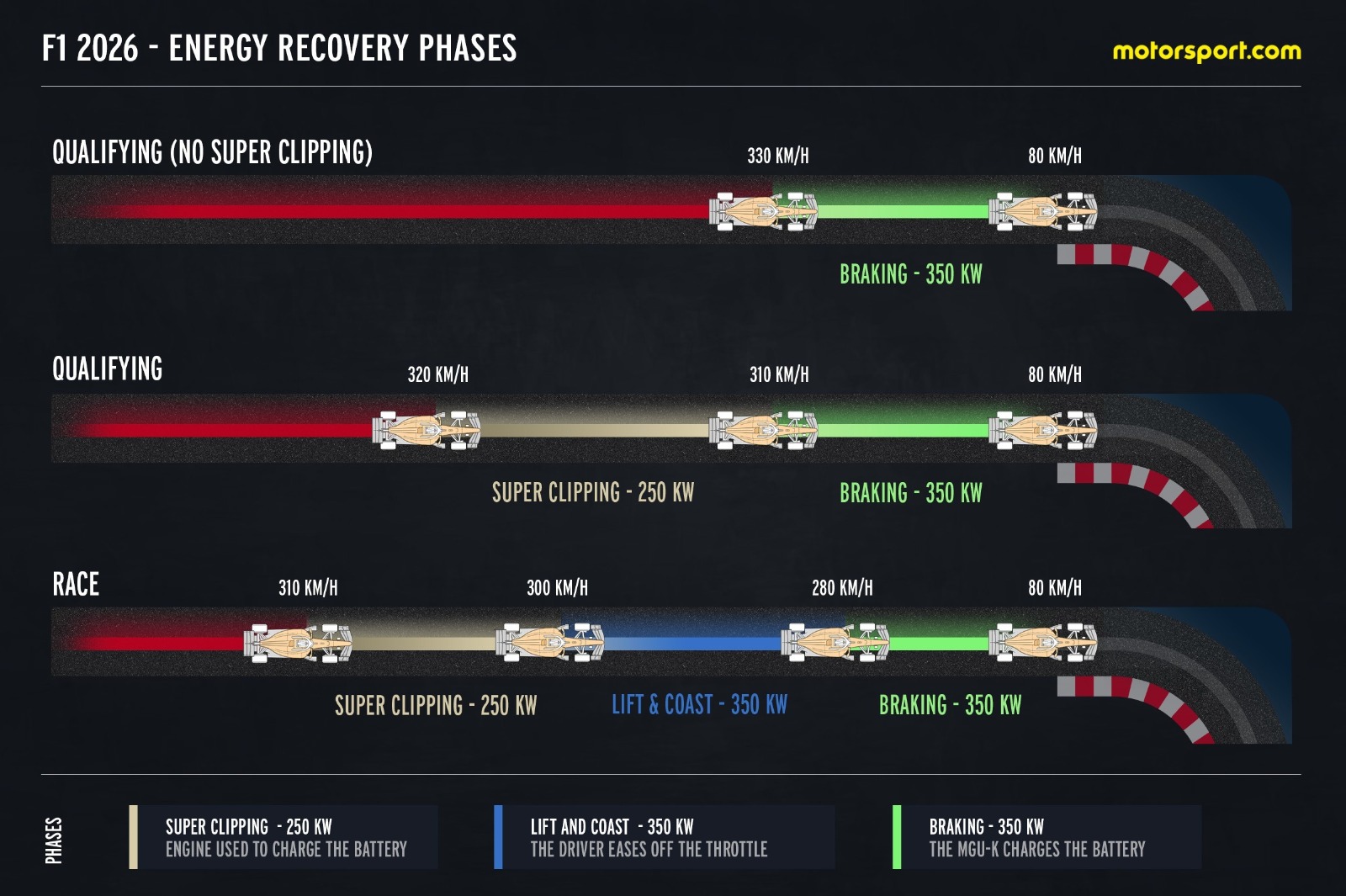
Photo by: Gianluca D’Alessandro
A single flash of the lights signifies that the MGU-K continues to provide power to the system, though at an output less than the authorized 350kW. Practically speaking, from this point, the vehicle’s acceleration might fluctuate and cease to be as rapid as when the electric generator supplies the peak power sanctioned by the rules.
Should the LEDs flash twice, the MGU-K is essentially inactive; it’s neither feeding energy into the system nor regenerating it. At this juncture, the vehicle relies exclusively on the internal combustion engine (ICE), which in 2026 will produce over 500 horsepower.
Ultimately, if the rear lights are flashing without interruption and at a quick pace, it indicates the MGU-K is undergoing complete recharging while the ICE continues to operate at maximum power. This scenario is known as “super clipping,” where energy is being collected even when the accelerator is fully engaged.
In such situations, particularly in fast sections, there will be periods where the driver maintains a wide-open throttle, yet the MGU-K will counteract the ICE to produce energy and replenish the battery. While this offers following drivers an instant insight into a competitor’s energy status, the primary motivation for these modifications is safety.
Abrupt reductions in velocity can happen when the MGU-K begins its recharging cycle, especially during super clipping. Consequently, a warning was deemed necessary for vehicles following closely to enable timely reactions and prevent hazardous situations.
Nonetheless, it is certain that racing teams will meticulously examine the rear light patterns of competing cars to acquire data regarding their energy characteristics. Correlating these indicators with telemetry information allows for determining the MGU-K’s power output or pinpointing sections where the battery is being refilled.
Beyond these functions, the rear lights also serve broader purposes, including signaling a safety car deployment, a double yellow flag zone, indicating an engine stall on the circuit, or signifying that the vehicle is fitted with wet weather tires.