While opinions may still differ, the Las Vegas Grand Prix in Formula 1 is progressively finding its rhythm, especially after a turbulent and extravagant introduction in 2023.
Although F1 hasn’t disclosed precise attendance numbers beyond stating the race was “sold out,” it remains unclear whether this exceeds last year’s 306,000, which was a decrease from the inaugural year’s 315,000. The event has adjusted its ticket options, presenting more accessible choices to attract a broader segment of F1’s diverse audience, reducing its reliance on high-end spenders who may feel they’ve already experienced it.
Local sentiments remain varied, according to discussions with Uber drivers and bartenders. Some express concerns about the event’s disruptions, although they are admittedly lessened, while others acknowledge the inconveniences for the city’s broader economic benefits.
Formula 1 has turned a typically quiet period before Thanksgiving into a major occasion. However, this transformation comes at a cost for the F1 community. They now face a demanding journey from Las Vegas to Doha, commonly involving a 15-hour economy flight from Los Angeles, followed by a third consecutive weekend and post-season testing in Abu Dhabi.
A pattern appears to emerge in how warmly people regard Las Vegas, seemingly correlated with their position within Formula 1. Team leaders and commercial executives are ecstatic about the event’s B2B opportunities as F1’s popularity soars to unprecedented heights.
Conversely, mechanics are less enthusiastic, dreading the extended journey and time zone changes as part of a triple-header concluding just weeks before Christmas in Abu Dhabi, a mere seven weeks before the initial 2026 trials in Barcelona.
These perspectives are not mutually exclusive. One can acknowledge that Las Vegas is undeniably advantageous for F1, while also suggesting a more acceptable compromise. This might involve pairing the event with Brazil, allowing mechanics, setup personnel, and hospitality teams to recuperate before a more logical Qatar/Abu Dhabi double-header.
Several drivers are lending their support to F1’s paddock community, having witnessed firsthand the exhaustion of their crews upon reaching Abu Dhabi in previous years.
Two-time world champion Fernando Alonso expressed that the timing on the calendar is challenging, pointing out the circuit’s inadequate grip caused by November’s cold conditions, which he deems almost unacceptable by F1 standards. He also noted the significant time difference and distance from Europe, especially when considering Brazil two weeks prior, and the subsequent 17-hour flight to Qatar with an [11]-hour time difference.

Fernando Alonso, Aston Martin Racing
Photo by: Zak Mauger / LAT Images via Getty Images
Alonso questioned whether any other sport would accept such conditions, remarking that the decision to hold the race during Vegas’ quietest weekend shouldn’t justify overlooking sporting considerations. He suggested that if this rationale were followed, Monaco might be raced in February for similar reasons, stressing the need to prioritize the sport’s integrity.
When asked about Alonso’s remarks, GPDA director Carlos Sainz shared that they had voiced their concerns to Stefano Domenicali, F1 CEO. Sainz suggested pairing Vegas with Brazil to avoid returning to Europe only to come back. He strongly agreed that a triple-header of Vegas, Qatar, and Abu Dhabi is detrimental for everyone involved.
While Alonso and Sainz advocate for their mechanics, creating a 24-race calendar is complex, and organizing an event like the Las Vegas Grand Prix, which effectively shuts down a significant part of the city, has many complexities. Shutting down the Strip for F1 would have seemed improbable just a decade ago. Yet, it has succeeded, and moving the timetable forward by two hours for the 2025 edition made it seem more manageable, particularly for those present.
F1 management recognizes the issues raised, and having managed to reschedule the Canadian Grand Prix for the following year, they are committed to further refining the calendar. However, resolving Vegas’s scheduling challenges won’t occur in 2026, as it remains part of the final triple-header.
Sainz noted that Stefano is dedicated to improving the calendar and will implement positive changes next year. He objectively believes there’s room for enhancement, confident that Stefano is doing everything possible to achieve it.
Toto Wolff of Mercedes, who had a busy Vegas schedule with a speaker appearance at F1’s Business Summit, believes that the event’s benefits outweigh the negatives for the series.
He acknowledged that the schedule might be strenuous for teams and the media but emphasized that the quality of the product is paramount, and this was the best weekend possible in Las Vegas.
Wolff mentioned having free weekends in between and wanting to avoid extending the season too late, as had happened in previous years, so the current arrangement is what it is and should be embraced, even if it’s not always convenient for everyone.
Sauber’s team boss, Jonathan Wheatley, soon to be with Audi, humorously requested advice on achieving a good sleeping pattern in Las Vegas.
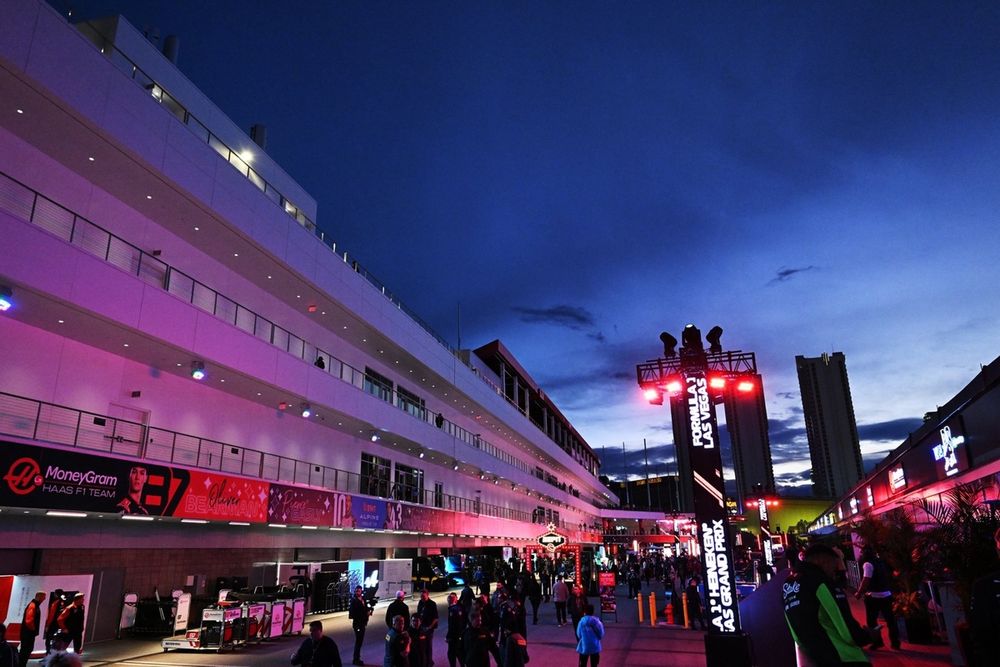
The Paddock at dusk prior to the F1 Grand Prix of Las Vegas
Photo by: Simon Galloway / LAT Images via Getty Images
He admired the pit building complex, the race’s location in Las Vegas, and the extraordinary setup, acknowledging that holding the event at this time of year benefits Las Vegas.
Wheatley added that it’s an incredibly tough triple-header, underscoring that Formula 1 has always tested not only the drivers but everyone involved. Yet, they adapt and learn, and Liberty Media and Stefano are open to discussing potential adjustments if necessary.
As Wolff noted, the challenge lies in appropriately spacing out the calendar without extending races until Christmas Eve. Due to commercial considerations, Vegas is scheduled on its specific weekend, requiring close collaboration with the city, casinos, the Las Vegas Convention and Visitors Authority, and Clarke County for any changes.
Moving the event forward could potentially conflict with races like Austin and cause other scheduling issues.
However, after a flashy start, the event has matured and gained approval from the drivers. Even Max Verstappen, who has been hesitant about Vegas’s extravagance, understands the weekend’s significance to those who fund his salary, offering a balanced view.
Verstappen stated that while some prefer more spectacle and others different track types, he also has personal preferences. He enjoys being in Vegas but acknowledges his aversion to being a showman. He understands that this is part of being in Vegas and accepts it.
The essential point is that Las Vegas has quickly become a cornerstone of F1 due to its off-track allure, but it isn’t another Monaco. Although it lacks history, the on-track product rivals or surpasses many traditional locations. Ironically, the lack of grip might enhance the spectacle.
As the event enters its third year, Formula 1’s achievements should be acknowledged. Envisioning the calendar without Vegas is now challenging. However, there is still room for improvement to benefit fans, personnel, and the local community.
We want to hear from you!
Let us know what you would like to see from us in the future.
Take our survey
– The Autosport.com Team