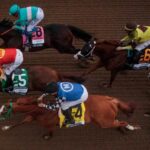
The upcoming Saturday racing program at Santa Anita Park features the $200,000, Grade 2 San Felipe Stakes, sponsored by DK Horse. This event will see several of California’s leading 3-year-olds compete in the ultimate local preparatory contest leading up to the Grade 1 Santa Anita Derby.
Naturally, numerous contenders in this race are aiming for more significant achievements. The first five horses to cross the finish line will accumulate points for the Grade 1 Kentucky Derby Presented by Woodford Reserve, with the victor receiving a total of 50 points.
Originating in 1935, the San Felipe has been exclusively for 3-year-olds since 1941. It has been run at its present length of 1 1/16 miles since 1952, and it has carried Grade 2 status since 1989. Below, we will revisit some of the most celebrated racehorses who have triumphed in the San Felipe.
AFFIRMED (1978)
CAREER RECORD: 29 starts, 22 wins, 5 seconds, 1 third
CAREER EARNINGS: $2,393,818
By the time the 1978 Derby season commenced, Affirmed was already a highly recognized name among horse racing enthusiasts. He earned the title of champion 2-year-old male in 1977, having secured three Grade 1 victories. All these wins were achieved competing against another promising colt named Alydar, who later defeated Affirmed in the Grade 1 Champagne Stakes near the close of the year. Although Affirmed spent most of 1977 on the East Coast, his trainer Laz Barrera opted to relocate him to the West in early 1978 to prepare for the Kentucky Derby.
His 3-year-old campaign commenced with an allowance event on March 8, which he easily won by five lengths. Just eleven days afterward, he encountered five competitors in the San Felipe Handicap. Carrying the highest weight in the field by four pounds, Affirmed was the favored entry at 3-10 odds.
He faced a momentary challenge but ultimately succeeded. Acclaimed jockey Steve Cauthen, sporting the pink and black silks of Harbor View Farm, kept Affirmed just behind the front-runners before urging him forward on the final bend. Nevertheless, the initial leader, Chance Dancer, resisted yielding and bravely maintained its position. As both horses matched strides down the stretch, the outcome remained uncertain until the final sixteenth, when Affirmed finally overtook the longshot and pulled ahead for a two-length victory.
The San Felipe merely marked the beginning of Affirmed’s extraordinary 3-year-old campaign. He convincingly won his subsequent two Derby preparatory races, then proceeded to conquer the Kentucky Derby, Preakness Stakes, and Belmont Stakes, becoming the 11th Triple Crown champion. In each of these contests, his principal rival, Alydar, finished as the runner-up. The Belmont featured an epic struggle between the two adversaries, with Affirmed ultimately prevailing by a head.
In 1979, as a 5-year-old, Affirmed secured five additional Grade 1 wins, including a victory over the legendary Spectacular Bid in the Jockey Club Gold Cup. He became the inaugural horse to accumulate over $2 million in career earnings, retiring as the highest-earning horse of all time.
DESERT WINE (1983)
CAREER RECORD: 25 starts, 8 wins, 8 seconds, 3 thirds
CAREER EARNINGS: $1,618,043
Desert Wine had already achieved significant success leading up to the 1983 San Felipe Handicap. He had claimed victory in three graded stakes and placed second in three others, notably the Hollywood Futurity, which then stood as the wealthiest race for 2-year-olds in American horse racing annals.
To kick off his 3-year-old season, Desert Wine secured a win in the Grade 3 San Rafael Stakes by 2 ¼ lengths, going off as the 13-10 favorite. This strong performance solidified his position as the dominant 7-10 favorite among the six-horse field for the San Felipe.
Chris McCarron guided Desert Wine to the front, but faced continuous pressure from the longshot Easy Cash. Concurrently, Bill Shoemaker positioned the second favored Naevus just off the leading pair, then made his move as Easy Cash started to tire. The two leading contenders battled intensely down the stretch, while Naevus began veering outward. Despite Naevus crossing the wire a head in front, race officials promptly signaled an inquiry following the finish.
Following a review, Naevus was demoted from first place to second. Desert Wine was consequently declared the winner, thereby cementing his reputation as California’s premier Kentucky Derby contender.
Desert Wine’s prominence slightly diminished in his subsequent two starts. He finished sixth as the 9-10 favorite in the Santa Anita Derby, then secured second place in the Blue Grass Stakes. Nonetheless, he found redemption during the Triple Crown series, achieving runner-up finishes in both the Kentucky Derby and the Preakness Stakes. At age 4, he excelled even further, capturing three Grade 1 races within California.
SUNDAY SILENCE (1989)
CAREER RECORD: 14 starts, 9 wins, 5 seconds, 0 thirds
CAREER EARNINGS: $4,968,554
Heading into the 1989 San Felipe Handicap, Sunday Silence seemed full of promise but had yet to demonstrate significant achievements on the racetrack. He had never competed against stakes-level opposition nor had he run a distance beyond 6 ½ furlongs. In an entry-level allowance race held 17 days prior to the San Felipe, he secured a 4 ½-length victory on a sloppy track. Based on that performance, he was listed as the 8-5 second choice on the morning line for the San Felipe, eventually closing at 2.90-1 odds. Music Merci, a three-time stakes winner, was the commanding 1-2 favorite.
Following a poor start, Pat Valenzuela maneuvered Sunday Silence into a tracking position, while the longshot Yes I’m Blue established a substantial early lead. When that competitor began to falter, both Sunday Silence and Music Merci launched bids to pursue the leader. While Music Merci failed to sustain his run, Sunday Silence maintained his momentum and pulled away to triumph by 1 ¾ lengths.
Despite this victory, Sunday Silence was not the favorite in the Santa Anita Derby. Houston, a promising colt from trainer D. Wayne Lukas’s stable, was favored at 9-10, whereas Sunday Silence was 2.40-1. However, as Houston struggled, Sunday Silence surged to an 11-length win, silencing all Californian skeptics and establishing a formidable rival for Easy Goer, the leading 3-year-old on the East Coast.
As history records, Sunday Silence and Easy Goer became inextricably linked. Sunday Silence bested him in the Kentucky Derby and Preakness Stakes, but Easy Goer reversed fortunes in the Belmont Stakes. In their ultimate confrontation, the 1989 Breeders’ Cup Classic, Sunday Silence fended off Easy Goer’s desperate late surge to win by three-quarters of a length, thereby securing Horse of the Year honors. He stands as one of only four horses to win both the Kentucky Derby and the Breeders’ Cup Classic in the same year.
BERTRANDO (1992)
CAREER RECORD: 24 starts, 9 wins, 6 seconds, 2 thirds
CAREER EARNINGS: $3,185,610
By 1992, three decades had passed since a California-bred horse last claimed victory in the Kentucky Derby. Bertrando appeared a strong contender to break this dry spell as he entered the 1992 San Felipe. During his 2-year-old season, he captured two graded stakes in California, then secured second place behind Arazi in the Breeders’ Cup Juvenile. For his inaugural start as a 3-year-old in the San Felipe, he was established as the 2-5 favorite among the six-horse lineup.
He faced a challenging task, but Bertrando ultimately triumphed. Jockey Alex Solis, consistent with his usual strategy, placed him at the front, compelling him to maintain a punishing pace while relentlessly pressed by Hickman Creek. Despite enduring the intense pace, Bertrando maintained his advantage in the stretch and secured a three-quarters of a length win, resisting a late charge from Arp.
This contest paved the way for a highly anticipated Santa Anita Derby confrontation featuring another promising 3-year-old, A.P. Indy. Bertrando was the 11-10 second choice, while A.P. Indy was sent off as the 9-10 favorite. After Bertrando established the early pace, A.P. Indy gradually wore him down to achieve a 1 ¾-length victory.
Regrettably, Bertrando was denied the opportunity to conclude the California-bred Derby winning drought. An ailment kept him out of action for the subsequent eight months. He made a strong comeback at age 4, performing as well as ever with three graded stakes victories. The highlight was an astounding 13 ½-length win in the Woodward Stakes at Belmont Park, which elevated him to favorite status for the Breeders’ Cup Classic. In that race, he finished second, trailing the 133.60-1 longshot Arcangues.
ARTAX (1998)
CAREER RECORD: 25 starts, 7 wins, 9 seconds, 3 thirds
CAREER EARNINGS: $1,685,840
While he would fully exploit it later in his career, Artax displayed considerable speed during the 1998 Derby prep circuit. In the Santa Catalina Stakes, he dictated the early pace, withstood challenges, and pulled away for a 5 ½-length victory. Following this impressive showing, he entered the San Felipe Stakes as the 6-5 favorite. He competed against only four other horses, one of whom was the emerging Bob Baffert-trained colt named Real Quiet. That particular colt would go on to achieve significant feats, missing a Triple Crown win in the Belmont Stakes by merely a nose.
However, on this specific occasion, Artax emerged victorious. Jockey Chris McCarron positioned him at the forefront early, establishing a swift initial quarter-mile in 22.80 seconds. Once McCarron had secured the lead, he significantly eased the pace. The half-mile segment was clocked at 46.85 seconds, indicating a second quarter completed in just 24.05 seconds. With such a favorable pace advantage, Artax successfully maintained his lead throughout the race. Although Real Quiet mounted a late challenge, Artax crossed the finish line a head in front.
This particular win marked his final victory in a two-turn race. He was unable to gain the lead in either the Santa Anita Derby or the Kentucky Derby, resulting in subpar performances in both. After a series of uninspiring races in California, Artax was transferred eastward in March 1999, joining trainer Louis Albertrani’s stable.
Under Albertrani’s guidance, Artax exclusively competed over shorter distances. This tactical shift proved highly effective, as he secured four graded stakes wins in 1999 and placed second in four others. In the Carter Handicap, he established a new track record for seven furlongs at Aqueduct, completing the distance in 1:20.04. He concluded his season with a half-length triumph in the Breeders’ Cup Sprint.
FUSAICHI PEGASUS (2000)
CAREER RECORD: 9 starts, 6 wins, 2 seconds, 0 thirds
CAREER EARNINGS: $1,994,400
“FuPeg” garnered considerable attention even before his racing debut. At the 1998 Keeneland July yearling sale, Japanese entrepreneur Fusao Sekiguchi acquired him for an astonishing $4 million. As a progeny of Mr. Prospector and a Danzig mare, FuPeg was impeccably bred for exceptional performance.
A late-maturing and spirited colt, FuPeg did not achieve his first victory until January 2 of his 3-year-old season, breaking his maiden by two lengths as the 1-5 favorite. After securing an allowance win, he was installed as the 1.30-1 favorite in the seven-horse San Felipe field. His competitors included two-time stakes winner The Deputy, reigning Breeders’ Cup Juvenile champion Anees, and Commendable, who would later win the Belmont Stakes.
Kent Desormeaux orchestrated a superb ride for Fusaichi Pegasus in the San Felipe, patiently allowing him to settle off the pace set by Commendable. Commendable had established a two-length advantage entering the stretch, but Desormeaux urged FuPeg forward, and he effortlessly overtook the leader. He crossed the finish line three-quarters of a length ahead, successfully fending off a late surge from The Deputy.
After an impressive victory in the Wood Memorial, Fusaichi Pegasus was designated the 2.30-1 favorite for the Kentucky Derby. He met expectations, closing from behind to secure a 1 ½-length win. This made him the first favorite to claim the Derby title since Spectacular Bid in 1979.
He competed only three times subsequent to the Derby. After finishing second as the 3-10 favorite in the Preakness Stakes, he was absent from racing until a win in the Jerome Handicap in September. He concluded his career with a sixth-place finish as the favorite in the Breeders’ Cup Classic.
POINT GIVEN (2001)
CAREER RECORD: 13 starts, 9 wins, 3 seconds, 0 thirds
CAREER EARNINGS: $3,968,500
Point Given demonstrated a robust 2-year-old season in 2000, positioning himself as the premier Kentucky Derby prospect from Bob Baffert’s stable. He secured victories in two graded stakes events and placed second in the Breeders’ Cup Juvenile. Point Given’s debut as a 3-year-old was delayed until the San Felipe on March 17. He entered the eight-horse field as the commanding 2-5 favorite.
Emerging from the outermost starting position, jockey Gary Stevens positioned Point Given in mid-pack during the early stages, while the front-runners maintained a blistering pace. As the field rounded the final turn, the leading trio began to falter, and Point Given initiated a powerful five-wide surge. By the time they reached the eighth pole, Point Given had established a comfortable lead, ultimately crossing the finish line 2 ¼ lengths ahead.
Following an impressive 5 ½-length triumph in the Santa Anita Derby, the Kentucky Derby appeared poised for Point Given’s coronation. Nevertheless, he delivered a disappointing fifth-place finish, trailing Monarchos by 11 ½ lengths, who recorded the second-fastest Derby time in history. For the remainder of the year, Point Given was flawless. He dominated the rest of the Triple Crown series, winning the Preakness Stakes and Belmont Stakes by significant margins. He then claimed the Haskell Invitational by half a length, concluding a Horse of the Year season with a 3 ½-length victory in the Travers Stakes.
PIONEEROF THE NILE (2009)
CAREER RECORD: 10 starts, 5 wins, 1 second, 1 third
CAREER EARNINGS: $1,634,200
Pioneerof the Nile approached the 2009 San Felipe as California’s leading Derby hopeful, a reputation that arguably extended nationwide. He had previously triumphed in the CashCall Futurity at Hollywood Park and the Robert B. Lewis Stakes at Santa Anita. Bettors universally designated him as the top selection for the San Felipe, sending him off at 3-10 odds.
The second favorite, New Bay, established a clear early advantage, while jockey Garrett Gomez kept Pioneerof the Nile near the rear of the six-horse field during the initial quarter. Recognizing the developing slow tempo ahead, Gomez permitted Pioneerof the Nile to gradually advance towards the front-runners. Shortly after the half-mile mark, Pioneerof the Nile drew alongside New Bay and continued to challenge as they turned for home. In the homestretch, Gomez called on him for more, and Pioneerof the Nile ultimately prevailed by 1 ¼ lengths.
After a one-length victory in the Santa Anita Derby, Pioneerof the Nile was the 6.30-1 third favorite in the Kentucky Derby. He executed what appeared to be a winning maneuver on the far turn but could only manage second place, behind the spectacular late surge of longshot Mine That Bird. Pioneerof the Nile’s racing career concluded after an 11th-place finish in the Preakness Stakes, yet his most significant contribution arguably came in breeding. A colt from his second progeny, American Pharoah, famously went on to secure the Triple Crown in 2015.
CALIFORNIA CHROME (2014)
CAREER RECORD: 27 starts, 16 wins, 4 seconds, 1 third
CAREER EARNINGS: $14,752,660
Prior to the 2014 San Felipe, California Chrome was recognized as a colt with considerable latent talent, though he hadn’t yet achieved significant victories against general competition. He had secured three stakes wins exclusively against California-bred horses but still lacked a graded stakes triumph. The San Felipe was anticipated to be his test of class, and bettors installed him as the 7-5 favorite to successfully navigate it.
Jockey Victor Espinoza swiftly guided California Chrome to the front, where he faced early pace pressure from the second betting choice, Midnight Hawk. This rival pushed him through demanding fractions, clocking the opening quarter-mile in 23.09 seconds and the half-mile in 45.55 seconds.
As they rounded the final turn, California Chrome displayed no signs of weakening. In fact, he began to widen his lead over Midnight Hawk, who offered no resistance. In the ultimate eighth of a mile, Espinoza eased him down, and he crossed the finish line 7 ¼ lengths in front. This victory immediately propelled him into contention as a leading Kentucky Derby favorite.
California Chrome continued to impress in the Santa Anita Derby, winning by 5 ¼ lengths. He was made the 5-2 favorite for the Kentucky Derby and also triumphed there, becoming the first California-bred to win the Derby since 1962. Following his Preakness Stakes victory, he was the 9-10 choice to achieve the Triple Crown in the Belmont Stakes. However, he finished fourth, losing by 1 ¾ lengths to Tonalist.
After the Belmont, California Chrome continued to enhance his impressive record. He secured six more graded stakes victories, including the 2016 Dubai World Cup. In 2014, he placed third in the Breeders’ Cup Classic, and in 2016, he was second in the same race. He was awarded Horse of the Year honors in both those years, despite his Classic losses. Upon his retirement, he held the distinction of being the all-time leading money earner in American racing.
AUTHENTIC (2020)
CAREER RECORD: 8 starts, 6 wins, 2 seconds, 0 thirds
CAREER EARNINGS: $7,201,200
Bob Baffert’s stable seemed replete with Derby prospects during the 2020 Derby prep season, and Authentic was a standout among them. Following a victory in the Sham Stakes, he was installed as the 6-5 favorite in the San Felipe field of seven horses. His competitors included stakes-winning stablemate Thousand Words and the current TVG Breeders’ Cup Juvenile champion, Storm the Court.
The race itself unfolded with minimal suspense. Jockey Drayden Van Dyke sent Authentic to the early lead and never encountered any significant threats to his position at the front. Authentic secured a 2 ¼-length victory, with Storm the Court finishing third and Thousand Words a non-contending fourth. This triumph foreshadowed future successes.
Given the Kentucky Derby’s rescheduling to September due to the COVID-19 pandemic, Authentic benefited from extended preparation time for the prestigious event. He capitalized fully on this, winning the Haskell Invitational and placing second in the Santa Anita Derby. In the Kentucky Derby, he pulled off a wire-to-wire upset victory over the heavily favored Tiz the Law, then narrowly lost an exhilarating stretch battle in the Preakness Stakes to Swiss Skydiver. Authentic concluded his Horse of the Year campaign with a 2 ¼-length win in the Breeders’ Cup Classic, thereby becoming the fourth horse in history to win both the Derby and the Classic within the same year.
LIFE IS GOOD (2021)
CAREER RECORD: 12 starts, 9 wins, 1 seconds, 0 thirds
CAREER EARNINGS: $4,541,700
While some highly touted contenders on the Kentucky Derby circuit often falter when facing formidable competition, this was emphatically not the outcome for Life Is Good in the 2021 San Felipe Stakes… or thereafter.
The bay colt, sired by Into Mischief, entered the San Felipe following consecutive wire-to-wire victories: his inaugural race on November 22, 2020, at Del Mar, and his first start as a 3-year-old (and stakes debut) in the Sham Stakes in January 2021 at Santa Anita. Life Is Good was dispatched as the 1-2 favorite in the San Felipe, swiftly established a three-length advantage, and concluded with an eight-length domination to extend his perfect record to 3-for-3 under trainer Bob Baffert. His 107 Beyer Speed Figure indicated Life Is Good was, by a considerable margin, the swiftest 3-year-old on paper for the 2021 Kentucky Derby campaign, but a subsequent injury forced him to miss the American Triple Crown events.
He made his comeback in the summer under new trainer Todd Pletcher. After experiencing his first career loss, finishing second in the Grade 1 H. Allen Jerkens Memorial Stakes, Life Is Good ended his 3-year-old season with commanding, runaway wins in the Grade 2 Kelso Handicap and the Big Ass Fans Breeders’ Cup Dirt Mile. In 2022, as a 4-year-old, Life Is Good further augmented his resume with Grade 1 victories in the $3 million Pegasus World Cup Invitational Stakes, the Whitney Stakes, and the Woodward Stakes.
JOURNALISM (2025)
CAREER RECORD: 11 starts, 6 wins, 3 seconds, 1 thirds
CAREER EARNINGS: $4,348,880
Journalism, a bay colt by Curlin and out of the graded stakes victor Mopotism (by Uncle Mo), was acquired at auction for $825,000. He began to distinguish himself in his second career start in November 2024, decisively winning a one-mile race at Del Mar by 2 ½ lengths. Following that, he impressively triumphed by 3 ½ lengths in his stakes debut, the Grade 2 Del Mar Futurity, under jockey Umberto Rispoli.
Trainer Michael McCarthy provided Journalism with a 2 ½-month respite after the Del Mar Futurity, bringing him back on March 1, 2025, for the DK Horse San Felipe Stakes. In this event, he was the 3.10-1 second betting choice, trailing Bob Baffert’s highly regarded 2-5 favorite, Barnes. Journalism once again demonstrated superior performance in the stretch, besting Barnes by 1 ¾ lengths. The caliber of Journalism’s San Felipe victory was evident, with Rodriguez, the eventual Wood Memorial Stakes winner, finishing a significant 11 ¼ lengths back in third.
Subsequently, Journalism outran future Grade 1 winner Baeza by three-quarters of a length in the Santa Anita Derby, before securing a courageous runner-up finish to Sovereignty as the lukewarm favorite in the Kentucky Derby Presented by Woodford Reserve. He achieved classic winner status by overcoming considerable obstacles (detailed below) when tightly boxed in during the early stretch, then surged late to overtake Gosger for a half-length victory in the Preakness Stakes. After again placing second to Sovereignty in the Belmont Stakes Presented by NYRA Bets, Journalism earned his third Grade 1 win of the year in the NYRA Bets Haskell Stakes. He concluded his 3-year-old campaign with a second-place finish in the Pacific Classic Stakes and a fourth in the Longines Breeders’ Cup Classic, both against older horses, and commenced training for his 4-year-old season in the winter of 2026.