For the upcoming Spanish Grand Prix in Madrid, McLaren will shelve its H-wing design, with plans being in place for the rotating Formula 1 rear wing to reappear in Baku.
The Woking squad developed its unique take on the rear wing assembly—capable of a 180-degree rotation between Corner and Straight configurations—following Ferrari’s early runs with the concept in winter testing. After some delays in its introduction, the team first ran the specification during practice sessions at the Hungarian Grand Prix, followed by further evaluations in Zandvoort. The design was ultimately raced for the first time during the recent Italian Grand Prix.
Reports indicate that the device, designated internally by McLaren as the H-Wing, performed exactly as expected, with its action successfully lowering straight-line aerodynamic drag. Nevertheless, Autosport has learned that McLaren intends to restrict the H-wing mechanism to its low-drag configurations for the time being, opting against retrofitting the device onto its high-downforce aerodynamic setups.
For the inaugural race at the high-downforce Madrid circuit this weekend, the team will utilize the rear wing design first seen at Zandvoort, which is characterized by its distinct, contoured endplates.
With Formula 1 outfits forced to manage their manufacturing assets diligently, McLaren chose to prioritize the rapid development of the H-wing for Monza, a venue where minimizing drag provides a far more significant performance advantage than on winding tracks. Consequently, the team bypassed creating a high-downforce Zandvoort-spec wing integrated with the H-wing assembly.
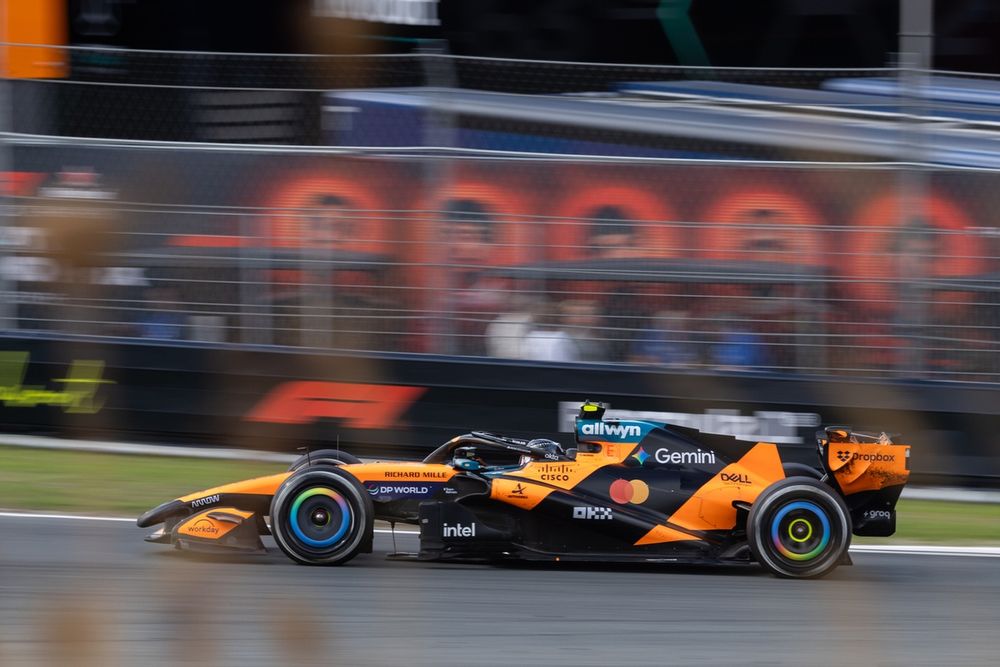
McLaren’s Zandvoort-spec rear wing with contoured endplates will be utilized in Madrid.
Photo credit: Eric Le Galliot
The Monza-spec H-wing is scheduled to reappear on the fast street tracks of Baku in late September, where top-end velocity and aerodynamic efficiency are critical. In the meantime, there are plans to develop a separate high-downforce variant later in the campaign, designed from its inception to accommodate the pivoting wing actuator.
Entering the Madrid event, McLaren is highly tipped to fight for the win around the demanding 5.4-kilometer track, buoyed by Lando Norris’s recent triumphs at both Zandvoort and the Hungaroring.
The “H-wing” name refers to the letter H within the Etihad branding visible on the MCL40’s rear wing element. This character sits right along the central axis where the straight-line configuration actuator is housed. This naming convention mirrors the team’s iconic 2010 F-duct, which drew its name from the Vodafone lettering positioned on the car’s nose cone where the system’s inlet was located.
Autosport also reports that the Racing Bulls squad, which debuted their own version of a pivoting rear wing at Monza, will shelve the device for Madrid since it is ill-suited to the demands of the Spanish street venue. The Faenza-based outfit likewise intends to bring the wing back at a later stage in the championship.
Share your thoughts with us!
Tell us what kind of content you want to experience going forward.
Participate in our survey
– The Team at Autosport.com