By the time the Azerbaijan Grand Prix concludes, voices in Formula 1 circles will likely have shifted their focus, finding new subjects to dissect and scrutinize as the Monza situation gradually becomes a distant memory.
McLaren’s strategically implemented driver swap between Lando Norris and Oscar Piastri ignited a flurry of online memes, impassioned reactions, and playful jibes. This occurred as the team reverted the running order to its pre-pitstop configuration, a decision prompted by Norris’s delayed stop. While Piastri voiced his opinion that time lost during pit stops should be considered part of racing, the resolution appeared relatively straightforward as he ultimately adhered to the team’s instruction.
Many observers expressed strong feelings regarding the exchange, even though team principal Andrea Stella asserted that the team considered it a fair decision.
The intensity of the debate surrounding the swap seemed to largely revolve around the notion that it was inherently unjust, placing Piastri at a disadvantage due to circumstances beyond his influence. However, one could contend that if the team genuinely aims for an entirely equitable environment, it should also account for factors that might unfairly hinder Norris. But does the literal interpretation of “fair” truly equate to actual fairness?
It is subjective and contingent on perspective; McLaren’s rationale appeared to be that a pitcrew error was a greater injustice to one driver over the other.
The 2024 Hungarian Grand Prix presented a somewhat parallel scenario, with Piastri initially taking the lead from Norris. Norris then regained the lead through an unexpected undercut, resulting from pitting to counter Lewis Hamilton’s move, and was initially hesitant to relinquish it. Eventually, he ceded the position to Piastri, enabling Piastri to secure his first F1 victory.

Lando Norris, McLaren, Oscar Piastri, McLaren
Photo by: Andy Hone/ LAT Images via Getty Images
This instance could be considered even more subtly nuanced. However, in that race, McLaren established its guiding principles. Monza was a continuation of this philosophy, albeit in reverse. Piastri’s pit stop was strategically timed to effectively neutralize Charles Leclerc, while Norris entered the pits subsequently. The pit crew encountered difficulties with his front-left wheel, resulting in him rejoining the race behind Piastri.
McLaren had no intention of this outcome and sought to restore the original positions. Consequently, the situation mirrored the pre-pitstop arrangement, but with the added element of Piastri briefly holding second place. This sparked discussions about object permanence, attempts to contain the uncontainable, and efforts to reverse irreversible situations—approaching a level of existential contemplation.
Situations such as this also fuel debates about what constitutes “right” within the realm of motorsport. Did the convergence of two improprieties—one intentional, one accidental—lead to a just resolution? Or was it a case of McLaren defying natural forces or happenstance in an attempt to rectify the order?
A philosophical dimension emerges here: akin to opening Pandora’s Box, or discovering that Schrodinger’s cat had not only passed away but was also emitting an unpleasant odor. Should one venture into the realm of team orders, contest moments perceived as unfair, and potentially create a path to unforeseen repercussions? Or should one allow events to unfold naturally, trusting that cosmic justice will prevail?
Frankly, either approach has merit. However, when viewed through the lens of the grandest philosophical frameworks, the matter seems somewhat trivial.
Toto Wolff proposed that McLaren’s team orders call set a “dangerous precedent,” yet a similar course of action had already been taken in Hungary the previous year.
Intriguingly, this year’s Hungarian race appeared to be characterized by a more open approach—perhaps the team genuinely doubted the effectiveness of Norris’s strategy, though strategic variations have not been entirely atypical within the team. The adjustments to the running order seem to be limited to scenarios where the team had specific intentions that were subsequently disrupted.
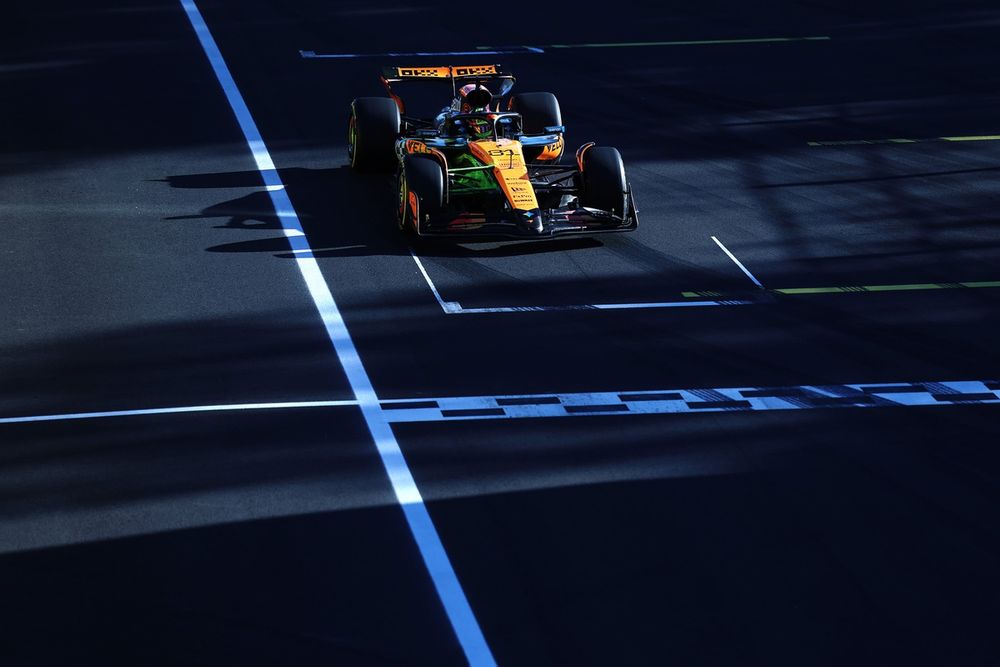
Oscar Piastri, McLaren
Photo by: Mark Thompson / Getty Images
This contrasts with F1’s reputation as an intensely competitive arena, where individuals might betray one another even before their morning coffee, and where ethical considerations often take a backseat to victory and achievement.
When McLaren steps in and expresses a desire to cultivate a culture of “fairness and transparency,” it elicits skepticism. This concept clashes with conventional perceptions of F1 team dynamics. Surely, the fiercely competitive nature of the championship is incompatible with such a philosophy?
Consequently, many perceive this as McLaren attempting to exert control over the title race. Naturally, some fans will assert that the team favors one driver over the other, while those less invested in the sport may believe McLaren is orchestrating a climactic title showdown.
Given the value placed on both drivers within the team, this is almost certainly not the case. Moreover, Piastri holds a 31-point advantage, making him the statistically more likely contender for the title. Despite what the memes might suggest, McLaren is not going to force Piastri to retire from a race to compensate for Zandvoort…
However, as previously noted, this matter will likely fade from memory within a week. Attention will shift to new sources of discontent, as is typical of human nature.
In this article
Be the first to know and subscribe for real-time news email updates on these topics