A cornerstone of McLaren’s achievements in Formula 1 in recent seasons has been attributed to the team’s progressive enhancements to their cars during the racing year, marked by an immediate upswing in performance at the 2023 Austrian Grand Prix.
Prior to that season, McLaren had pinpointed several areas in the MCL60’s aerodynamic design that needed improvement, leading to a reorganisation within its technical division and a comprehensive development strategy aimed at revitalising the team’s competitiveness.
Introducing a significant upgrade at the 2023 Red Bull Ring event, McLaren transitioned from occasionally securing points to consistently achieving podium finishes; while the foundation of the 2024 successor (the MCL38) started from a more advantageous position, it was the introduction of a floor upgrade in Miami that set the stage for the team’s eventual victory in the constructors’ championship.
The Woking-based squad has sustained this positive trajectory, and its MCL39 has demonstrated superior performance throughout 2025, with its closest competitors struggling to mount a consistent challenge.
It is widely acknowledged that McLaren’s internal correlation processes are unmatched, to the extent that each new modification seems to seamlessly integrate with the existing package, thereby enhancing overall performance. Team principal Andrea Stella suggests that this success stems from the team’s meticulous attention to the “fundamentals” underlying each potential upgrade.
“This pattern we’ve managed to establish, where advancements – whether mechanical or, primarily, aerodynamic – have been successful, is attributable to a multitude of factors,” Stella stated.

Andrea Stella, Team Principal, McLaren F1 Team
Photo by: Simon Galloway / Motorsport Images
“There is no single element in Formula 1 that guarantees success; it’s all about working on the core aspects.
“These core aspects encompass not only the ability to conceive innovative ideas and design new geometries for components like the floor or front wing, but also a deep understanding of the methodologies employed in this development process – and recognising when these methodologies will effectively drive innovation while also ensuring that the outcomes achieved in the wind tunnel or through CFD simulations will translate into tangible improvements on the track.
“This entails cultivating know-how within the team, which may sound simple – ‘let’s develop the expertise to achieve the best correlation’ – but in reality, it represents one of the most fiercely contested areas for any Formula 1 team.
“We’ve invested significantly in this area. I commend the quality of our personnel because, despite discussions about methodologies, they are ultimately guided by individuals. I’ve been fortunate to have the support of highly competent leaders and a remarkably talented team.”
In this context, correlation is assessed as a team gathers data from its various simulation tools and observes that the data patterns generally align with what is experienced on the track during practice sessions. While the actual figures may vary slightly, a team can adapt to this discrepancy in subsequent simulation work as long as the variance remains consistent.
Problems arise when that variance fluctuates significantly across all aspects of a car’s performance. McLaren appears to have avoided this pitfall. The team also tends to adopt a cautious approach to updated parts, testing them during practice sessions and thoroughly reviewing the data before committing to their use for the remainder of the weekend.
For instance, consider the front wing that McLaren initially introduced in Canada; the team evaluated it during Friday practice but opted to delay its competitive debut until the data had been fully analysed. It was then used in a competitive session for the first time in Austria.
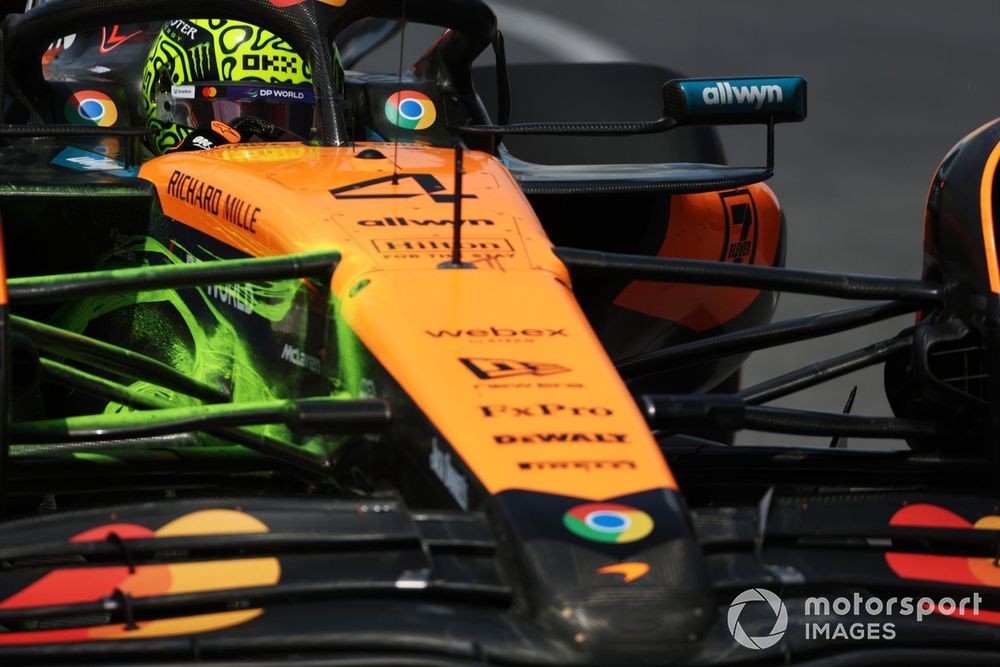
Lando Norris, McLaren
Photo by: Sam Bloxham / Motorsport Images
Reflecting on his team’s performance in 2025, Stella acknowledged his surprise at their level of competitiveness – while emphasising the team’s ‘aggressive’ approach to enhancing last year’s car.
The team’s objective was to consistently outperform the other leading teams, and Stella explained that their ongoing development efforts stemmed from the realisation that their pre-season estimates of their advantage over rivals were insufficient.
“I’ve been taken aback by this degree of competitiveness. When we were deliberating last year about how much effort to invest in improving the 2024 car, we resolved to be exceptionally ambitious,” he added.
“We aimed to move beyond the ‘uncertainty of who would win on any given race weekend’ that we experienced last year, and we determined that we needed to surpass the typical development pace.
“So, how did we achieve this? We embraced a highly aggressive approach to innovation. The MCL39 is a fundamentally innovative car. From an engineering standpoint, we harboured reservations about certain solutions – questioning our ability to effectively implement them.
“However, upon examining lap times and simulation data, we realised that it still might not be enough. Indeed, at the beginning of the season, it wasn’t sufficient.
“That’s a factor that has been evident throughout this season: the car has been continually upgraded.”
In this article
Be the first to know and subscribe for real-time news email updates on these topics