Following the initial race of the season in Melbourne, beyond the grievances concerning the rules, attention largely focused on a distinct topic: Mercedes unveiling its genuine capability. While Toto Wolff stated post-George Russell’s win that his squad retained “a fight on our hands” with Ferrari, discreet indications suggested Mercedes was significantly superior to all others at Albert Park.
The initial segment of the race was likely more tightly contested than projected, a factor also attributable to the inherent characteristics of the current regulations. Energy management has evolved into a cyclical process: a driver who passes a competitor frequently faces a disadvantage on subsequent straightaways, significantly elevating the probability of an immediate counter-attack.
This phenomenon prompted Lando Norris to describe the competition as “even worse” than qualifying, appending his belief that it felt “way too artificial.” Another consequence is the struggle to establish a significant lead even with superior speed. When Mercedes gained clear track ahead, their true dominance became apparent – particularly as Russell maintained quicker lap times on aging tires following Ferrari’s pitstop.
Mercedes sets the standard, and a primary reason for this is their exceptionally effective energy utilization. This characteristic was already apparent during Saturday’s qualification analysis. A direct comparison of Russell’s pole-position lap with McLaren’s fastest qualifying attempt, delivered by Oscar Piastri, indicated Mercedes outperformed in nearly every turn according to GPS data.
Typically, a driver would experience a penalty on the straight sections for such performance, but this did not apply to Mercedes – highlighting a crucial advantage. While Russell might not have registered top speeds in the FIA traps, he nevertheless significantly outpaced McLaren on the straights overall.
The primary performance gap emerged on the straight leading to Turn 6 and within the stretch approaching Turn 9. The interplay between these two zones is revealing. Approaching Turn 6, Piastri eased off the throttle sooner, as visually depicted below. Russell maintained full throttle for an extended period, which would typically reduce energy recovery. Ordinarily, the Mercedes driver would have incurred a cost for this on the subsequent full-throttle segment to Turn 9; however, the contrary occurred. The time difference actually widened there, and Piastri engaged super clipping noticeably sooner than Russell.
This strongly emphasizes Mercedes’ superiority in efficiency compared to all its client teams. The German constructor demonstrates greater speed through corners yet successfully regenerates ample energy – partially by using lower gears more often – to avoid losing ground on straightaways, or even to accelerate past competitors.
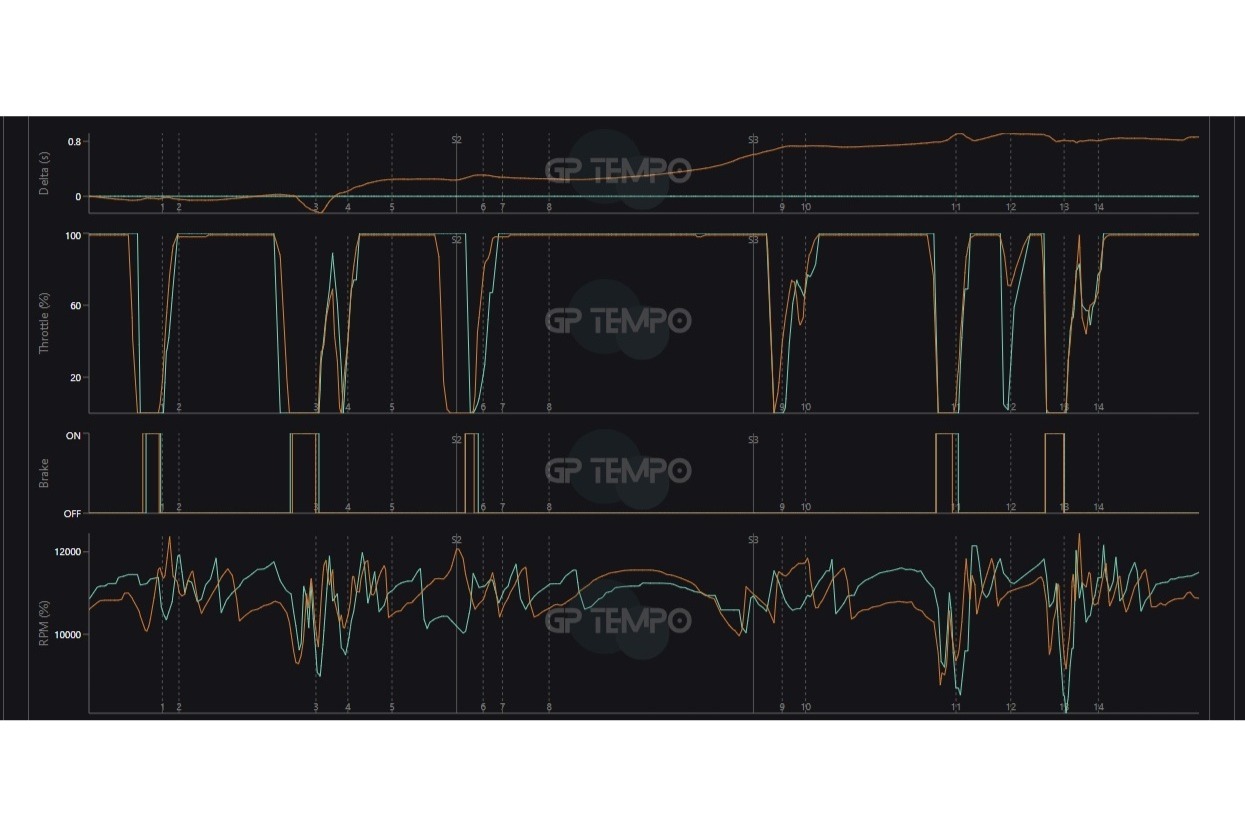
GPS data comparison between Russell and Piastri from Australian GP qualifying
Photo by: GP Tempo
Further insights for client teams following specification variations in trials
The puzzle remains as to how Mercedes achieves such superior efficiency compared to its client squads, despite utilizing fundamentally identical power units. While the chassis and aerodynamic configuration might contribute, this explanation alone is insufficient. A more critical aspect relates to Mercedes’ ability to draw considerably more from the entirely new power unit concerning energy release.
McLaren team principal Andrea Stella remarked following the Melbourne race, “I can say that we spent a lot of time looking at several overlays, in particular Mercedes, but also to other competitors.” He continued, “And definitely, the result of this analysis seemed to indicate that we have work to do as a team in collaboration with our HPP engineers. We have work to do to exploit the potential of the power unit, which, once I see the potential that HPP is extracting, looks like there’s more that is available.
Stella further elaborated, “Now, it’s not obvious how you do that. For us, we are in a journey of knowledge. Probably, or maybe I should say certainly, a journey that is earlier than the works team. The works team and HPP will have worked together for a long time, so they will have collaborated, talked about how to use the power unit. That’s fair enough. But we’ll definitely intensify the collaboration with HPP because our understanding is that there is some low-hanging fruit that we should be able to cash in.”
While acknowledging that this is, to a certain degree, a standard benefit for a factory team, Stella suggests additional factors are involved. During Bahrain testing, Mercedes’ client teams utilized a distinct, more fundamental specification of the 2026 engine, including simpler mappings, compared to the factory team. Although this arrangement complied fully with contractual agreements, it enabled the factory team to gather more insights into the true potential of the package, an opportunity not afforded to the customer teams.
Stella also stated, “When it comes to ‘is this all that is available and are we underexploiting?’, I am not sure. I think we will need some more analysis to understand whether this is only about parameters that we can control or driver’s input that we can control, or that there are some other factors, more systemic, that not necessarily a customer team can control.”
This final point is critical, as Stella conveys that McLaren has not possessed complete autonomy – strictly due to the resources provided – and consequently, the team now confronts a challenging period of accelerated learning. Operating based on what was accessible encompasses two areas: the particular setup for energy utilization at the Albert Park track and the broader vehicle evolution.
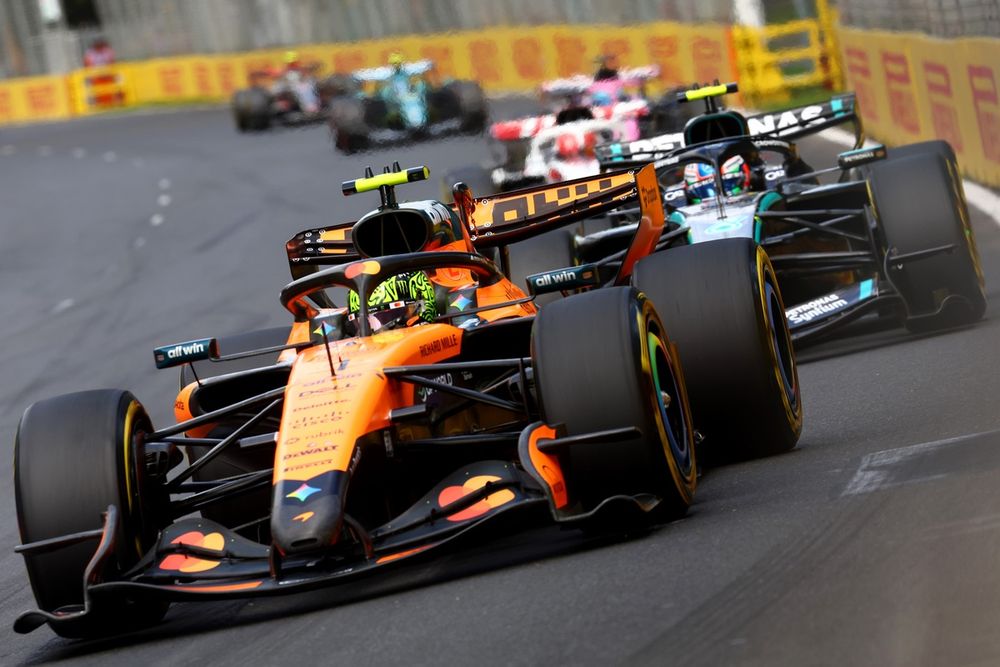
Lando Norris, McLaren, Andrea Kimi Antonelli, Mercedes
Photo by: Joe Portlock / Getty Images
Nonetheless, Toto Wolff clarified after the competition that Mercedes has met all its commitments and endeavors to assist its clients optimally, emphasizing that commencing a new era inherently involves significant complexities.
Wolff articulated, “I think it’s clear when you roll out new regulations, there’s so much to learn. Whether you have a customer that’s on your gearbox or suspension, and in the same way on the power units, the development slope is very steep and you can never deploy things to make everybody happy. But I think most important is we’re trying to provide a good service, and that’s always the way.”
Williams “somewhat astonished”: Mercedes displayed greater ingenuity
James Vowles, uniquely positioned due to his experience with both the Mercedes factory team and his current role partnering with the manufacturer as a client at Williams, articulated in Melbourne a similar sentiment to McLaren, expressing astonishment at the considerable gap between the constructor and its affiliate teams.
He commented, “What Mercedes are doing on the power unit is something that caught us off guard. It took a qualifying for us to really see just how off the pace we are in that regard. That’s probably three tenths, something in that ballpark.”
Nevertheless, he rejected the notion that Mercedes intentionally withholds resources from its clients: “And I still maintain this, Mercedes are incredibly fair to customer teams. I stated this already: we have everything that they have access to. They have just been cleverer than we have, and it’s our job to get on top of it. I’m just a little bit shocked by how much more clever.”
When Vowles refers to access, this specifically excludes insights into how to fully optimize the power unit’s performance, a distinction the Williams team principal deems entirely reasonable.
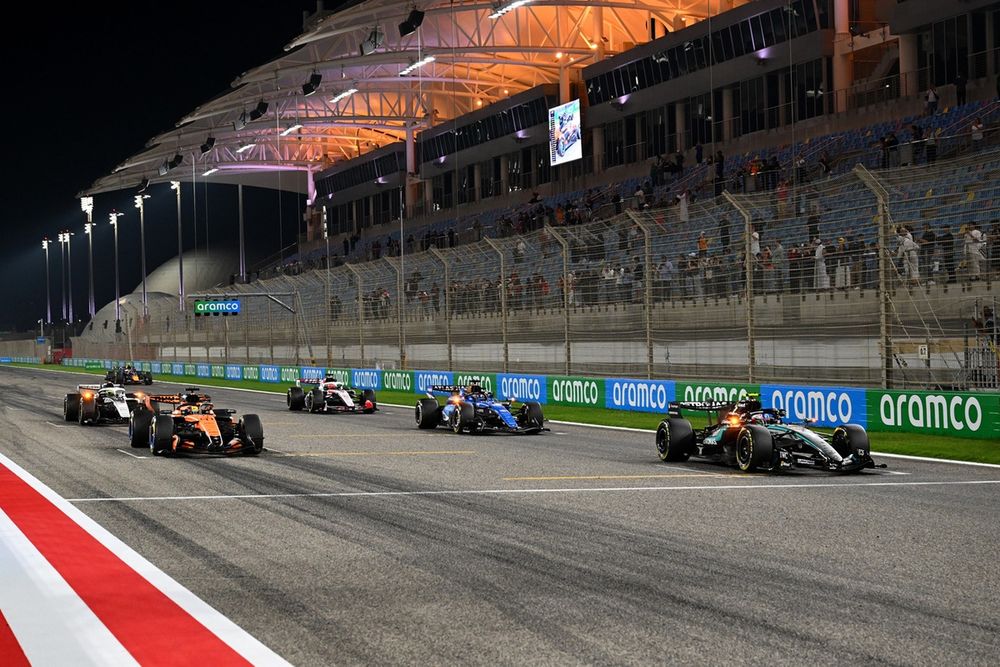
Oscar Piastri, McLaren, Andrea Kimi Antonelli, Mercedes, Esteban Ocon, Haas F1 Team, Alexander Albon, Williams, Sergio Perez, Cadillac Racing
Photo by: Mark Sutton / Formula 1 via Getty Images
He stated, “It is not an open door, as you would imagine, because that’s where the performance is found. So it is down to us to try and work around it. But I would say we have to acknowledge we, as Williams, do not have the sophistication that they have in the level of technologies. And definitely that’s on us, that’s not on them.”
McLaren expresses no inclination to pursue the Red Bull model
Fundamentally, beyond the physical integration, this represents a significant drawback for client teams when contrasted with a factory squad, particularly during substantial regulatory shifts. Such disparities become more pronounced than usual at the outset of a new era, though this does not automatically imply McLaren intends to pursue an alternative long-term strategy – for instance, replicating Red Bull’s proprietary engine venture.
When questioned about McLaren potentially adopting Red Bull’s approach in the future, Zak Brown responded, “We’re very happy with HPP. We won a couple championships while everyone was saying it was impossible to do it, so I think we proved that wrong. I’m very impressed with what Red Bull has done, but that’s not an inexpensive adventure they’ve gone on, but hats off to them.
He concluded, “But I’m very happy where we are and focused on the moment. If an opportunity arose, we would look at it but you can also see the downside of not getting it right.”
With Mercedes, client teams are assured of receiving a competitive power unit, a fact substantiated in Melbourne. Simultaneously, the recent race event in Australia also highlighted certain drawbacks of this reliance. The established competitive hierarchy has now shifted compared to previous seasons, a reversal that Wolff – having endured several years of being outperformed by a client team – undoubtedly finds favorable.