At the United States Grand Prix, George Russell’s performance reached a disappointing low, even with signs of improvement in Formula 1 races just prior. In Austin, the Mercedes racer qualified over four tenths behind teammate Kimi Antonelli, ultimately finishing eighth while the 20-year-old secured his ninth victory of 2026, advancing closer to the championship title.
Several factors contributed to Russell’s P8 result, notably a five-second penalty incurred on the first lap that pushed him behind McLaren’s Oscar Piastri. This would turn out to be a lasting setback. Yet, Mercedes team principal Toto Wolff noted that this situation “doesn’t change the fundamental issue we must address.”
This decline followed a brief resurgence after the summer hiatus, marked by his win in Baku, before the issues facing Russell intensified leading into Texas. Other than a solid showing in the Singapore sprint qualifying—where he achieved second place prior to crashing while in the lead—he has not qualified better than sixth, nor ahead of Antonelli, since Mercedes unveiled its major upgrade in Malaysia. Although, he was on track for third in Sepang until a late engine failure thwarted his efforts.
Regardless, the new package has not been favorable for Russell, leaving him at a loss regarding the reasons for his struggles. However, the prevailing belief is that the revamped W17, while capable of greater speed at its peak, operates within a significantly narrower performance window. Whether due to driving style or adaptability, Russell seems to struggle terribly when the car falls out of its optimal range.
“George has really faced challenges,” Wolff remarked. “I think that’s attributed to the car’s challenging operational window. He was competitive in Q2, but Q3 didn’t go well. He admitted: ‘That falls on me.’
“During the race, I’m unsure why we couldn’t overtake Piastri, which felt a bit unjust. The reason for not passing him was that they share the same engine and electric deployment.”
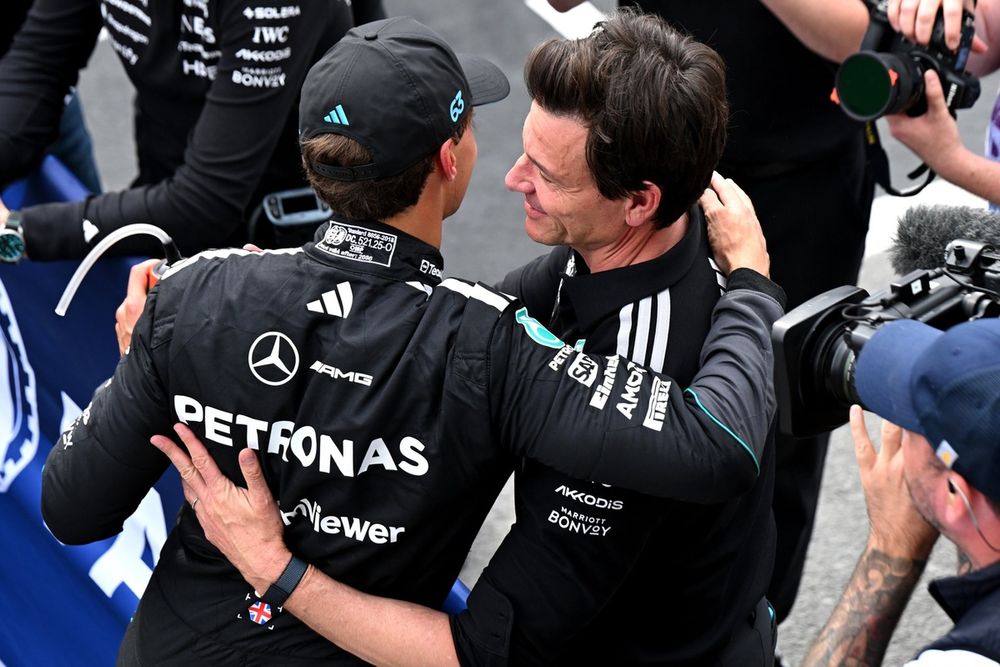
Russell and Wolff in Montreal
Photo by: Sam Bagnall / Sutton Images via Getty Images
Russell described his race as consisting of “six solid laps, followed by 50 difficult laps,” but struggled to articulate the reasons for his declining performance. “I wish to comprehend why the pace was so lacking in the initial stint,” he remarked, now sitting with a 123-point deficit to Antonelli. “The penalty seemed somewhat absurd, but it was the least of my concerns after such a terrible weekend.
“The capability is evident, but the margin for error is very slim. We witnessed it in Malaysia. I think he [Antonelli] was the fastest in FP3, and we qualified fourth and eighth. Over the weekend, we both had decent performances in Q2, yet I found myself nowhere in Q3 and in the race as well.
“He clearly was exceptionally competitive, and the signs indicate that the operational window is quite limited. I hope that’s an explanation for my speed struggles today, but I need to collaborate closely with my team to gain some clarity when you’re this far behind.”
When asked whether he feels he has regressed recently, Russell replied: “A bit, a bit. I don’t have the answers at this moment, so I’ll need to take 24 hours to think rationally!”
Russell has already attempted to tweak his driving style to adapt to the 2026 cars, a process that began after his win in Melbourne from pole, having encountered challenges against Antonelli’s five consecutive victories—even with some mischance on his part.
This means his issues are unlikely to be resolved in the five races remaining this year, leading Mercedes to hope that their 2027 car will better accommodate both drivers, or, alternatively, that Russell can uncover new strategies to utilize it more effectively.
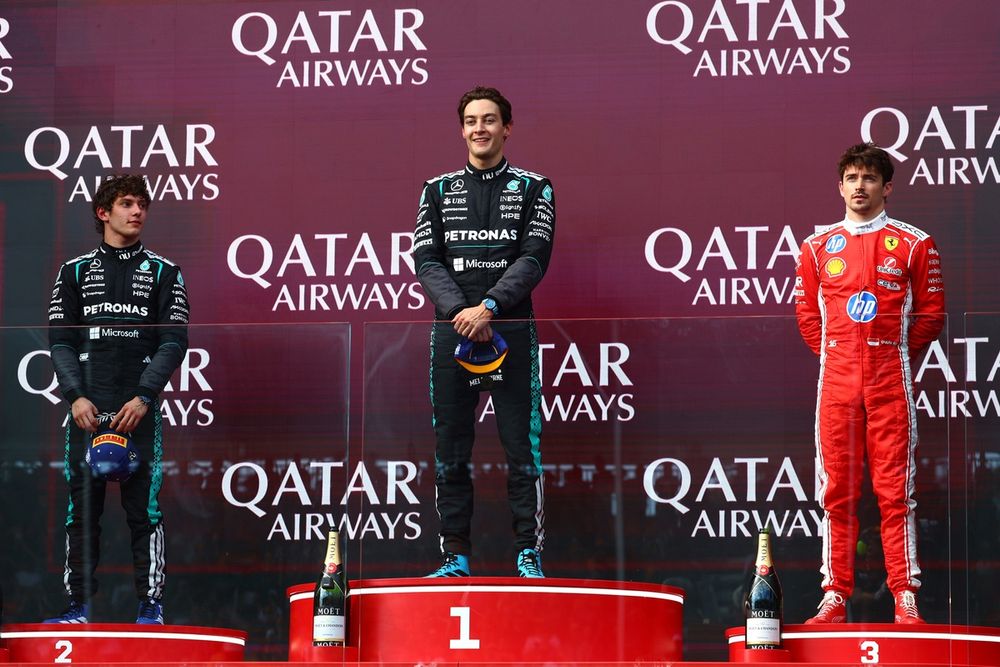
Russell was the heavy title favourite when he won from pole in Australia
Photo by: Joe Portlock / Getty Images
Wolff firmly believed that Russell would recover from the discontent of being overshadowed by a younger, less experienced teammate. The Austrian affirmed that the 28-year-old possesses the capability to initiate his own title bid based on his impressive rise through the ranks—achieving back-to-back GP3 and F2 championships—compared to his time alongside Lewis Hamilton, and showing competitiveness in 2025 when the car was not performing well.
“George is a champion who has won in every category. He deserves to be counted among the elite. We witnessed that last year,” said Wolff, emphasizing that the Mercedes team is equally responsible for resolving Russell’s challenges.
“This year has shown an inconsistency in results. When the car is set up for him, he is incredibly fast. However, when it falls outside of that operational range, he struggles more than perhaps Kimi—which is essentially our fault.
“We need to figure out with him why there is such a performance disparity because George is not significantly slower than Kimi by half a second or three tenths. That’s simply not accurate.
“Hence, what is it that does not suit him? What modifications in the car setup can we implement to enable him to be faster? The capability is there—his intelligence, skill, and determination are undeniable.”
We want to hear from you!
Let us know what you would like to see from us in the future.
Take our survey
– The Autosport.com Team