In the bright lights of the Las Vegas setting, amid the constant hum of pensioners in the United States steadily feeding their savings into slot machines bit by bit, Lando Norris reaped the benefits of the lessons learned through the challenges he faced earlier in the season to hit the jackpot at the most important moment.
That is the perspective of McLaren’s team leader, Andrea Stella – although not necessarily concerning the depositing of small amounts of money into the grasping mechanisms of modern-day capitalism, but undeniably concerning a driver building a solid foundation at a vital period. There was a phase earlier in the year, with instances in Bahrain and Saudi Arabia, where it seemed almost certain that Norris would falter in Q3.
Around the slick, freshly laid asphalt of Las Vegas, a track that was made less enjoyable by the unexpected showers just before qualifying, Norris wasn’t totally faultless but he managed a lap that was smooth and quick enough to secure pole position on a night when a seven-time champion could only manage 20th place. And this all occurred at a venue where McLaren has traditionally struggled and was not expected to perform well.
In fact, last year’s victor, George Russell, had been leading the way in his Mercedes during the practice sessions until an issue with his power steering during Q3. But, as Kenny Rogers famously sang, you should never count your winnings before the hand is played.
“What we have been observing in Lando’s performances in recent races,” mentioned Stella, “I would attribute to the effective application of crucial data gathered during the initial phase of the season, when Lando couldn’t consistently deliver to his full potential.
“This is largely thanks to Lando himself, who has put in a significant effort to analyse the lessons learned from different aspects relevant to a Formula 1 driver. These may include technical elements, event approach, or session strategies developed with his engineers, forming a comprehensive and integrated approach.”
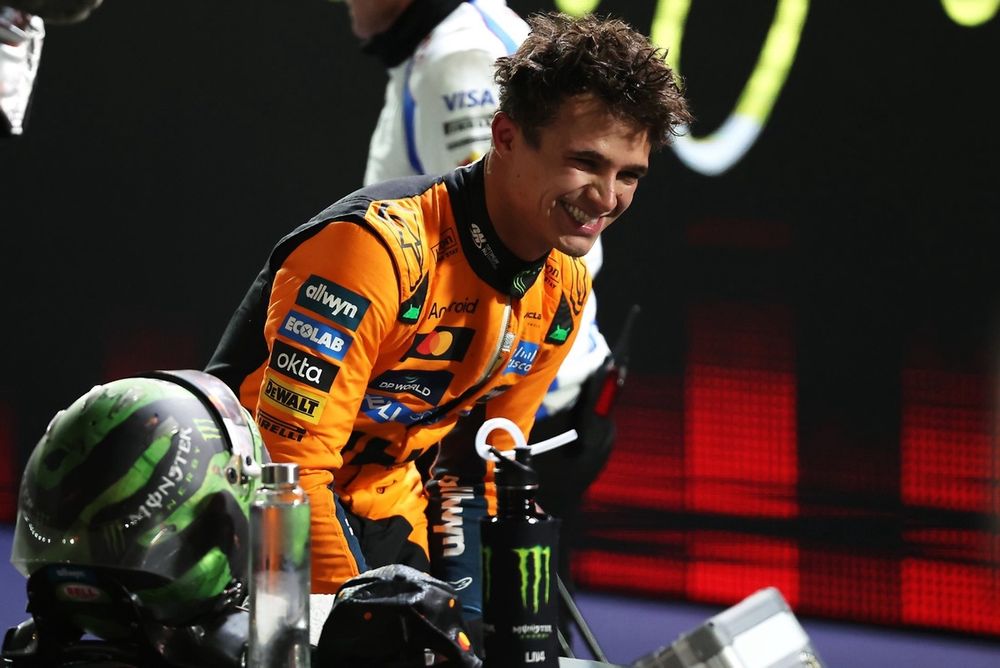
Lando Norris, McLaren
Photo by: Glenn Dunbar / LAT Images via Getty Images
Advancement from Third to the Top Spot
As he began his final flying lap in Q3, Norris held the third position, trailing his teammate, Oscar Piastri, by a significant margin of over half a second. Ahead of him were Max Verstappen and Carlos Sainz, with Sainz having just edged out Norris by a tenth of a second, and the two separated by a mere 0.039s.
Examining the telemetry data from Verstappen’s and Sainz’s fastest laps provides insight into how easily time could be lost on the challenging left-right-left sequence of Turns 14-16 towards the end of the Strip. Carlos lagged behind Max by three tenths in the initial section of this straight but managed to narrow this down to 0.054s by the apex of Turn 14. A brief wheelspin incident for Sainz widened the gap again, but he recovered ground along the final straight, gaining slightly as Verstappen momentarily eased off the throttle at the kink just before the finish line.
The perception of race car drivers always makes for a fascinating study. “I believed it was a lap worthy of pole position,” Sainz commented on his own attempt. “As I completed the lap, I saw myself leading, only to remember I was the first across the line.
“Although, I knew my position might not last, with those behind me yet to complete their runs, it nonetheless felt like a very solid qualifying effort.”
“Throughout Q3, we were never in a leading position,” Verstappen remarked, almost dismissively, despite finishing just fractions of a second behind. “We were never the quickest, and therefore, finishing second is acceptable.”
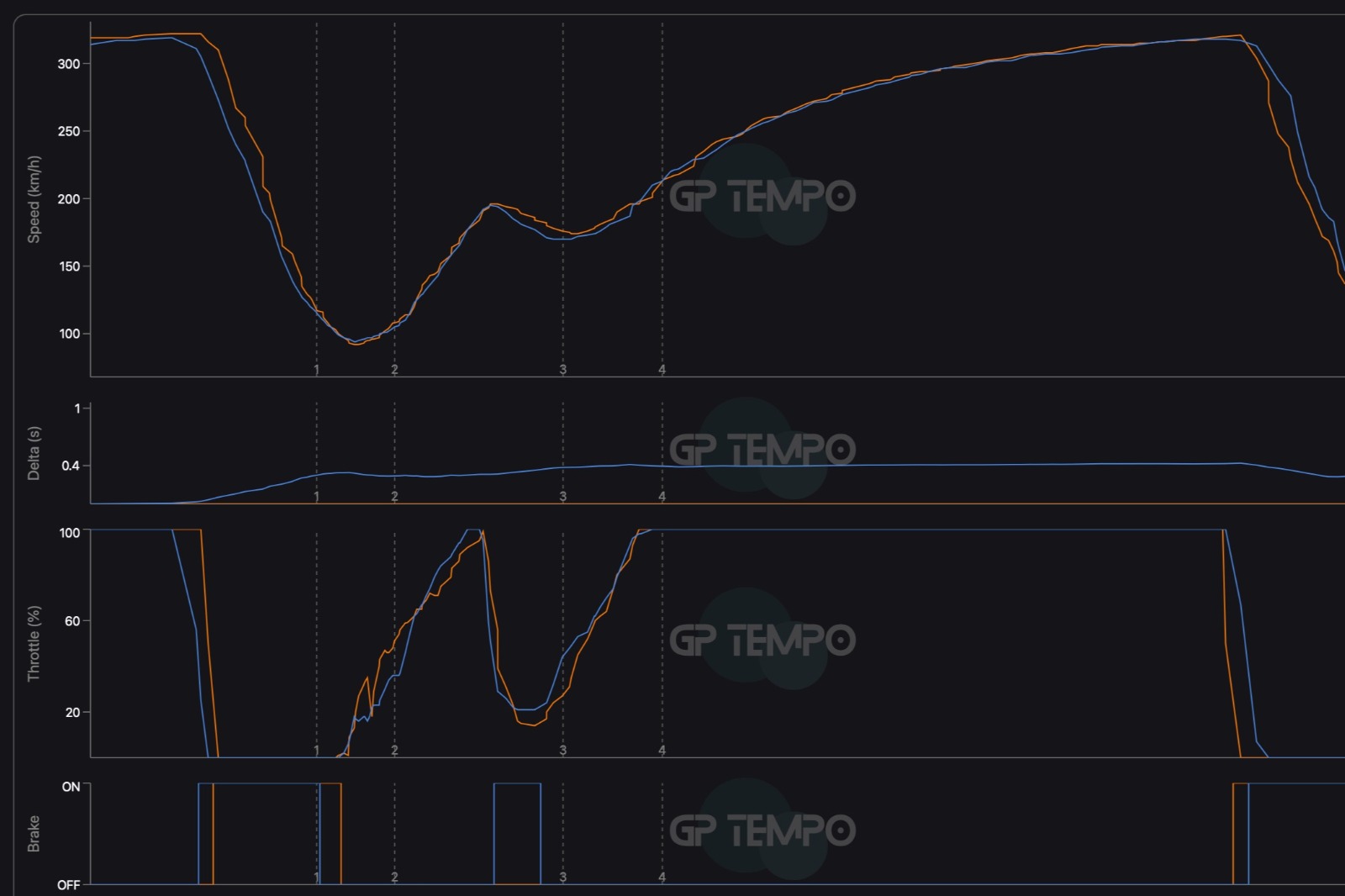
Comparing Norris’s data with Verstappen’s shows that Norris was already ahead as they crossed the start line, moving at a speed 5km/h faster, an advantage that later decreased, influenced possibly by the power unit characteristics or the aerodynamic setup. However, the critical difference arose from Max’s earlier lift and brake application for Turn 1. By the time they reached the area between Turns 1 and 2, their speeds were nearly identical, but Max was now 0.321s behind.
Verstappen then regained some ground as Norris struggled with throttle control, but Norris maintained approximately 10km/h more speed leading into Turn 3, despite a slight lift, a factor reflecting different vehicle performances.
The gap held steady at around four tenths until the approach to the sharp right-hander at Turn 5, where Verstappen trimmed just over a tenth by lifting off the throttle and braking more progressively. Although Norris briefly released the brake and began to reapply throttle before adjusting his braking again, he managed to re-establish his pace advantage by being slightly more aggressive with the throttle once he had straightened the car.
Difficulties in Slower Turns
Verstappen’s evident lack of assurance in his car was particularly noticeable in the complex sequence of Turns 6 to 9 in the second sector. Turn 6 begins as a smooth curve before tightening, leading Verstappen to start lifting somewhat prematurely after the apex; while his reduction in throttle was less abrupt than Norris’s, it was still significant and accompanied by earlier braking. Norris was traveling almost 30km/h faster as he began to lift off.
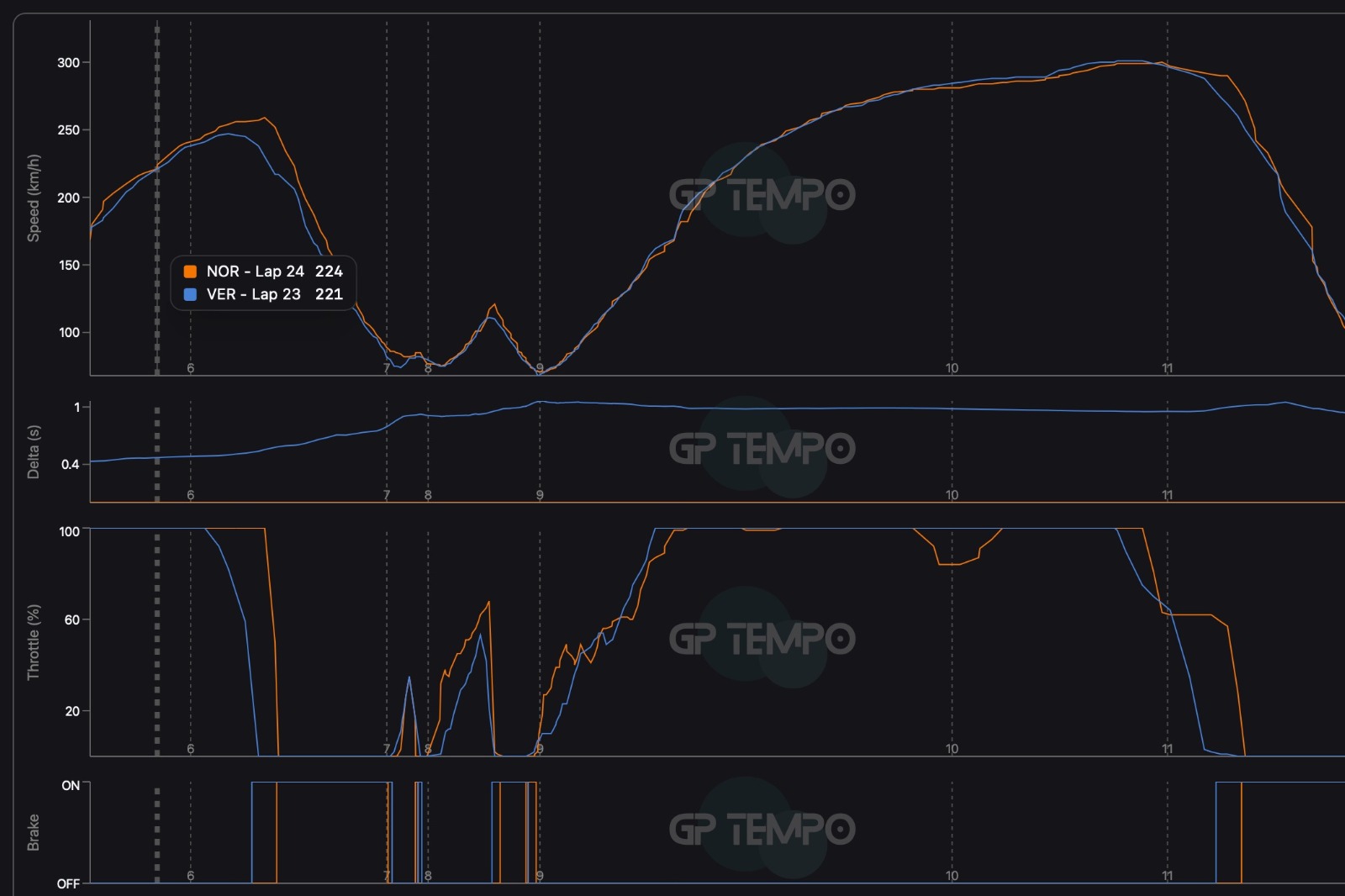
Between Turns 8 and 9, Norris could apply throttle more decisively for short critical moments, translating into a speed difference peaking at 11km/h, which was enough to extend his lead to a full second by the apex of Turn 9.
From that point, the margin remained fairly consistent throughout the rest of the second sector, despite Norris having to slightly lift through Turn 10.
Areas Where Norris Could Improve
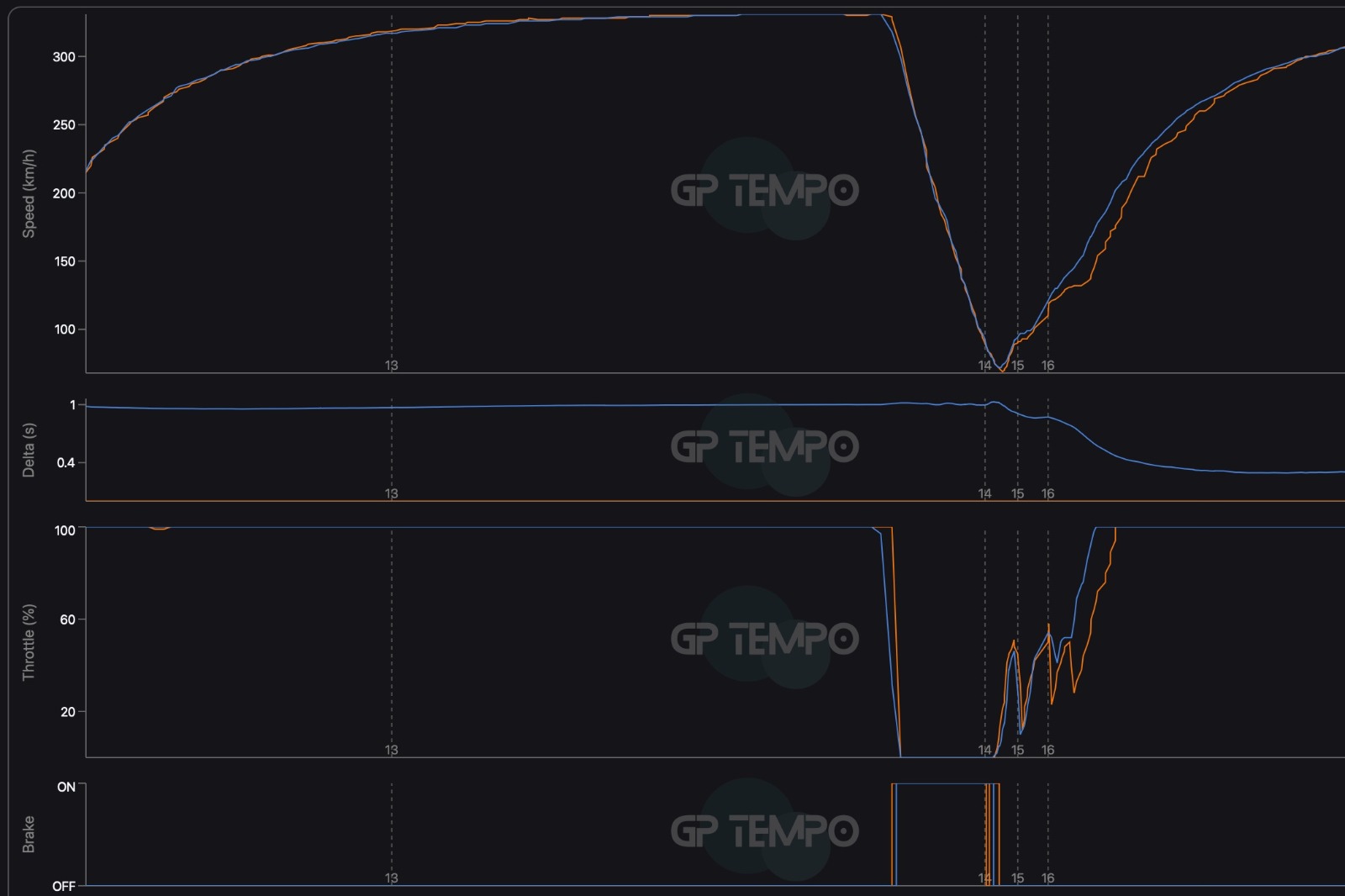
“Even during the pole position lap, there was a noticeable mistake in the final chicane, which cost several tenths of a second,” Stella commented.
This analysis is very accurate, as evidenced by the onboard footage showing Norris wrestling with his vehicle after entering the corner, where he lifted off the throttle later but started braking sooner than Verstappen. This section of the track was one of the determining factors for drivers up and down the grid, warranting the descriptor of the weekend: “sketchy”.
Max’s cleaner exit from Turn 16, where Norris had to correct his throttle twice to manage wheelspin, gave him a brief 30km/h advantage, which Norris only began to close as they approached Turn 17. This cut the gap to three tenths.
Norris had already laid the groundwork at the beginning of the lap—positioning himself to do so—as the only driver to complete a fast lap at the end while others were affected by their strategies or, in teammate Piastri’s instance, yellow flags.
“The conditions are inherently challenging, even when the pace is there,” Stella stated.
“In Q1, we observed that Lando’s pace was very strong. However, toward the end of the session, as the track improved dramatically, he found himself caught in traffic, trailing a slower car. This situation significantly impacted his pace.
“The lap time we observed did not accurately reflect the car’s potential but rather was a consequence of him following a slower vehicle for the last two laps. Consequently, we emphasized the importance of creating space as a primary takeaway from that session.
“We decided against trying to overtake or otherwise solve the situation to avoid excessively compromising our performance.”
Lando Norris, McLaren
Photo by: Cristobal Herrera-Ulashkevich / via Getty Images
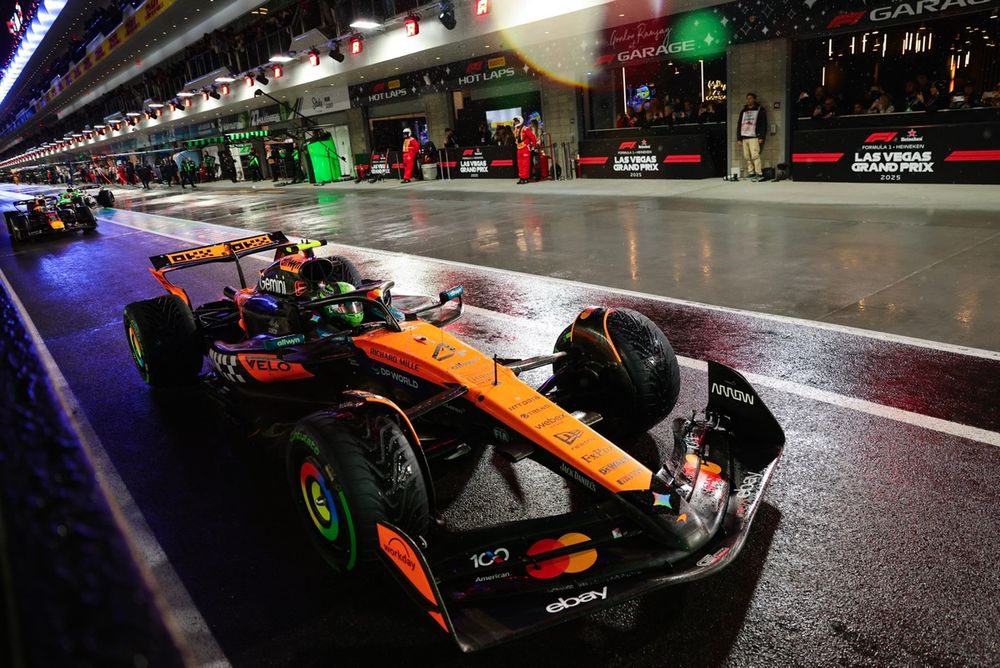
As a result, Norris was promptly released from the garage ahead of Q2 to be first in line at the pit exit. A strategy was then developed for Q3 to separate him from the rest of the pack. This began with a later entry onto the track using intermediate tires instead of the full wets that had (unexpectedly) been preferred during the initial two qualifying rounds.
This tactic had risks, as a crash by another driver could trigger a red flag. However, it allowed Norris to ease into the use of the intermediate tires.
“It was challenging,” he explained, “mainly due to the constant risk of yellow and red flags. I’m somewhat surprised there weren’t more, given the conditions.
“Since we weren’t at the front, I was fine with waiting a bit longer at the end of the pit lane to have clearer air, avoid the other drivers, and minimize the risk of yellow flags. This allowed me to complete more laps and build my confidence in the car.
“I believe I was the only one to complete an additional lap at the end, which worked out perfectly. We were already in a good position, and the timing of everything—I think we did a push-push, push-cool-push sequence near the end.
“So, it was about ensuring the battery was ready and the tires were in good shape. Having that extra lap made a significant difference. It’s never simple under conditions like these, but everything came together well.”
We want to hear from you!
Let us know what you would like to see from us in the future.
Take our survey
– The Autosport.com Team