Todd Pletcher, possessor of an unmatched seven Eclipse Awards for outstanding training in North America, gained invaluable insights serving as a key assistant to Hall of Famer D. Wayne Lukas. Chad Brown acknowledges the influence of the late Hall of Famer Bobby Frankel and the significant bond he shared with Frankel when reflecting on his professional growth.
In contrast, Phillip “P.G.” Johnson, who passed away, was an autodidact. He acquired knowledge through direct experience and extensive, hands-on effort, which only enhanced his achievements.
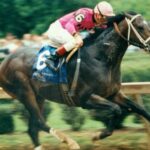
His illustrious Hall of Fame training career, spanning six decades, reached its pinnacle with an unexpected triumph at the Breeders’ Cup World Championships. Volponi, a homebred with odds of 43.50-1, delivered a stunning performance, winning the 2002 Breeders’ Cup Classic by 6 ½ lengths.
The journey to the beloved underdog Volponi was challenging. It commenced with Song Master, a horse Johnson acquired for $75 at auction in 1942, marking his initial Thoroughbred purchase. The sale was prompted by a fire, as Song Master had suffered smoke inhalation.
The situation following Song Master’s arrival at the stable would be revealing of Johnson’s career. Johnson labored with Song Master and the pair continued to put in effort, culminating in the Chicago-born trainer guiding the horse to victory at Hawthorne Race Course two years later, the first of his 2,315 wins. Johnson’s total career earnings reached $47,519,937.
Johnson was admired across the racing world for his dedication to his wife, Mary Kay, and subsequently to their daughters, Kathy and Karen, who relished the opportunity to spend time at the barn and offer assistance.
“He had tremendous enthusiasm for his profession, while also caring deeply for family,” Karen, who is now a seasoned turf writer, observed. “He always prioritized family time away from the track whenever he could.”
Johnson enjoyed observing Kathy’s skill with show horses. When Karen participated in high school track events, he made every effort to attend the meets.
At the stable, he was perceptive in determining a horse’s capabilities and identifying ways to improve its performance.
“His talent for assessing a horse’s physical condition was remarkable; he possessed a keen eye and had studied horses intensely since his teenage years,” Karen recounted.
The two years required to transform Song Master into a winner exemplified Johnson’s readiness to provide promising horses with the necessary time to develop.
“He demonstrated considerable patience with horses, preferring not to rush 2-year-olds and favoring a more cautious, observational strategy,” Karen explained. “If he progressed rapidly with a 2-year-old, it signaled his conviction in the horse’s exceptional speed, soundness, and ability to maintain that level.”
Johnson practiced training at Arlington Park close to Chicago, and also in Detroit, Florida, and Maryland prior to establishing himself in New York, where he distinguished himself on that fiercely contested circuit. He achieved four training championships at Belmont Park, three at Aqueduct, and one at Saratoga.
Remarkably, given the meet’s importance, he secured at least one victory at Saratoga annually from 1962 to 2003. He achieved noteworthy triumphs with Geraldine’s Store (Diana Handicap, 1983), Kiri’s Clown (Sword Dancer Invitational, 1995), and Maplejinsky (Alabama Stakes, 1988).
He developed a deep understanding of bloodlines and desired to breed a top-tier horse. Volponi, a son of Cryptoclearance foaled in Kentucky in the name of the family’s Amherst Stable, became that horse.
Volponi’s talent was not questioned, yet it seemed he was at a disadvantage in the Classic. Many questioned his participation. Johnson, with over five decades of experience, recognized potential that eluded others.
“He was remarkably confident that the horse would perform well,” Karen stated. “Predicting a win, especially one as decisive as that, is challenging. However, he sensed the horse was poised for an exceptional race.”
Volponi delivered a career-defining performance at Arlington Park, bringing P.G. and Mary Kay, his beloved wife, back to where it all began.
“That Breeders’ Cup victory was truly everything because, two years later, my parents passed away within 11 weeks of each other,” Karen reflected. “Recalling that moment and witnessing their happiness, seeing them holding hands as they made their way to the winner’s circle, was profoundly special.”
A moment created over a lifetime.
Fun Facts
- Volponi’s name was inspired by the writer Paul Volponi.
- In Italian, “Volponi” translates to “Sly Old Fox.”
- Johnson shared ownership of Volponi with Edward Baier, a close friend of many years.
- Following the Classic, Volponi achieved either second or third place in six consecutive graded stakes races, including the Suburban and Whitney Handicaps, which are both Grade 1 races.
- Steve Haskin, a veteran turf writer at BloodHorse, selected Volponi as his top pick for the 2002 Breeders’ Cup.