As Formula 1 prepares for its upcoming new era, a key inquiry arises regarding the standing of various teams and constructors, along with identifying the primary factor that will distinguish performance levels during the season.
Nikolas Tombazis, the FIA’s director for single-seater cars, has expressed a belief that the internal combustion engine will predominantly dictate the competitive hierarchy in 2026. Ben Hodgkinson, who leads Red Bull Ford Powertrains, partially agrees with this assessment, though not completely.
When questioned by Autosport about whether the internal combustion engine (ICE) would emerge as the chief performance variable in 2026, Hodgkinson conceded this was probable for the updated power units – even with a greater reliance on electrical energy – yet he emphasized that the aerodynamic aspects of the rules ought not to be downplayed.
“Within the domain of the power unit itself, I believe it’s plausible that the internal combustion engine will represent the most significant differentiating element,” Hodgkinson stated. “My expectation is that for the ERS component, nearly all competitors will achieve approximately 99% efficiency with their power electronics and electric motor.”
“The most substantial disparities will likely arise from the ICE, which also involves extensive collaboration with your fuel supplier. For instance, ExxonMobil has played a crucial role in our efforts to extract maximum performance from the ICE.”
However, he anticipates that the events of 2014 will not recur. In that period, Mercedes, Hodgkinson’s previous employer, held such a substantial advantage with their power unit that their supremacy was solidified for an extended duration.
“I project that the variances among the power units will be smaller than what we observed in 2014, largely because the power unit, and specifically the ICE, remains highly comparable,” he clarified. “Indeed, it utilizes sustainable fuels, we no longer have the MGU-H, and a compression ratio cap has been implemented. Numerous regulatory adjustments have intentionally re-established combustion technology, yet it’s not vastly divergent from previous iterations.”
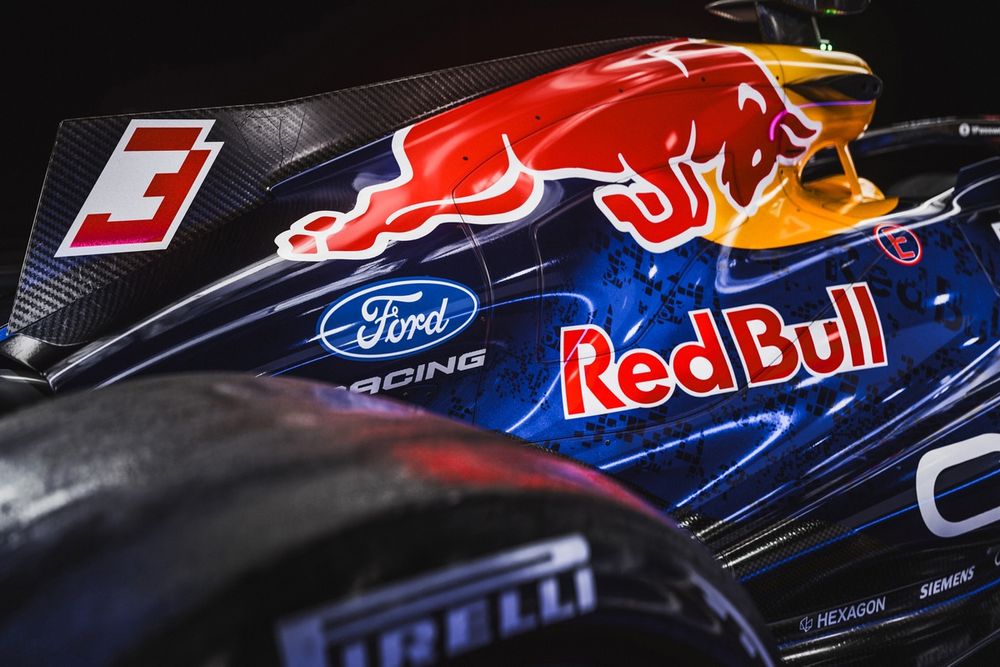
Red Bull Racing livery
Photo by: Red Bull Content Pool
To some extent, the rules have become more attainable than previously, a deliberate move aimed at facilitating entry for new participants like Audi.
“We aren’t abruptly creating an entirely distinct setup,” Hodgkinson observed. “It continues to be a V6 engine, and its core nature remains unchanged. The reductions in elements such as compression ratio and boost limitations have, in fact, lessened the operational loads, thereby making the strain on components somewhat lighter.”
“I anticipate the power units might exhibit similarities. Perhaps I articulate this perspective because, officially, Red Bull Powertrains is a new entrant, despite many of my colleagues possessing extensive F1 backgrounds. Consequently, I might not perceive us as much of a newcomer as would be expected, which could explain my viewpoint.”
“It will be intriguing to discover the positions of the other teams, but I suspect the greater uncertainty lies with the aerodynamic aspect.”
The FIA has recognized that variations are anticipated in that area too, although the governing authority indicated that substantial alignment will occur over several months – mirroring the situation in 2022. Nevertheless, Hodgkinson maintains his conviction that this could serve as a significant performance distinguishing factor in 2026.
“However, aerodynamics isn’t truly my area of specialization, so this shouldn’t be regarded as a formal declaration,” he chuckled. “Yet, it signifies a total overhaul for the entire vehicle, not merely the power units. Therefore, indeed, variations are expected, and their nature will become evident.”