Events at Red Bull have undergone substantial transformations following the passing of Dietrich Mateschitz. The intense scrutiny surrounding authority and the key figures in control at the principal organization has heightened, particularly after the controversy involving Christian Horner’s departure as the Red Bull Formula 1 team’s chief.
The uncertainty regarding the 2% holding in Red Bull GmbH, which shifted ownership on May 31, appears to have been resolved. An investigation conducted by Motorsport-Total.com, a sister site of Autosport, has corroborated suspicions that the transaction did not, despite numerous media reports, ‘drastically alter the power dynamic’.
The background is as follows: official records from the Austrian business registry indicated that 2% of Red Bull GmbH – the parent entity of the F1 operation – was transferred from Chalerm Yoovidhya’s portfolio to Fides Trustees SA, a Swiss fiduciary company. The chairman of its administrative council is identified as Martin Christopher Bowen.
Given that Horner was relieved of his responsibilities as the head of the Formula 1 program just five weeks after this transaction, certain observers interpreted the internal restructuring as ‘the underlying motive for Horner’s removal from Red Bull’. This interpretation was predicated on the supposition that there could have been a shift in power from Thailand towards Austria within the Red Bull corporation.
When asked to provide clarification, Red Bull GmbH issued a terse statement: “Such custodial arrangements are standard practice aimed at guaranteeing long-term stability in thriving, large-scale businesses. We respectfully request your understanding that, as per our policy, we do not offer public commentary on internal or family affairs.”
This triggered considerable conjecture: Who stands behind Fides, the Swiss fiduciary charged with overseeing the 2% stake? And who truly commands these shares in terms of voting rights? The significance lies in the fact that these 2% constitute the critical variance between the Yoovidhya lineage’s and Mark Mateschitz’s proportional ownership of Red Bull GmbH, both holding 49%.
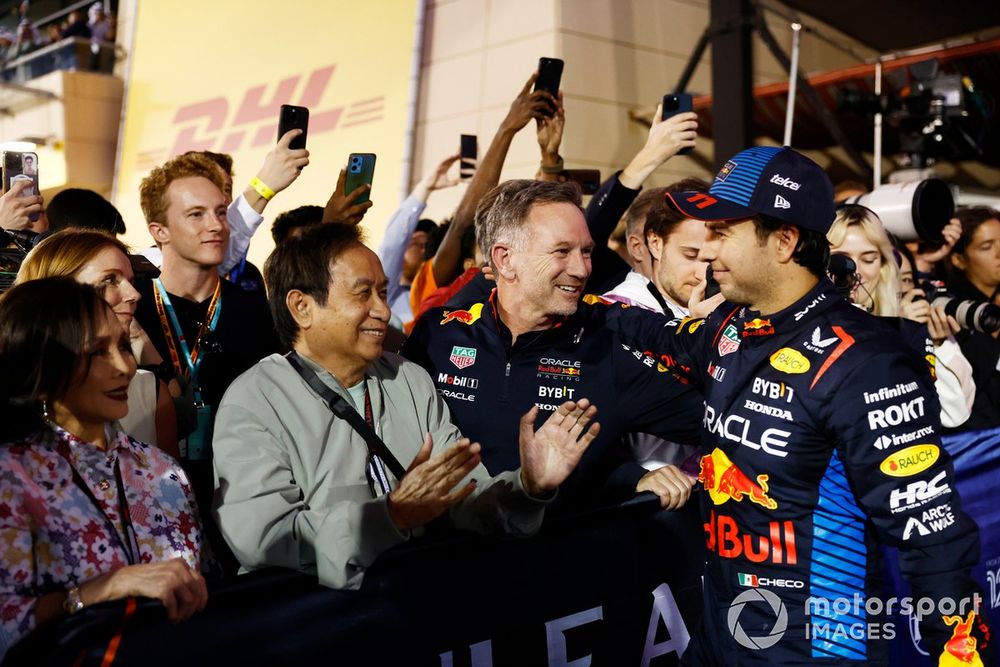
Daranee Yoovidhya, Geri Horner, Christian Horner, Team Principal, Red Bull Racing, businessman Chalerm Yoovidhya celebrate with Sergio Perez, Red Bull Racing, 2nd position, in Parc Ferme
Photo by: Zak Mauger / Motorsport Images
Presently, findings have reinforced the notion that Fides is administering the 2% under the directive of Yoovidhya – suggesting the Thai faction retains effective command over 51% of Red Bull GmbH. However, this assertion lacks definitive validation.
What is established is this: subsequent to Dietrich Mateschitz’s demise in October 2022 – who had served as the sole managing executive of Red Bull GmbH – the Yoovidhya lineage initially adopted a more pronounced involvement in fundamental operational undertakings. Discussions even surfaced concerning the potential relocation of the headquarters from Fuschl am See in Austria to locales such as Dubai or Amsterdam, presumably for considerations pertaining to taxation. This proposition encountered significant opposition from both the administrative leadership and the personnel stationed in Fuschl.
In close succession, disagreements arose regarding Horner’s continuity. According to media disclosures, entities within Fuschl advocated for the immediate removal of the F1 team director in the wake of allegations of sexual impropriety and duress. He was later absolved of any culpability following an internal investigation. Conversely, the Thai contingent insisted on backing him.
Over two and a half years have elapsed since Mateschitz’s passing. Under the functional guidance of the three managing directors – Alexander Kirchmayr (Finance), Oliver Mintzlaff (Projects & Investments, encompassing Formula 1), and Franz Watzlawick (Beverages) – Red Bull GmbH has prospered, notwithstanding the demanding global economic backdrop.
Kirchmayr, Mintzlaff, and Watzlawick were specifically designated by Mateschitz as his successors prior to his death. And they have effectively upheld his heritage: in 2023, Red Bull exceeded €10 billion in earnings for the initial time; by 2024, this figure escalated to €11.2 billion, propelled by the sale of 12.7 billion units globally.
This purportedly resulted in two salient realizations within the Yoovidhya family. Firstly, the initial understanding – whereby operations would be coordinated from Fuschl while they persisted in benefiting from the enterprise’s proceeds – is, indeed, an agreeable setup. The Austrian administrative cadre has demonstrated its capacity to perform exceptionally even in the absence of Mateschitz.
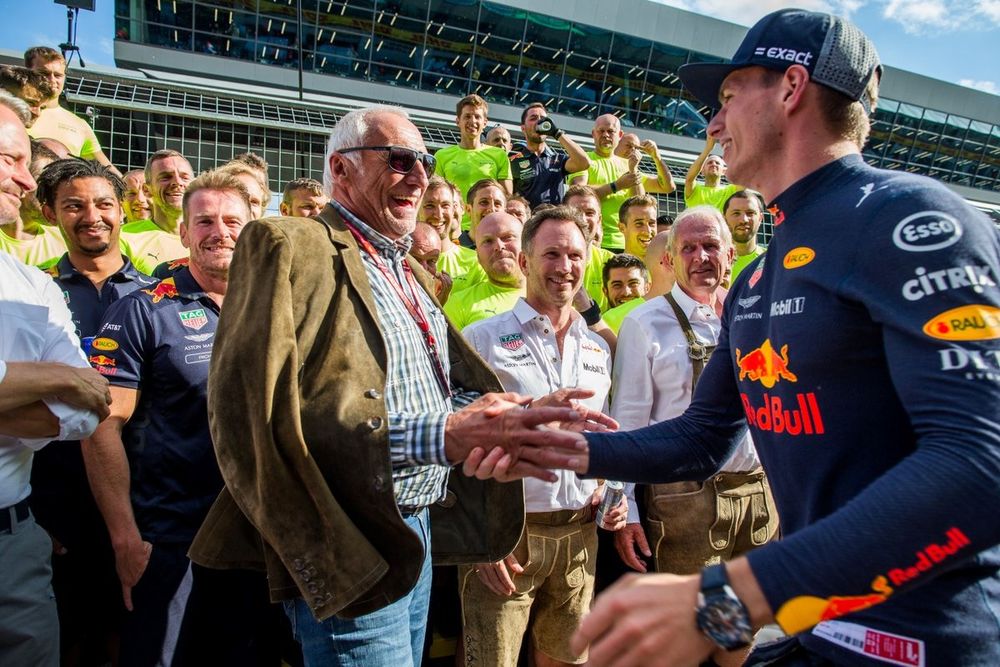
Max Verstappen, Red Bull Racing, Dietrich Mateschitz, CEO And Founder Of Red Bull
Photo by: Red Bull Content Pool
Secondly, the discussion concerning the relocation of headquarters abroad, where the corporation might encounter a reduced tax burden compared to Austria, is now dismissed. Ultimately, much mirrors the prior state: Fuschl superintends the operational aspects, presently under a triumvirate as opposed to Mateschitz alone – and Thailand secures 51% of the earnings.
The determination to entrust the 2% stake to a Swiss trust under the mandate of Chalerm Yoovidhya probably signifies that, in instances of an impasse on pivotal decisions, there now exists a neutral entity capable of furnishing impartial guidance to the stakeholders.
Consequently, Fides could function as the conclusive deciding vote in scenarios akin to the Horner affair, where stakeholder perspectives were purportedly divided for a protracted duration. Whether Fides genuinely influenced the Horner resolution remains uncertain. However, the concurrence in timing is noteworthy: five weeks post-transaction, Horner was dismissed.
Insiders suggest that the tumultuous epoch following Mateschitz’s death has concluded. Within Austria, there are indications that Mark Mateschitz and Chalerm Yoovidhya presently maintain an exceptional collaborative rapport.
“In some ways, the dynamics within Formula 1 underwent a transformation subsequent to Mateschitz’s passing,” remarked Ralf Schumacher in a discussion on the Formel1.de YouTube channel. Horner, notably, had evolved: “He unexpectedly wielded considerably more influence and commenced behaving divergently from preceding years.”
Retrospectively, Schumacher posits that it “reverberated detrimentally.” The scrutiny surrounding Horner in the preceding year unveiled profound fissures within the F1 program – reflective of disagreements at the executive level. Eventually, the shareholders recognized, he appended: “The situation is progressively deteriorating. We are allocating substantial funds, yet we are yielding inconsequential outcomes.”
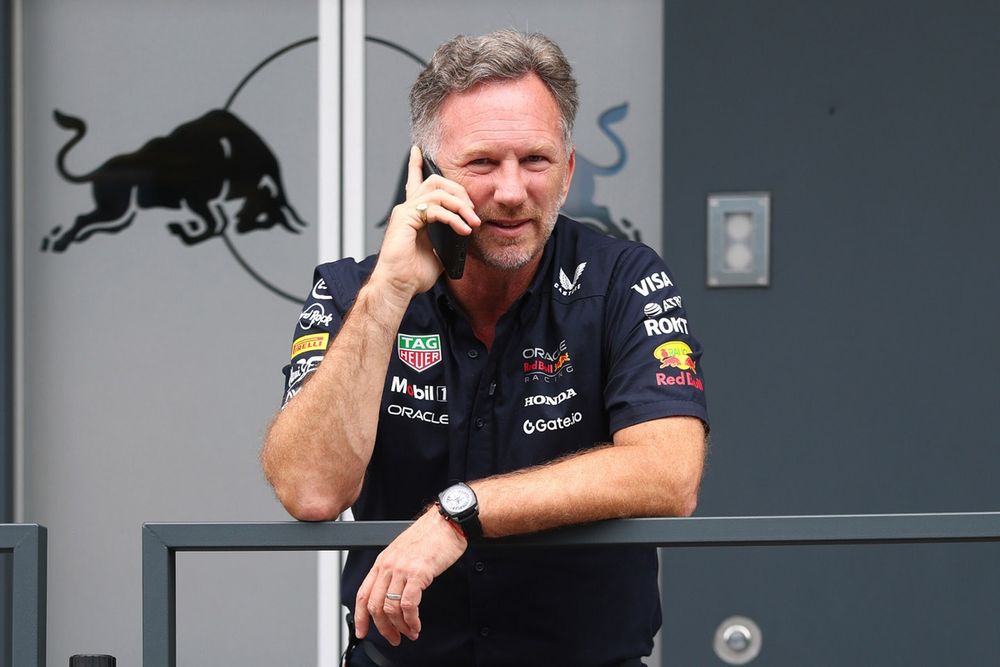
Christian Horner, Red Bull Racing
Photo by: Red Bull Content Pool
However, the erstwhile F1 participant also infers that missteps were enacted on both sides. In February 2024, he asserted, “An individual attempted to forcibly remove Horner – an action that was unduly aggressive.” The notion of substituting a team principal, “akin to how one would replace a football manager,” was comprehensible. “However, the unfolding events at that juncture constituted a reprehensible scheme.”
In summation, the cession of 2% may not have symbolized a seizure of power, but rather a tacit accord among stakeholders regarding the revised structure within Red Bull GmbH. And amidst pervasive media conjecture, personnel alterations, and strategic transitions, the narrative that materializes is not one of precipitous power struggles – but of strategic equilibrium.
In this article
Be the first to know and subscribe for real-time news email updates on these topics
Subscribe to news alerts