Following the completion of Friday’s on-track sessions, George Russell was not prominently featured in discussions regarding potential pole position contenders for the Singapore Grand Prix – particularly after his incident during FP2.
However, the situation dramatically shifted within a day, culminating in two impressive laps that secured his starting position at the forefront of tomorrow’s Formula 1 event. His initial time of 1m29.165s served as a clear demonstration of his intentions, despite a minor collision with the barrier at the exit of Turn 17. Subsequently, he improved by 0.007 seconds on his second attempt, adding a final touch to clinch his second pole position of the 2025 season.
The majority of the improvement was concentrated in the final corner. Russell’s performance in the first sector was slightly below his earlier benchmark (highlighted in yellow), while the second sector showed an improvement. In the final sector, he initially appeared slower before gaining additional speed through Turns 18 and 19. It’s plausible that the contact with the wall during the first Q3 lap indirectly contributed to the enhanced performance.
Examining the GPS data provides valuable insight. Compared to his Q3 benchmark (indicated in yellow), Russell exhibited a more cautious approach in the opening sector during his second attempt (represented in teal). He initiated braking earlier for each corner in this initial phase, but achieved quicker power application. Despite this, he trailed his best time by 0.11s at Turn 3, although he managed to narrow the gap through increased acceleration upon exiting the corner.
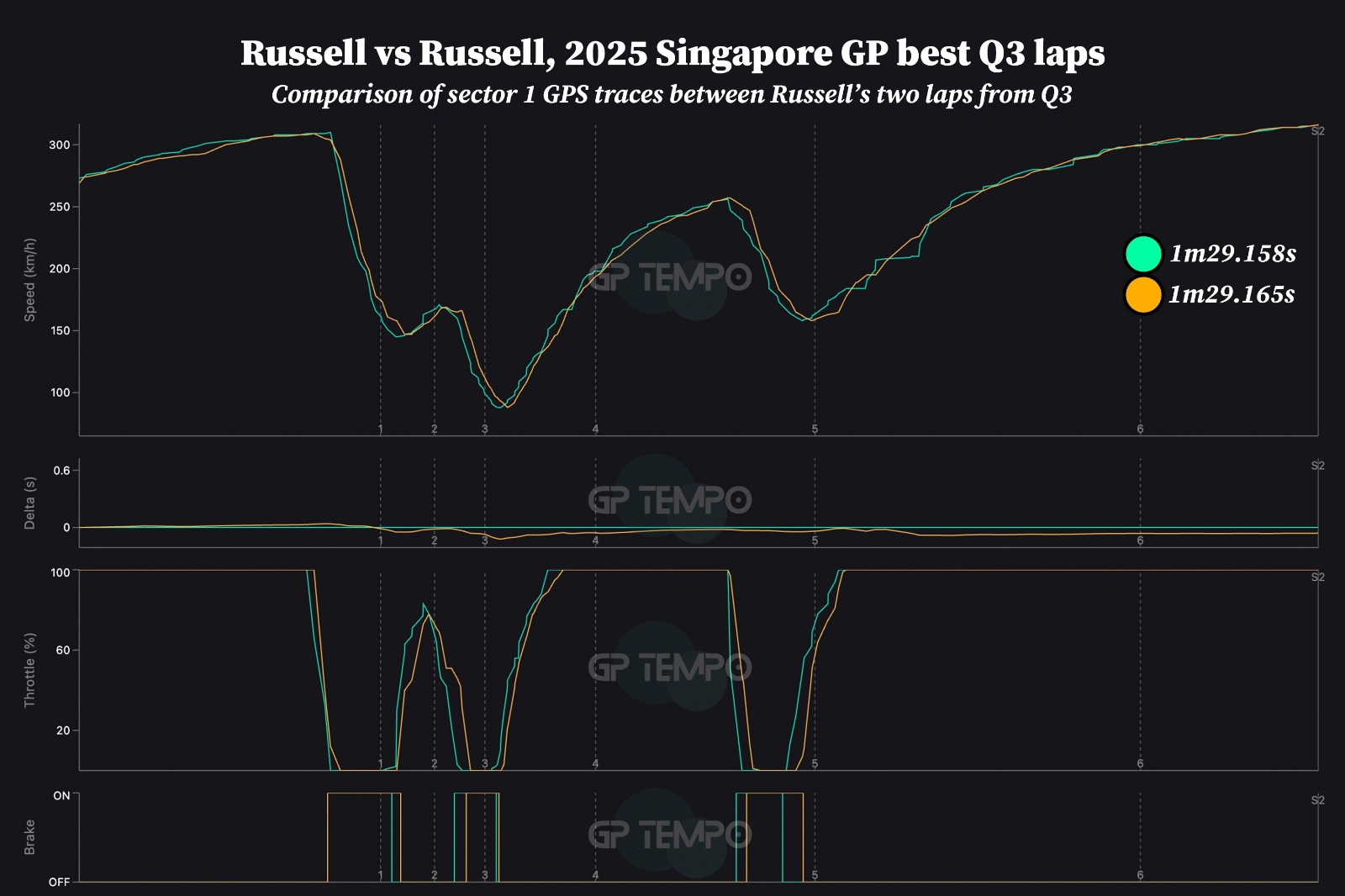
Photo by: GP Tempo
A similar pattern emerged at Turn 5, where he adopted a slightly earlier braking point and demonstrated a slower speed during the cornering phase. However, he reached peak acceleration at a slightly earlier point. By the conclusion of the first sector, specifically on the Raffles Boulevard segment leading to Turn 7, he was 0.06s behind his previous best.
During the eventual pole lap, Russell gained traction and identified opportunities to save time by braking later into Turn 7. The “slow-in-fast-out” technique proved effective in the 90-degree corners at the beginning of sector two, allowing him to maximize acceleration upon exiting Turn 9.
At this stage, Russell was nearly 0.15s ahead of his previous best time. He exhibited increased bravery under braking for Turn 10, releasing the throttle noticeably later than his prior attempt at the corner. Furthermore, he successfully maintained rear-end stability while braking for the subsequent chicane.
Russell found himself in a rhythm throughout this section, which coincided with the location of his crash during the final lap of the thrilling 2023 Singapore race. However, it’s possible that he didn’t maintain as much speed through the tight Turn 13 left-hander as he prepared for the straight along the esplanade. A brief throttle lift compensated for a slight instability at the rear, keeping him competitive but reducing the advantage he had built up throughout the lap.
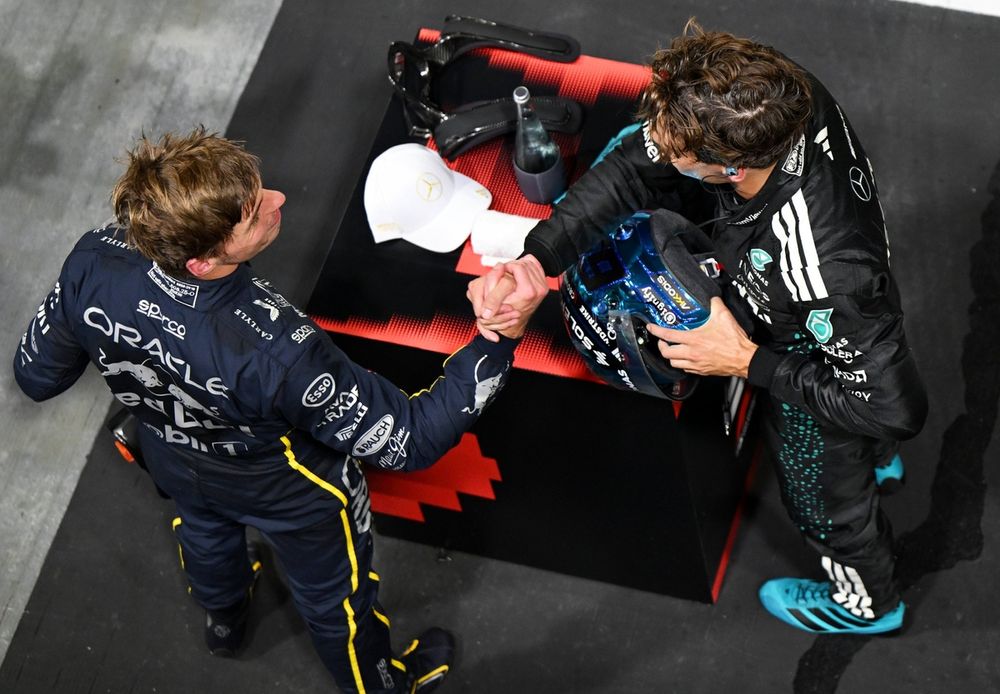
Photo by: GP Tempo
He still maintained a 0.077s advantage at the end of sector two, but the exit from Turn 14, preceding the back straight, ultimately resulted in a marginal time loss once the throttle was fully engaged. The most precarious moment of his lap occurred in the Turn 16-17 chicane, where he braked earlier and for a longer duration compared to his first attempt. To compensate, Russell applied more throttle between the two corners, preserving his speed through Turn 17.
Despite a deficit coming out of Turn 17, sustaining his exit speed provided sufficient forward momentum to attack the final double left-hander. Crucially, Russell maintained approximately 4-5% more throttle through the slowest point of entry, ensuring just enough acceleration to recover the 0.007s difference between the two laps. Had the finish line been situated any earlier, he would have finished approximately one-hundredth of a second behind.
Photo by: GP Tempo
Did Verstappen’s claim about dirty air hold substantial merit?
Following the qualifying session, Max Verstappen speculated that turbulence originating from Lando Norris’ car, as the McLaren driver returned to the pit lane, compromised his pursuit of pole position. “It would have been close,” Verstappen commented, noting that he was positioned approximately two to three seconds behind the McLaren through the final corners, deviating from the optimal six-to-seven second gap.
Verstappen braked later for Turn 16 compared to Russell. Consequently, he deviated from the ideal racing line, necessitating more correction in Turn 17 due to missing the apex. His minimum speed at Turn 16 was approximately 10kph slower than Russell’s, requiring extended braking to maintain the car within the track boundaries, and he encountered more kerbing from Turn 17 than preferred.
Immediately following the exit of Turn 17, Verstappen’s time difference relative to Russell increased, reaching approximately 0.33s before he chose to abandon the lap.
Norris had already reached Turn 17 when Verstappen was braking for Turn 16. Verstappen then positioned himself deep into the corner, presumably caught off guard by the reduction in front-end downforce caused by the lingering effects of turbulence.
Photo by: GP Tempo
Would this have a noticeable impact on Verstappen’s lap time? Possibly, similar to the subtle effect of a gentle breeze, yet attributing blame to a driver for causing turbulence appears somewhat flimsy.
If Verstappen had initiated braking a couple of meters earlier for that corner, he could have negotiated Turn 16 at the correct angle and potentially possessed the necessary acceleration to emerge from the final three corners with a slight advantage over Russell.
The debate surrounding dirty air is a topic for another discussion, but any physical object moving at a certain velocity will inevitably generate a wake. It is the responsibility of the drivers to account for this phenomenon. This is Formula 1, and while a slipstream can be advantageous on certain tracks, turbulence can be detrimental.
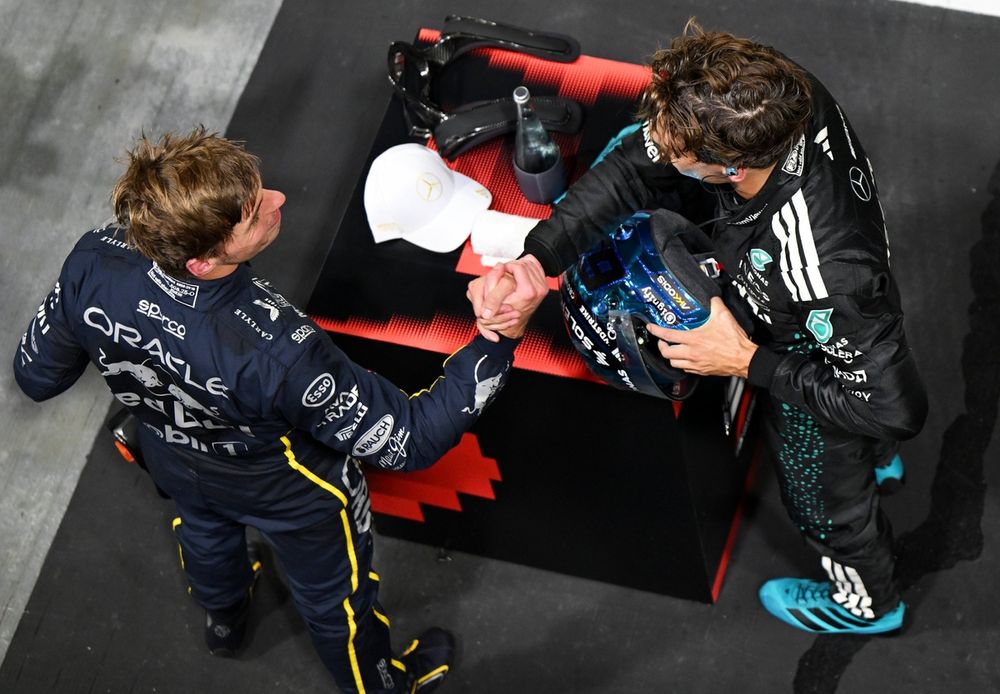
Max Verstappen, Red Bull Racing, George Russell, Mercedes
Photo by: Sam Bagnall / Sutton Images via Getty Images
We want to hear from you!
Let us know what you would like to see from us in the future.
Take our survey
– The Autosport.com Team