During his address to reporters on Friday evening in Bahrain, Andrea Stella revealed insights beyond his initial assessment of the new competitive order: McLaren had experimented with what is termed “super clipping,” engaging it up to its maximum capacity of 350 kilowatts that day.
In essence, “super clipping” refers to a condition where the 2026 Formula 1 vehicles are capable of regenerating energy even when the driver fully depresses the accelerator. While this capability might seem appealing for the ‘energy-deficient’ F1 cars operating under the forthcoming regulations, it comes with a trade-off, primarily a reduction in maximum velocity. When super clipping is active, not all generated power is channeled directly to the rear wheels; a portion is instead accumulated by the MGU-K for subsequent deployment.
How is super clipping discernible in the metrics?
The phenomenon of super clipping predominantly manifests at the conclusion of straight sections and within high-speed bends, which aligns closely with observations made by several F1 drivers.
Fernando Alonso’s remark in Bahrain about being able to enlist the Aston Martin catering staff to operate the vehicle was specifically directed at Turn 12. Analysis of telemetry data confirms this as a key location where drivers frequently engaged super clipping for energy recovery, consequently experiencing a speed reduction despite maintaining full throttle.
This effect is also illustrated in the visual provided below, which contrasts Oscar Piastri’s quickest lap on Thursday with Lando Norris’s fastest lap on Friday. On the latter day, McLaren expanded their super clipping trials to a 350kW threshold, an increase from the 250kW limit.
The velocity profiles for both laps displayed considerable differences, despite their almost identical lap times—a mere 0.010-second disparity. Piastri attained superior top speeds on the straights leading into Turns 1, 4, and 14 during his Thursday lap. In all these instances, both drivers maintained full throttle throughout, indicating that Norris likely utilized more super clipping in those track segments on Friday, consistent with McLaren’s intensified super clipping tests that day.
However, the situation was reversed at Turn 12. Telemetry data reveals that both drivers were again at full throttle, yet Piastri’s speed at that point was approximately 20 kilometers per hour slower. In that particular corner, it was the Australian driver who was employing super clipping to replenish energy. The significant impact on speed elucidates Alonso’s statement that 2026 cars could be 50 kilometers per hour slower in rapid corners and that even a chef could pilot them—though it should be noted that his figure represents the most extreme scenario.
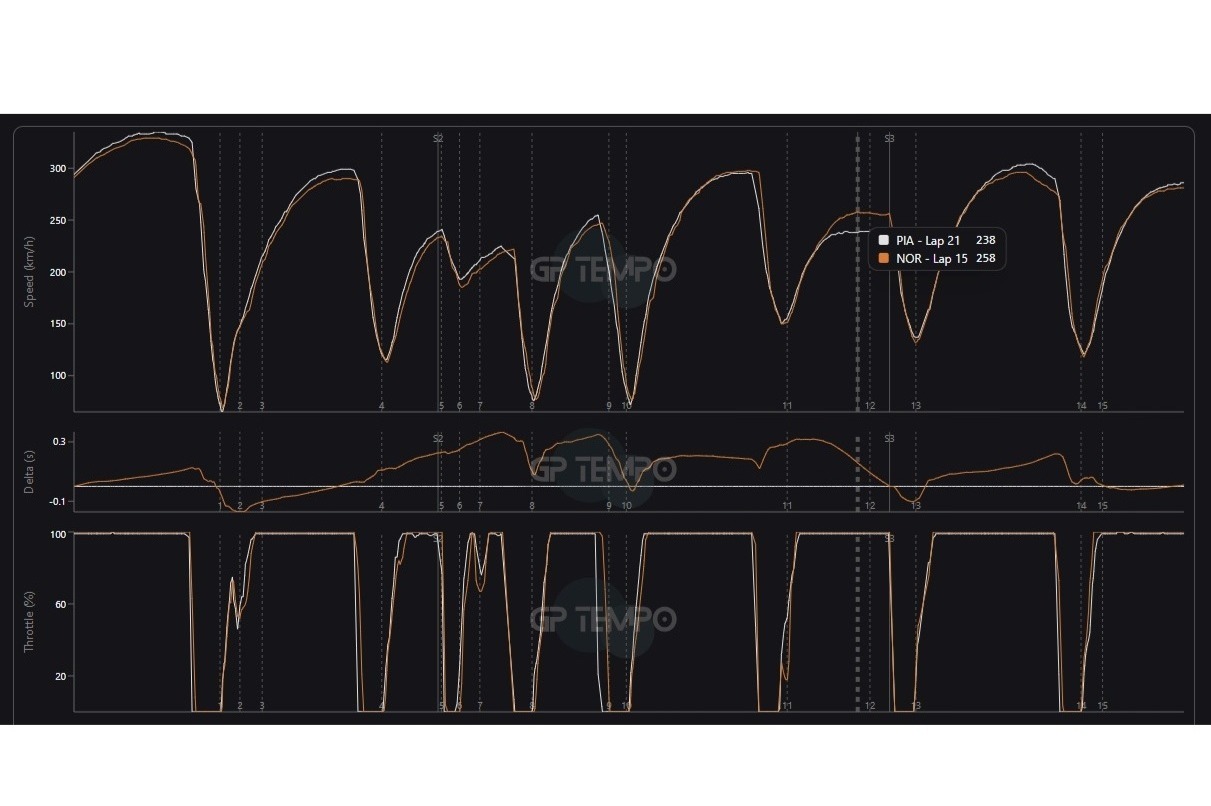
Photo by: GP Tempo
Might augmenting super clipping be a viable contingency?
According to the 2026 regulations, the energy recoverable through super clipping is presently capped at 250kW out of a total 350kW. Nevertheless, following what he characterized as a successful trial, Stella advocated for elevating this limit to the full 350kW.
“Currently, it’s restricted to 250 kilowatts, but all conditions are favorable to enable 350 kilowatts of harvesting while the driver is fully on the throttle, meaning the driver wouldn’t need to lift and coast to recuperate 350 kilowatts,” the McLaren team principal elaborated. “We’ve discussed this with the FIA, and ultimately it rests with them to decide whether to implement it. We conducted a successful test today and are pleased with the outcome.”
This stands as one of the potential courses of action for the FIA should the initial races present difficulties, compelling drivers to perform an excessive number of “unnatural maneuvers” concerning energy management. Theoretically, the governing body could opt to decrease the proportion of electrical power deployed during races to 250kW—reducing peak power but diminishing the energy deficit drivers face at the end of straights—or alternatively, increase super clipping for harvesting to the entire 350kW.
FIA single-seater director Nikolas Tombazis preferred not to disclose specific strategies during winter testing, but he did suggest that both control mechanisms could be adjusted if deemed necessary.
“There will invariably be potentially distinct approaches for qualifying sessions and for the main race, but I prefer not to anticipate that, as it’s a conversation we may need to have,” he stated. “Certainly, individuals hold differing viewpoints, and I do not wish to imply in any capacity that we are committed to a singular path. We are receptive to suggestions from the teams and other parties.”
It is crucial to recognize that any proposal concerning super clipping appears more complex in execution than in concept. Firstly, there have been intimations that its implementation might not be equally straightforward for all power unit manufacturers—Honda, for instance—and secondly, any intervention is inextricably tied to the competitive landscape.
Under the existing regulations, proficiency in energy management serves as a significant performance differentiator. Consequently, those possessing an advantage over competitors might be disinclined to support any proposal for change. Both a reduction in permissible power deployment during races and an increase in super clipping for energy recovery would lessen the energy scarcity across the grid. However, teams that are marginally more efficient than some rivals would forfeit a portion of their competitive edge in such a scenario.
Lando Norris, McLaren, Max Verstappen, Red Bull Racing, Gabriel Bortoleto, Audi F1 Team, Arvid Lindblad, Racing Bulls
Photo by: Mark Sutton / Formula 1 via Getty Images
Furthermore, the effect varies depending on the circuit. The Bahrain International Circuit was characterized by Stella as a track abundant in harvesting opportunities. There, drivers could largely replenish energy through braking and during phases of partial throttle, thereby minimizing the need for unusual lifting in other areas.
However, on circuits like Melbourne and Jeddah, the scenario might differ due to a scarcity of intense braking zones and low-speed corners. In theory, an increase in super clipping could help avert unnatural lift-and-coast maneuvers, making the overall spectacle more appealing to fans. Yet, precisely on such tracks, teams and manufacturers with superior efficiency might also secure a greater advantage—one they may not be inclined to relinquish easily.
FIA intends to evaluate initial races before intervention
Should this discourse materialize—if the early competitions prove underwhelming—the fundamental question will be which interest takes precedence: that of the sport as a collective entity or the specific competitive aims of individual teams and constructors. Tombazis has previously indicated that these factors could potentially come into conflict.
“When teams and manufacturers engage in discussions on these subjects, they consider a blend of what benefits the sport and what advances their own competitive standing,” he elaborated. “And naturally, these two aspects influence each other. Therefore, differing opinions are an unavoidable outcome.”
In any event, the FIA is not eager to make hasty decisions. The governing body first seeks to form a clearer understanding based on the initial races to ascertain whether intervention is required at all, and if so, what form it should take.
“We are progressing with our understanding as we go along. And the initial genuine assessment will be the first race, because here, they aren’t truly competing against one another, and so forth. These modifications necessitate a degree of deliberation. There might be several weeks of discussion, and we also need to follow the established governance procedures.
“It’s improbable that any changes would occur between, for example, Australia and China. However, it also won’t be a matter of many months. We will observe our position. We will fine-tune our systems, and if deemed necessary, we will present our proposals to the teams and to the Power Unit manufacturers.”