Riot Games’ revised Valorant Champions Tour (VCT) for 2027 appears to directly challenge its previous approach. The central theme is starkly simple: every event will be a competition. Gone are extended regular seasons. The clear division separating partnered organizations from independent ones will vanish. The lengthy annual anticipation for a single promotion game, which determined a team’s success or financial disappointment, will also be eliminated.
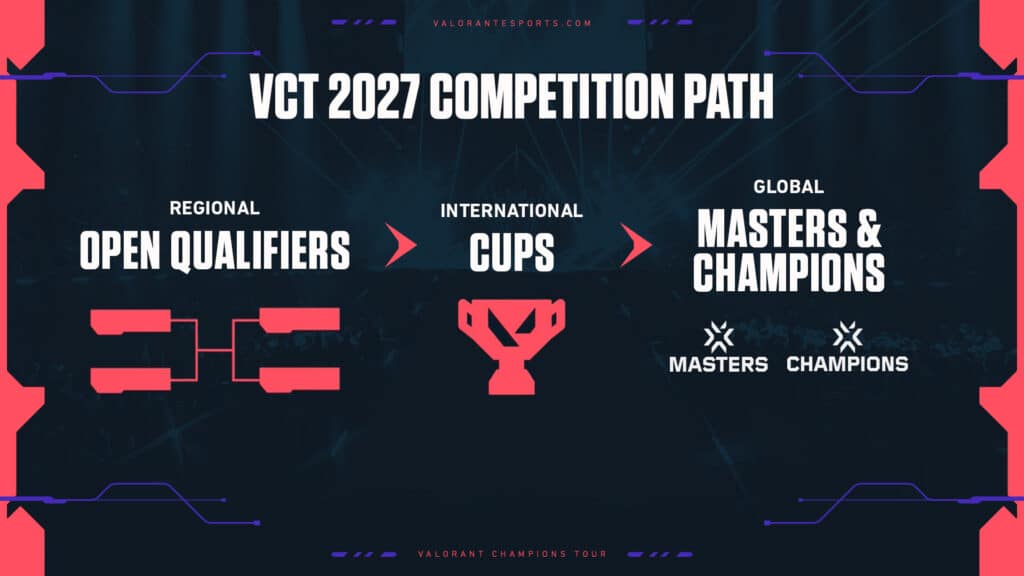
From 2027 onwards, Riot states, the pathway to prestigious Masters and Champions events will commence with accessible qualifiers, transition into novel “cups,” and maintain a greater dynamic flow throughout the competitive circuit in an increased number of locations, providing enhanced opportunities for non-established entities to participate prominently.
This represents a fundamental shift, rather than a superficial one. Riot is recognizing the core flaw of the previous framework: a disproportionate amount of Valorant’s grassroots competition revolved around a singular promotion result.
A video by FlyQuest addressing Tier 2 VALORANT articulates this issue with greater clarity than many official announcements. The prior Ascension period established an unbalanced motivational framework where numerous teams committed resources for an entire year to seize a single opportunity for advancement, while those unsuccessful found themselves with minimal continuity and diminished motivation for continued expenditure.
Consequently, Riot’s strategy for 2027 appears less as a modification of structure and more as a redefinition of motivation.
The organization intends to retain the partnership model, albeit with a reduced two-year duration, necessitating all existing partners to resubmit their applications. Riot indicates that applications will be evaluated based partly on financial viability, operational effectiveness, and community contribution, with partners continuing to gain fundamental remuneration, achievement incentives, unique team content, and immediate placement into advanced qualification stages.
Concurrently, Riot is extending access for qualification to all Masters and Champions competitions to every global team via localized routes that could encompass communal gatherings, university leagues, Premier circuits, and additional avenues.
This integrated approach holds significance. Riot aims to uphold the advantages of collaboration while simultaneously avoiding the perception of an exclusive, insular upper tier.
The most compelling justification for these alterations is straightforward: they transform the previous yearly abrupt drop-off into a succession of gradual ascents. During the Ascension phase, the distinction between the top two positions could be critically significant. With the updated framework, Riot states that unpartnered teams will be presented with several yearly opportunities for qualification, capable of accumulating championship standings and prize money, and in extraordinary circumstances, potentially surpassing the earnings of less successful partnered organizations.
Each tournament will include prize funds for qualification, Riot notes, with total seasonal prize assistance exceeding $6 million. For more modest organizations, Riot also indicates that cup finances will be disbursed promptly enough to facilitate coverage of visa and travel arrangements, instead of being delayed until after the event.
This final specific point might be the least appealing yet most crucial statement within the whole declaration. Esports doesn’t merely fail due to philosophical differences; it falters because of financial liquidity issues. An ostensibly accessible circuit holds minimal value if teams that qualify are unable to finance their travel.
Additionally, a secondary, less prominent factor suggests this could enhance the league’s vitality: Riot has ceased to assert that geographical proximity and professional standards must be maintained via centralized locations. During an interview featured in the ReaderGrev newsletter, Leo Faria stated that teams would no longer be compelled to reside close to a Riot studio; rather, they would designate a home territory and journey to competitions.
Riot’s public communications convey the identical overarching message: an increased number of events, a wider array of cities, and a reduction in the competitive schedule being confined within studio premises. The organization declares that the VCT will stage over 20 competitions annually and make appearances in nearly an equivalent number of locales.
However: Not Every Aspect of the VCT Has Been Resolved
Initial responses from individuals within the professional circuit have been positive, at least for public consumption. Melanie ‘meL’ Capone stated that 2027 is “set to be an exceptional year for VALORANT esports,” characterizing Riot’s reforms as an answer to frequently requested adjustments. Sean Gares, a former professional player now an analyst, was even more unequivocal, highlighting that the VCT has “fundamentally embraced the CS circuit framework” and labeling the implementation of accessible qualifiers as “monumental,” representing a much-anticipated move towards competition based on achievement.
However, this widespread excitement is not uniformly shared. According to a report from the previously mentioned ReaderGrev interview, an unnamed VCT coach presented a more circumspect perspective, cautioning that a system heavily reliant on tournaments might render the inaugural year “exceptionally challenging” and potentially result in truncated contracts, quicker team changes, and a deviation from the sustained equilibrium Riot had aimed to establish.
Considering all points, the initial agreement among numerous professionals and instructors is evident: Riot is at last progressing towards a framework that more explicitly recognizes achievement, yet uncertainties persist regarding its implications for enduring steadfastness.
Therefore, the discussion isn’t about whether accessible competition is appealing. It’s about whether Riot can render it sustainable.
There are grounds to believe the response is affirmative. Valorant is not embarking on this endeavor as a struggling esport. Riot disclosed in its 2025 seasonal review that it distributed $105.2 million among VCT teams, with approximately 80% originating solely from virtual merchandise. This constitutes substantial funds, and critically, it is revenue bolstered by supporters. Riot’s commitment for 2027 is that a greater number of teams ascending to prominence through competitive success, beyond merely partnership standing, will gain entry into that economic structure.
Should this prove effective, the updated structure could achieve what Ascension consistently failed to: render advancement a regular occurrence instead of an exceptional one.
Established athletic competitions provide some reassurance in this context. Accessible cup formats succeed by sustaining aspirations without dismantling established rankings. The prominent entity continues to receive a more favorable position in the tournament; the less favored contender still has an opportunity to compete. This seems to be Riot’s midpoint solution. Partners retain their allowances, brand benefits, and placement advantages. All other participants secure a genuine pathway for entry. It is neither an entirely exclusive league nor an unadulterated open-circuit free-for-all.
This represents Riot’s endeavor to integrate the two concepts.
Will this enhance the league’s vitality? Most likely. The well-being of a league extends beyond merely celebrating the strongest team. It concerns whether a sufficient number of organizations, competitors, and regional communities can envision a worthwhile future for commitment. The previous VCT paradigm generated acclaim at its apex but apprehension beneath. The updated iteration, conceptually at least, presents a more robust alternative: increased opportunities, compressed durations, swifter allocation of funds, and an advancement route resembling a thoroughfare rather than a sudden pitfall.
This provides no assurance of triumph.
Riot must still meticulously manage the specific elements: the concentration of qualifiers, equilibrium among regions, operational demands, financial disbursements, and regulatory supervision. Nevertheless, for the first time in a considerable period, VALORANT’s framework appears to be constructed upon the premise that optimism ought to be perpetually sustainable.
For a Tier 2 environment that has endured years relying on improbable chances, this factor alone represents a substantial restoration.
The article The 2027 VCT competition-centric model could improve Tier 2, though Riot must still refine the specifics was originally published on Esports Insider.