Our minds are naturally inclined to react to novelty and unforeseen events with an anxious reaction; the amygdala, a brain region governing our fight-or-flight impulses, identifies such shifts as potential dangers.
This fundamental biological response partly explains the surge of criticism concerning the upcoming 2026 Formula 1 rules and their rollout, ranging from drivers’ unfavorable initial impressions of the ’26 vehicles in simulations to the commotion surrounding the decision to conduct the inaugural test in private.
The choice to keep the initial test confidential has predictably annoyed a segment of the fan base, which is a reasonable reaction considering how every detail of F1 operations is typically shared publicly in today’s digital age. It has also provoked considerable self-important grumbling from the press, leading to numerous self-centered analyses suggesting the decision stems from a dominant apprehension of humiliation if issues arise on the track when journalists are present.
However, this viewpoint overlooks the fact that F1 functions as much as a commercial enterprise as it does a racing discipline. During its shift to new rules, the primary objective is to guarantee that core operational systems are functional. While undoubtedly wishing to prevent adverse media coverage, the persistent conviction that the test’s secrecy is solely to avert a public relations catastrophe stems from an excessive immersion in the media echo chamber.
The official communication includes a degree of selective interpretation, portraying the initial five-day session in Barcelona as a brief initial run instead of a comprehensive test, a framing that might readily be seen as obvious and weak semantic trickery. Indeed, one could argue that an initial run could be completed in a single day, as has occurred historically (though current testing rules would necessitate it being labeled a ‘filming day’). Moreover, some teams have already conducted track activity that would typically count as shakedowns.
Nevertheless, a recurring theme in reports from teams that have already tested their 2026 equipment is a desire for greater track time. The majority couldn’t approach the 200km limit, with poor weather being the main reason cars stayed in the garage, rather than unforeseen mechanical breakdowns.
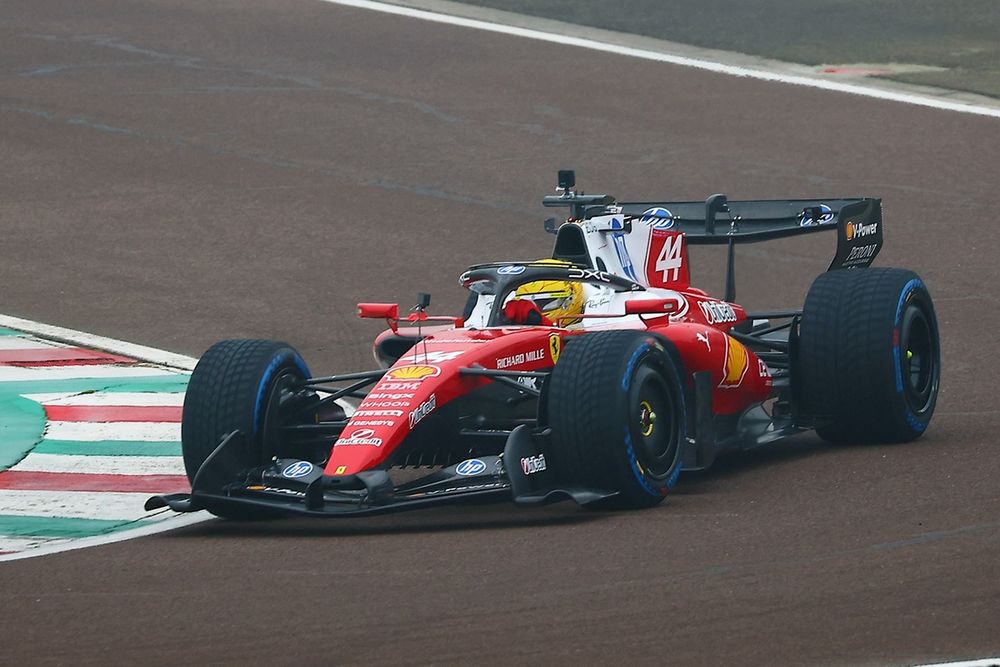
Lewis Hamilton, Ferrari SF-26
Photo by: Federico Basile | AG Photo
Admittedly, the 2014 pre-season testing, coinciding with the hybrid era’s debut, sparked considerable fascination—and, for some participants, outright humiliation. Yet, the conditions then diverged significantly: hybrid tech was largely novel, and one particular engine manufacturer (Renault) demonstrated a clear lack of readiness.
Currently, despite alterations to energy deployment balance and the introduction of new engines, a significant portion of the underlying technology has already undergone validation—and the MGU-H, the most problematic hybrid component from 2014, is no longer present.
Despite this, numerous novel aspects persist throughout the entire vehicle assembly, creating a complex web of what are termed ‘known unknowns’—and almost certainly, ‘unknown unknowns’ as well. Diverse car and engine configurations necessitate fresh electronic and mechanical frameworks, including active aerodynamic components. Each of these must be validated, both operationally and in terms of dependability, through practical track performance.
It is conceivable that the updated power units might exhibit reliability problems not apparent during dynamometer evaluations. Similarly, the updated fuel flow sensors require validation within the demanding conditions of real-world track usage, given that their internal components and wiring necessitate enhanced sealing from the fuel; while the new gasoline is sustainable, you wouldn’t want electrical systems submerged in it.
Teams and the FIA will also be scrutinizing the correlation between actual electrical energy recovery and deployment behavior and their simulated counterparts. As Nikolas Tombazis, FIA single-seater director, stated recently at the Autosport Business Exchange in London, substantial latitude exists for modifying energy deployment, necessitating genuine data to guide such alterations.
Drivers will additionally adapt to a modified cornering technique, not solely due to the narrower vehicles and tires. The removal of the MGU-H from the power unit configuration transfers greater responsibility to the (now enhanced) MGU-K, resulting in increased lift-and-coast maneuvers and lower gear selections when navigating turns. While this has been assessed in simulations, drivers need to cultivate a physical intuition for it on the circuit.

George Russell, Mercedes W17
Photo by: Mercedes AMG
Beyond merely validating the activation and functioning of systems, teams aim to comprehend the broader impacts active aerodynamics will exert on vehicle dynamics and stability as they switch between activated and deactivated states. While these ramifications are not expected to be as profound or troublesome as the porpoising phenomenon that surprisingly emerged during the initial 2022 ground-effect car test, that year served as a stark reminder of simulation technology’s boundaries.
The initial test session of any season invariably garners much anticipation, potentially intensified this time by the extensive revisions to the technical specifications. Consequently, it’s expected that enthusiasts and journalists are eager to observe the new vehicles’ appearance and auditory characteristics.
However, unlike a typical season where early track time might hint at performance levels and competitive standings, this week’s Barcelona shakedown differs. A significant portion of the activity will be dedicated to basic functionality checks. Furthermore, as teams are restricted to running on only three out of the five days, there’s a distinct possibility that no cars will be on track whatsoever on at least one of those days.
Aside from meteorological conditions, the scheduling of team arrivals and track sessions will be governed by development objectives. McLaren, for example, aims to introduce a highly refined design, subsequently dedicating initial testing and races to comprehending their vehicle before initiating substantial enhancements. Consequently, they’ve deferred the final assembly until the last moment, intending not to run before Tuesday. Alpine, conversely, has an early-season upgrade strategy already formulated and plans to begin track activities on Monday.
It is probable that for observers, this event would be even less engaging than typical testing (though this hasn’t deterred the Barcelona circuit owners from selling tickets previously, or from offering minimal media accreditation then exorbitantly charging enthusiastic applicants for internet access). The majority of teams will defer performance-focused efforts until the two three-day Bahrain tests; at this stage, they will largely be conducting leisurely laps, having meticulously reviewed weather predictions to select the three most suitable days out of five. With rain and temperatures barely reaching the low teens, no team will be driving from morning until evening.
Consequently, providing elaborate features like continuous television broadcasts, real-time lap data, and planned post-session driver interviews would be inefficient. A small F1 TV crew will be on-site to conduct routine, less probing interviews with drivers and team staff, and a protocol for sharing imagery has been established by the teams. This setup is rudimentary compared to previous arrangements, but does it truly represent a coordinated effort by invested parties striving to manipulate the narrative?
No, as information will inevitably surface. However, it effectively manages public anticipation. Vehicles will spend considerable periods in their garages, and emptiness invites chatter—should the Barcelona shakedown be fully televised, there would be extensive stretches of unproductive airtime for broadcasters and online commentators, leading to abundant idle talk and speculative theories. It is preferable for all if people remain home and critique the drying of paint instead.