A grand new automotive exhibition venue has officially launched in Le Mans, marking the culmination of an immense building endeavor finished in a remarkably brief period.
The previous Le Mans 24 Hours Museum remained shut for slightly less than a year. Throughout this interval, structural walls were repositioned, 45,000 cubic meters of soil were excavated, displays were innovatively redesigned, and an exceptional assembly of artifacts was curated.
The M24 – Motorsport Museum welcomed visitors starting May 28, situated right beside the entrance to the iconic Le Mans racetrack.
During a conversation with Autosport merely hours prior to the grand unveiling, Pierre Fillon’s voice betrayed a slight tremble, filled with the palpable anticipation of a momentous occasion.
“This signifies the completion of an extensive undertaking,” stated the president of the Automobile Club de l’Ouest, the entity behind the Le Mans 24 Hours. “We feel immense satisfaction, particularly regarding the dedication shown by our teams, as developing this museum presented considerable hurdles. While the planning spanned a long duration, executing it within nine months demanded constant effort.”
“Every team, across all ranks, and every participant, focused on a singular goal. My instruction to them was clear: the Le Mans 24 Hours begins at 4 PM on Saturday, and the museum needed to be operational by 10 AM on May 28.”
Expanding beyond endurance events
A magical place
Photo by: Rainier Ehrhardt
The initial change is evident in its very designation, which perfectly encapsulates the project’s vast scope. The prior Le Mans 24 Hours Museum has been superseded by a more expansive setting, now covering the entirety of motorsports. This ambitious and inclusive strategy aims to provide the public with an unparalleled encounter, with the declared goal of becoming “the global benchmark,” as articulated by Fabrice Bourrigaud.
“We were firmly convinced that Le Mans represented the ideal location to establish something currently absent: a comprehensive motorsport museum, one designed to narrate the extensive saga of motor racing,” the museum director elaborated.
“Our location in Le Mans, renowned for the Le Mans 24 Hours, places us at one of the globe’s three most iconic racetracks, alongside Indianapolis and Monaco. We have hosted almost every variant of motor racing here, even pioneering the first contemporary motor contest in 1906, over a century ago, making Le Mans genuinely the perfect setting for this endeavor.”
Having closed following the 2025 iterations of the Le Mans 24 Hours and Le Mans Classic, the museum accomplished the seemingly unattainable task of resuming operations prior to the 2026 event.
“Our primary shortcoming is quite simple: we cannot tolerate being closed during the Le Mans 24 Hours!” Fabrice Bourrigaud chuckled. “We were compelled to finalize a project in just eleven months that would typically require two years. It’s a minor triumph, somewhat akin to a racing crew preparing for the Le Mans 24 Hours competition.”
Double the area, numerous exhibits to explore
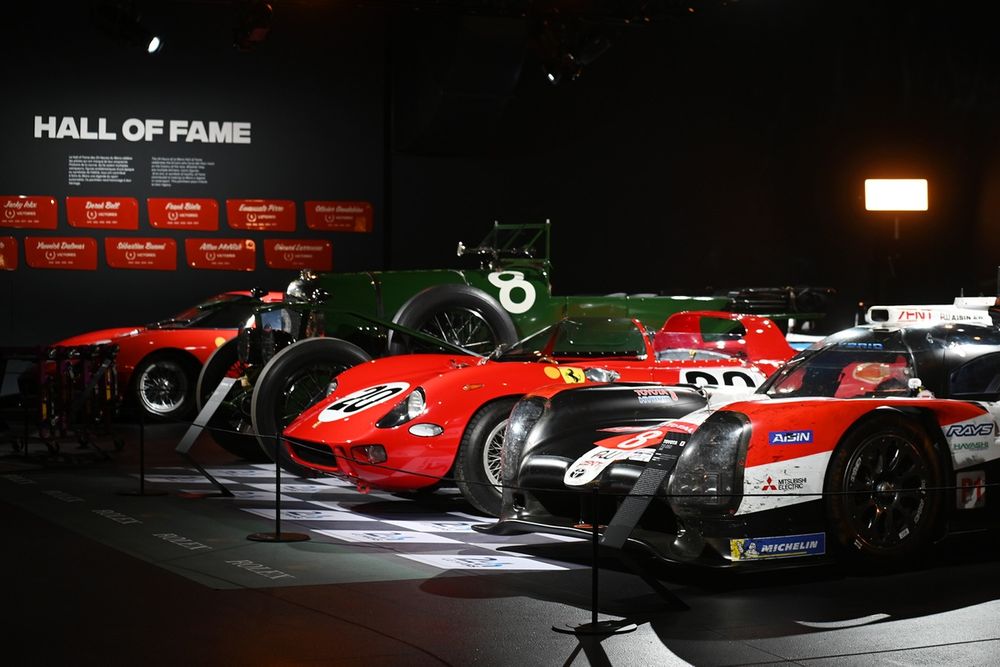
Legendary, race-winning Le Mans machinery
Photo by: Rainier Ehrhardt
The exhibition venue has seen its footprint expand significantly, growing from 5,000 square meters to 10,000 square meters. This entirely re-envisioned environment has facilitated a complete reconsideration of the patron’s journey, decisively updating the establishment for contemporary times.
Beginning with the excitement of a race launch and extending to the captivating allure of night racing, an especially absorbing feature, guests are guided through the sequential events of a Le Mans week, simultaneously traversing historical periods. The presentation then broadens to encompass other leading motorsports categories, including Formula 1, IndyCar, rally racing, and even motorcycle competitions.
“Before, our collection comprised just under 100 vehicles, but now we display approximately 130 in total, as our objective was to present them more effectively and narrate their histories,” Fabrice Bourrigaud clarified. “An exhibition space must convey narratives, which led us to create a much more engaging environment. The concept was to evoke feelings and experiences in visitors.”
“We collaborated extensively with Raphael Daguet, our exhibition designer, on both the thematic installations and the overall presentation. However, the foundational component of our design is lighting. To reiterate, what we showcase here are intricate mechanical masterpieces, essentially canvases on four wheels. They are not suspended on walls; rather, they are positioned directly on the asphalt where each one accomplished its notable achievements.”
Legends like Schumacher and Pescarolo share the space
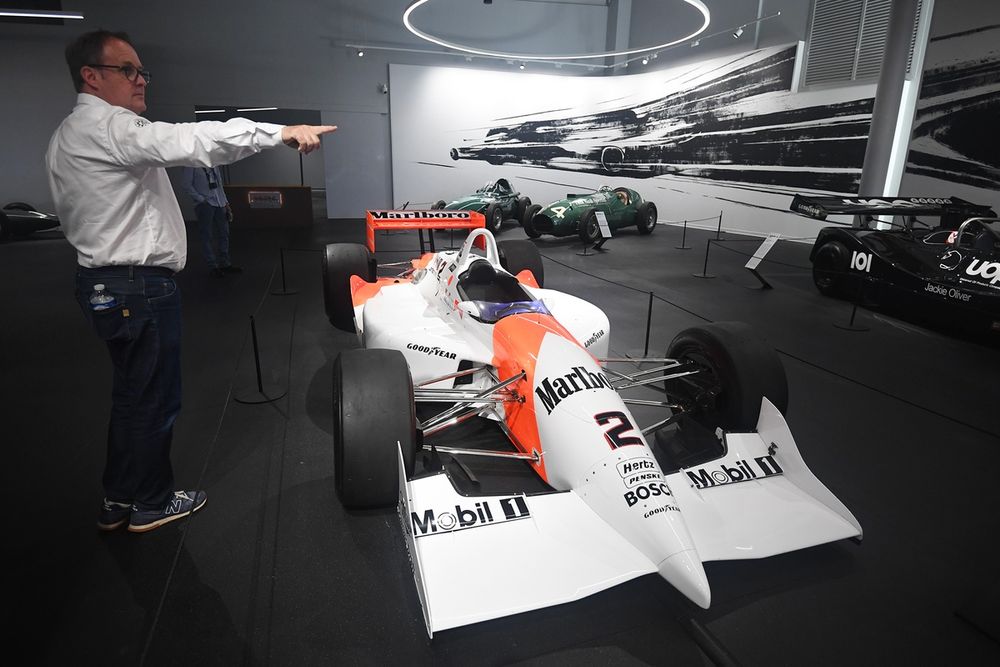
Fabrice Bourrigaud, M24 director, and a Team Penske Indy car
Photo by: Rainier Ehrhardt
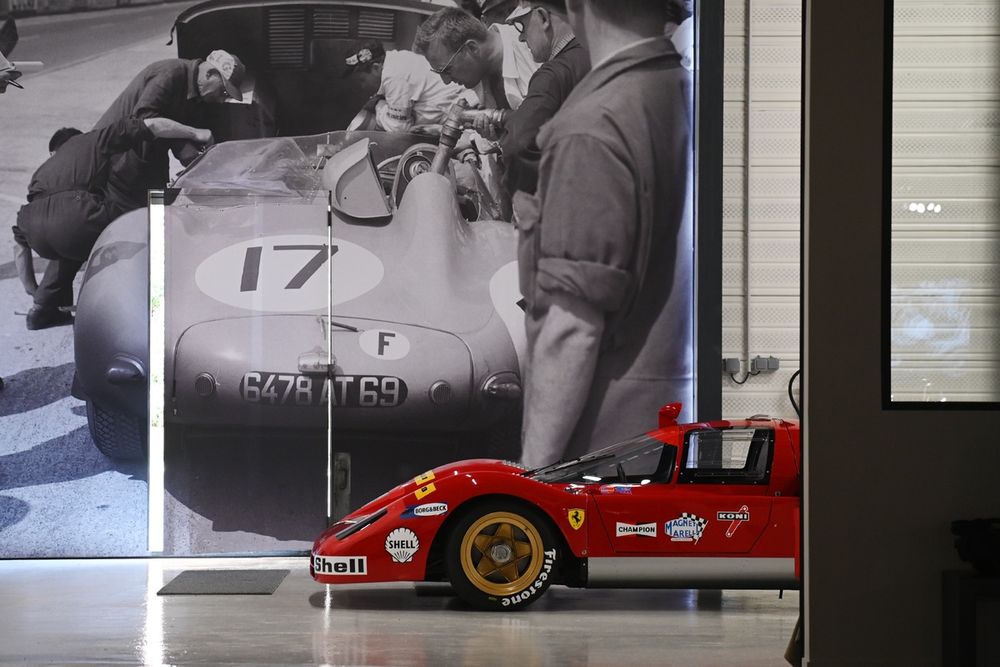
A remarkable meticulousness is evident, extending to the very floor, which perfectly replicates the tarmac texture of the Circuit des 24 Heures. The extensive scale and magnificence of the exhibits, encompassing both quantity and historical significance, provide attendees with an enhanced appreciation for the fervent spirit of motor racing. The life-sized dioramas, complete with vehicles, support trucks, and realistic silicone figures, are especially captivating.
Owing to Richard Mille’s financial contribution to the initiative – driven by his desire to make the most exquisite items from his personal collection accessible to the public – alongside the Automobile Club de l’Ouest’s extensive repository of 1,000,000 images, and primarily the emphasis on genuine artifacts, the undertaking stands as an undeniable triumph. The premises also feature “extraordinary artifacts,” highlighted by the Alley of Heroes, which commemorates two iconic figures at opposing ends: Michael Schumacher and Henri Pescarolo.
“Michael Schumacher’s Ferrari F2002, a vehicle he used to utterly dominate competitions, is a source of great pride for us to display in the museum,” stated Fabrice Bourrigaud, yet he found himself unable to pick a single automobile as his proudest exhibit: “To make a selection is to relinquish others! It’s challenging… The victorious Bentley from 1924, an incredibly scarce artifact, represents something genuinely outstanding.”
“Given my fondness for personal narratives and the adventurous spirit inherent in this sport, there is the Rondeau, with the tale of a local Le Mans native who constructed his own vehicle to compete in the Le Mans 24 Hours and astonishingly triumphed, surpassing Porsche and Jacky Ickx: it’s the pinnacle of aspiration. In the realm of Formula 1, Jacky Ickx’s 1970 Ferrari still evokes shivers, and of course, there’s Sebastien Loeb’s rallying accomplishments…”
“The array of vehicles currently showcased exemplifies the collaboration between the ACO and Richard Mille. We possess the capacity for 400 automobiles, implying a substantial backlog yet to be exhibited! To maintain the museum’s vitality, the enduring displays will undergo rotation. Additionally, a specific area is designated for ephemeral showcases, with prominent topics scheduled to commence in 2027.”
The facility is now accessible, perfectly timed for the 2026 Le Mans 24 Hours, and is destined to be a compelling destination for motor racing aficionados of all ages.