Anyone watching the Esports World Cup hoping for the typical roaring stadium and intense energy that defines a Grand Final probably found the atmosphere surprisingly subdued. It felt almost as silent as an unpopulated custom game lobby.
Recent data published by Esports Charts reveals that VALORANT experienced a major slump in its audience metrics relative to the previous year. The shooter suffered a staggering 45% decrease in peak viewership alongside a 13% dip in overall hours consumed.
Predictably, users on X have plunged into a frenzy, questioning whether the shooter is heading toward its downfall. It is the classic “dead game” narrative that competitive gaming communities eagerly repeat the second a title’s numbers begin to slide.
Is the game’s momentum genuinely starting to derail, though?
The Misfortune of Missing Fan Favorites
A quick glance at the competition’s bracket explains why the primary broadcast struggled to attract eyes. To begin with, massive crowd-pleasers such as Sentinels, Gen.G, and Fnatic failed to qualify for the Parisian stage.
To make matters worse, the beloved organizations that actually participated were eliminated early on. The fan-favorite, unpredictable squad Paper Rex fell during the group phase, effectively wiping out the audience interest from the entire Pacific zone. A parallel tragedy struck European favorites, including Karmine Corp and Gentle Mates.
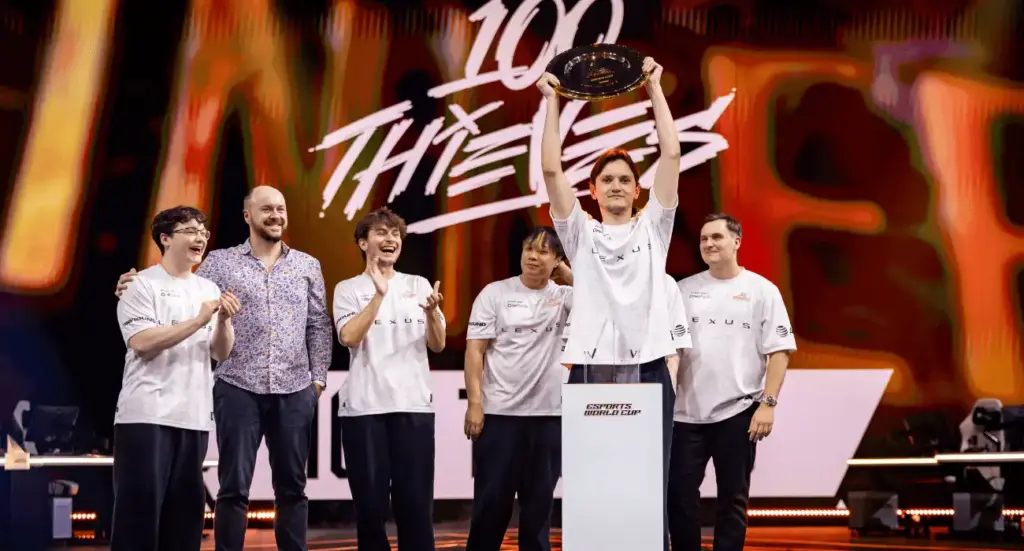
When the tournament culminated in the Grand Finals, the audience was presented with an exclusively domestic clash between 100 Thieves and NRG. Although this marked a monumental milestone for the 100 Thieves faithful, a purely North American finale rarely translates into a worldwide spectacle.
Compounding this issue was the conspicuous absence of the game’s ultimate viewership drivers: community co-streamers. Popular creator Tarik skipped broadcasting the tournament entirely, while other prominent streamers witnessed their viewership halved. This demonstrates that without top-tier content creators reacting live to the action, casual viewers simply find other activities to occupy their time.
Going Head-to-Head with Esports Giants
We must also consider that VALORANT operates in a highly competitive landscape where older, established titles are reclaiming their dominance. Throughout the Esports World Cup, Dota 2‘s early qualifying rounds drew in more than 264,000 concurrent viewers at their peak. Crucially, this was merely a preliminary stage, not the championship round. Conversely, VALORANT’s ultimate Grand Finals capped out at a disappointing 248,000. It requires little effort to understand why this comparison is incredibly concerning.
On top of that, there is the everlasting rivalry with Counter-Strike 2. Looking at recent reporting on the ongoing tactical shooter war, the divide between the two games has widened immensely. In the span of one weekend, CS2’s IEM Cologne broke historical records by generating a peak audience of 2.75 million. Meanwhile, across the Atlantic, VCT Masters London managed only a peak of roughly 1 million viewers.
Having existed for well over two decades, Counter-Strike possesses an incredibly dedicated and deep-rooted community. Given a choice, general first-person shooter enthusiasts are progressively opting to watch the older, iconic franchise.
Why the Esports World Cup Isn’t a True Reflection of VALORANT’s Community
Does this indicate a terminal decline for the game, or represents merely a brief speed bump on its journey?
Analyzing the broader competitive calendar reveals clear red flags. VCT Stage 1 recorded historically poor engagement metrics across both the American and European regions. This downward trend could stem partly from rapid gameplay and meta updates. Keeping viewers engaged becomes incredibly difficult when the competitive landscape shifts constantly, with rising and falling teams preventing fans from ever recognizing a stable lineup.
Granted, when measured against titles like Street Fighter 6 or Overwatch, VALORANT’s metrics remain highly impressive. Declaring the game “dead” is a massive exaggeration (even if that term is readily tossed around by the gaming community). Nonetheless, dedicated enthusiasts are beginning to express genuine worry about the dropping numbers. A disconnect seems to be growing among hardcore competitive gaming fans, particularly given the plethora of alternative options.
One could argue the Esports World Cup fails to paint an accurate picture of VALORANT’s true reach, given the absence of major co-streamers and top-tier squads. However, if a title relies entirely on secondary broadcasters to secure an audience, does it possess any inherent pulling power? In my view, this highlights a systemic failure to sustain organic interest independent of popular influencers.
Furthermore, a significant segment of the community boycotted the Esports World Cup due to its controversial nature and its perception as an over-engineered, try-hard attempt at mainstream relevance. Additionally, because the event sits outside the official circuit, supporters have far less incentive to tune in.
The festival structure also placed the shooter in direct opposition with rival games running at the exact same time, magnifying its relatively modest audience base next to more mature esports. Directly comparing VALORANT’s draw against a titan like Dota 2 was never going to yield positive optics.
Even so, we cannot simply brush aside the sobering data presented by Esports Charts.
While VALORANT’s demise is certainly not imminent, its golden age of effortless viral sensation status may be fading. Riot Games will likely have to introduce fresh dynamics or, at a minimum, plead with their primary co-streamers to keep their broadcasts running nonstop.