The president of the FIA, Mohammed Ben Sulayem, expresses confidence that the Formula 1 events scheduled for Qatar and Abu Dhabi will proceed, despite the ongoing tensions in the Middle East.
The conflicts involving the United States and Israel against Iran previously led to the cancellation of races in Bahrain and Saudi Arabia earlier this year; however, Bahrain’s organizers successfully rescheduled their postponed grand prix in Malaysia. Attacks on ships in the Strait of Hormuz have persisted, with both parties contesting the region as oil exports have significantly diminished.
Complications have intensified as Saudi Arabia faces off against the Houthi rebels from Iran in Yemen; a missile strike targeting Riyadh’s King Khalid International Airport resulted in 13 fatalities. Following these attacks, the airport has resumed limited operations, and the United Kingdom has recently committed to support Saudi Arabia with fighter jets to counter further assaults from the Houthis.
The locations of Qatar and the United Arab Emirates in relation to the current conflicts have raised questions regarding the viability of the two upcoming races in the Middle East; nevertheless, F1 CEO Stefano Domenicali indicated a few weeks back that keeping the races is still considered the primary objective, while a contingency plan is in place to possibly shift the season’s finale to Imola if tensions escalate further.
Discussions about possibly canceling the races have diminished recently, and it now appears likely that both Qatar and Abu Dhabi will host their respective races. Additionally, in MotoGP, teams have been informed that the rescheduled round in Qatar is confirmed to take place in November.
In conversations with select media outlets, including Autosport, Ben Sulayem conveyed that he feels “secure” about the forthcoming races, asserting that he would not allow his family to remain in the Emirates if he judged the situation to be unsafe.
“Everything is fine. One thing I would like to point out is that I have my children there; do you think I would leave them there if I felt unsafe?” Ben Sulayem commented.
“You must be reasonable and ask, ‘are we going to encounter any issues?’ The information we receive from the media doesn’t always match the reality on the ground. We view the news and television, but we don’t experience the same situations directly. Otherwise, why would I be here instead of with my family?”
“This doesn’t guarantee that nothing will happen; I can’t predict. I can only confirm today that everything is alright and that the two races will happen.”
“I am willing for the FIA personnel to be present there. Honestly, I don’t consider FIA staff more important than myself and my family; however, my presence there indicates I feel safe about the situation.”
“However, we can’t be entirely sure right now. As previously stated, regarding the Dakar Rally in Saudi Arabia, should we hear anything from them, we will modify our plans accordingly. When I say ‘them,’ I’m referring to the Federation of Motorsport in Saudi Arabia; we will adjust to their instructions and provide our support.”
“Similarly, when we assisted Bahrain by responding to a request to withhold the event in Saudi Arabia, the Crown Prince of Bahrain subsequently reached out to rearrange it in Malaysia. Our relationship is strong, signaling that there is still a commitment to motorsport despite these challenges.”
Ben Sulayem mentioned that the FIA has established contingency plans in case of travel disruptions, such as collaborating with local ASNs to secure volunteers and officials who can assist in facilitating these events.
He referenced the Lebanese round of the FIA Middle East Rally Championship, which effectively revived this year’s series. This event was managed by officials from Cyprus, Greece, and Jordan, concluding with the Cypriot event marking the end of the championship when the Saudi Arabian round was called off.
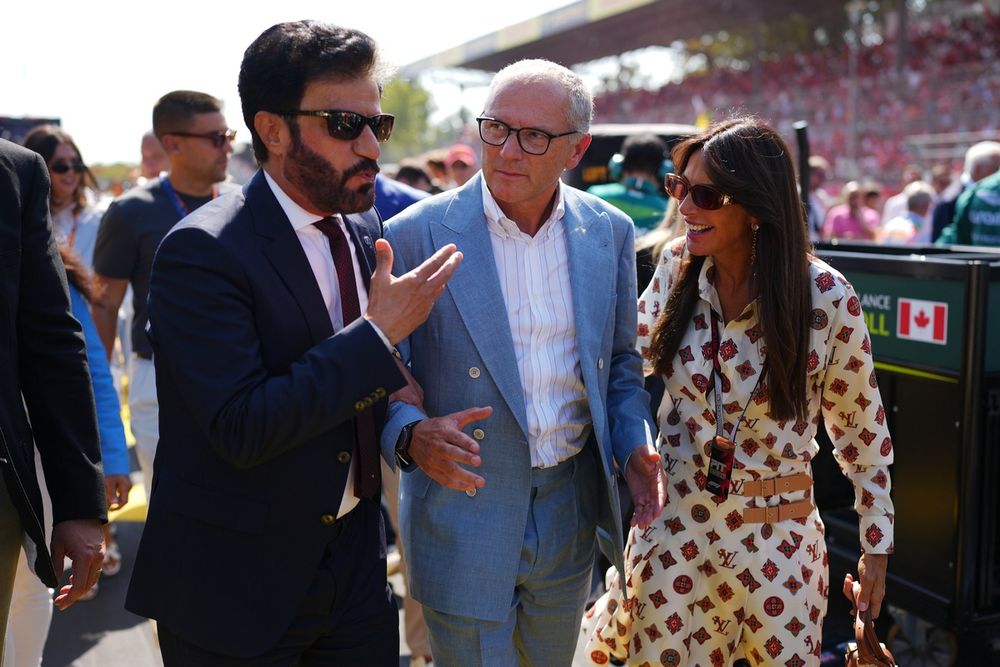
Mohammed Ben Sulayem, FIA President, Stefano Domenicali, Formula 1 President and CEO
Photo by: Alex Bierens de Haan / LAT Images via Getty Images
“Certainly, the FIA remains prepared. I instructed them to have an alternative team ready should conditions permit without issues. However, there may be directives from certain governments prohibiting travel, so what would we do in that scenario?” Ben Sulayem continued.
“If everyone is on-site, and the teams are present, and FOM is managing the event, then suddenly, we might find ourselves unable to utilize our race director or stewards. It’s essential to remain prepared and have an alternative team on standby.”
“We also share common sense regarding the safety of our staff, drivers, and officials; we would never take them anywhere deemed unsafe.”
Ben Sulayem concluded by emphasizing that while the prospects for the 2027 Dakar Rally remain uncertain, he hinted that a move to Morocco might be considered if Saudi Arabia can’t hold the event.