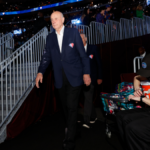
The sporting community is grieving the loss of Don Nelson, a five-time league champion and three-time NBA Coach of the Year, who passed away on Sunday at the age of 86.
“This Sunday morning, our cherished husband, father, grandfather, and great-grandfather Don Nelson peacefully departed to be with the Lord, with his devoted family by his side,” his relatives announced in a statement. “Over the course of his final week, friends and family gathered close to shower him with love, celebrating the gift of his friendship and reflecting on precious moments shared together.”
Following a standout All-American career at the University of Iowa, Nelson entered the league as the 17th overall pick in the 1962 NBA Draft, selected by the Chicago Zephyrs, a franchise that is now defunct. Following brief tenures in Chicago and with the Los Angeles Lakers, he found a long-term home for the rest of his playing days with the Boston Celtics. Serving as a crucial rotational forward in Boston, Nelson claimed league titles in 1966, 1968, 1969, 1974, and 1976, while posting averages of 11.4 points and 5.2 rebounds per game throughout his time with the Celtics.
Even with those five championship rings as a player, Nelson left his most significant mark on the sport when he moved to the sidelines. He initially served as an assistant under Larry Costello for the Milwaukee Bucks, but was quickly promoted to the head coaching role when Costello was dismissed. He guided the franchise for over a decade, racking up 540 regular-season victories. While he was unable to lead the Bucks to the Finals, his outstanding leadership earned him the Coach of the Year honor on two occasions.
Following his time in Milwaukee, Nelson directed the high-tempo “Run TMC” Golden State Warriors for seven seasons, spent one year leading the New York Knicks, and then coached the Dallas Mavericks for eight years. After his tenure in Dallas, he made a return to Golden State, where he masterminded one of the most astonishing postseason upsets in league history—marking only the second time an eighth-seeded squad (his Warriors) eliminated a top seed (his former team, the Mavericks). Coincidentally, his son, Donnie Nelson, was serving as the general manager of those very Mavericks at the time, and would later construct Dallas’s 2011 championship-winning team.
His final run as an NBA head coach took place during the 2009-10 season, which was also Stephen Curry’s rookie campaign with Golden State. Two years later, in 2012, his legendary contributions were honored with an induction into the Basketball Hall of Fame. Upon stepping away from coaching, he was the most successful regular-season coach in league history, holding the record with 1,335 wins—a milestone that has only been eclipsed by Gregg Popovich since then.
Although he never captured a championship ring as an NBA head coach, he is universally celebrated as one of the most creative offensive strategists in the history of the sport. His signature playing style, famously dubbed “Nellie Ball,” played a crucial role in shaping modern offensive philosophies.
He was a pioneer in utilizing a “point forward” by giving playmaker duties to Paul Pressey in Milwaukee, enabling the Bucks to exploit matchups by putting the ball in a larger player’s hands. His Golden State teams were famous for their breakneck velocity, ranking in the top five league-wide in pace during every single season he was in charge.
During his tenure in Dallas, Nelson guided the formative years of Dirk Nowitzki, who revolutionized the league as the inaugural superstar perimeter-shooting big man, alongside Steve Nash, who would subsequently become a focal point of the league’s pick-and-roll transition under Mike D’Antoni. His Dallas squads, much like his Golden State teams, consistently sat near the top of the league in both three-point shot frequency and offensive efficiency.
This offensive style was equally prominent when he returned to Golden State, where one of his final and most impactful strategic developments—the “small-ball” lineup—sparked one of the most famous playoff upsets of all time. During that legendary series victory over the 67-win Mavericks, the Warriors frequently deployed forwards Stephen Jackson and Al Harrington at the center position. This tactical choice not only spread throughout the NBA in the years that followed but also helped establish a modern dynasty for the Warriors franchise, with Draymond Green eventually becoming arguably the most decorated small-ball center in basketball history.
“Don ‘Nellie’ Nelson was among the most visionary and impactful coaches in the history of the league, and remains a foundational figure for our franchise,” the Warriors shared in a statement on Sunday. “He looked at the sport through a unique lens, constantly willing to challenge traditional philosophies. His innovative style helped reshape basketball and paved the way for generations of players and coaches to come.
“Above all, Don will be remembered for his genuine spirit, his vibrant personality, and his immense love for the game of basketball. His footprint on the Warriors will endure for generations. On behalf of the entire Warriors organization, we offer our sincere condolences to his wife, Joy, his family, and countless friends.”
When the NBA selected its ten greatest coaches of all time in 1996, Nelson stood out as the sole recipient of the honor without a championship ring as a head coach. He represents a rare breed of leader whose imprint on the game extends far beyond the win-loss column, with an influence that continues to reverberate more than ten years after his final game on the bench.